An air purifier not working usually has a simple cause: a filter cover that is not fully seated (many units will not start without it), a clogged pre-filter or HEPA filter, a dusty air quality sensor, or a filter timer that was never reset. Check those four in about 10 minutes before assuming the motor or circuit board has failed.
- Many air purifiers will not start with the filter cover open or the filter missing.
- Levoit says most of its filters last 6 to 8 months; an expired filter moves far less air.
- The filter light is usually a run-hours timer that must be reset by hand.
- A dusty air quality sensor makes auto mode stick on low or high.
- A burning smell, smoke, or a hot plug means unplug it and stop using it.
A portable air purifier is a fan that pulls room air through a pre-filter, a HEPA (high-efficiency particulate air) filter, and often an activated carbon layer. When one part clogs or a small switch or sensor misreads, the unit can look broken even though nothing inside has failed.
Below, each symptom gets its likely cause and first check. Every step stays outside the unit or inside the filter compartment; nothing requires opening the motor housing.
- Why won’t my air purifier turn on?
- Why is the fan running but the air is not cleaner?
- Why does my air purifier smell bad?
- How do you reset the filter light?
- Why is auto mode or the sensor not responding?
- Why is my air purifier so loud?
- Why does my air purifier keep shutting off?
- How often should you replace air purifier filters?
- What will not fix an air purifier
Why is my air purifier not working?
An air purifier stops working properly for one of six symptom groups: no power, weak cleaning, bad odor, a filter light that will not clear, an unresponsive sensor, or noise and shutdowns. In practice, the filter and its compartment cause most complaints, so start there before suspecting electronics.
| Symptom | Most likely cause | First check (cheap and easy first) |
|---|---|---|
| No power, no lights | Cover not seated, dead outlet | Reseat filter and cover; test outlet |
| Lights on, fan off | Lock, sleep mode, or timer | Unlock; cancel timers |
| Fan runs, air not cleaner | Clogged or wrapped filter, undersized unit | Inspect filter; compare CADR to room |
| Musty or sour smell | Saturated carbon or damp filter | Replace filter; move away from mist |
| Filter light stays on | Timer not reset | Hold reset button 3 to 5 seconds |
| Auto mode stuck | Dusty sensor | Wipe sensor with a dry cloth |
| Loud or rattling | Off-center filter, blocked intake | Reseat filter; add clearance |
| Shuts off by itself | Timer, overheating, loose plug | Clear vents; use a wall outlet |
Why won’t my air purifier turn on?
An air purifier that will not turn on most often has an open or misaligned filter cover, because many models use a small switch that blocks the fan until the cover is fully closed. The next most common causes are a dead outlet, a loose cord at the base, and a child lock or display lock that ignores button presses.
-
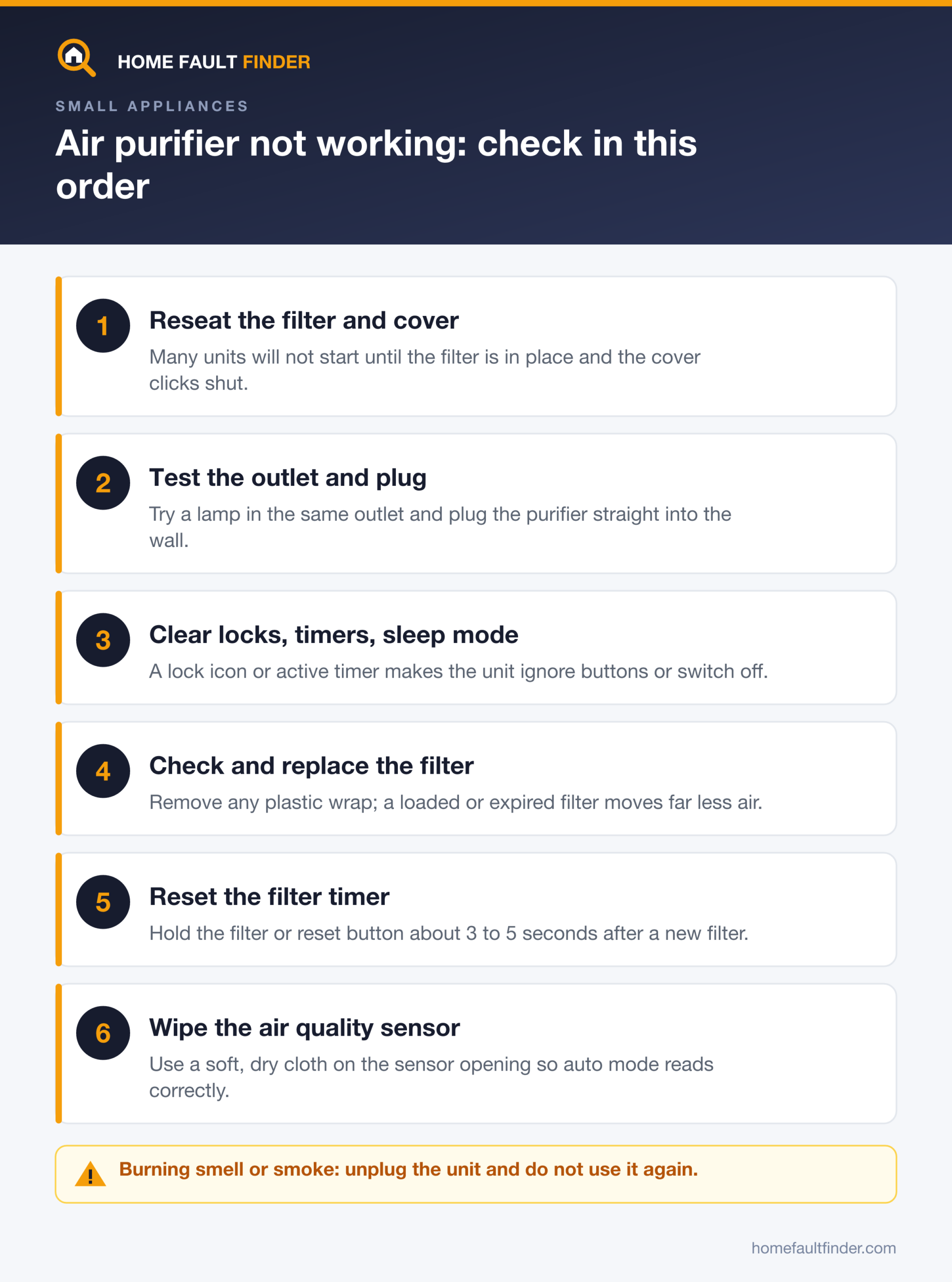
Reseat the filter and cover
Unplug, remove the filter, strip any plastic wrap, reinstall it tab facing out, and close the cover until it clicks. Time: 2 minutes.
-
Test the outlet
Plug a lamp into the same outlet. If it is dead, check for a wall switch or a tripped GFCI outlet nearby.
-
Plug straight into the wall
Skip power strips and extension cords, and check that a detachable cord is fully seated.
-
Clear a lock or timer
A lock icon means buttons are ignored; most models unlock by holding the lock button for 3 to 5 seconds.
If the outlet works and the cover is seated but nothing lights, the power supply or control board has likely failed, which is a warranty item, not a home repair. If the breaker trips, see our guide to a circuit breaker that keeps tripping.
Why is the fan running but the air is not cleaner?
An air purifier that runs but does not clean the air usually has airflow restricted by a loaded filter, a plastic bag still on a new filter, or furniture blocking the intake. The second cause is an undersized unit.
Clean Air Delivery Rate (CADR) is a rating, usually measured at the highest fan speed, of how much filtered air a purifier delivers in cubic feet per minute. The EPA guide to air cleaners in the home sizing chart pairs about 65 cfm with a 100 square foot room and 390 cfm with 600 square feet, roughly two-thirds of the floor area. Rooms with ceilings above 8 feet need a unit rated for a larger area.
Placement matters too. EPA advises running the unit where you spend the most time, clear of curtains; test it on medium or high for a few hours with doors closed before judging it.
Why does my air purifier smell bad?
A bad smell from an air purifier usually means the activated carbon layer is saturated or the filter has absorbed moisture and turned musty. Carbon traps odor molecules only until its surface is full, so replacing the carbon or combined filter is the usual fix.
A musty odor often appears when the purifier sits next to a humidifier or in a damp room. Move it away from mist; if you also run a humidifier, see our article on a humidifier not producing mist. A plastic smell is normal for a day or two with a new filter.
A burning or electrical smell, smoke, a hot plug, or a scorched outlet is not a filter problem. Unplug the unit by the plug body and do not use it again until the manufacturer has inspected it.
How do you reset the filter light on an air purifier?
The filter light on most air purifiers is a timer that counts run hours, not a sensor that measures how dirty the filter is. Levoit, for example, describes its Check Filter indicator as an internal timer that does not reset itself.
On many models you hold the filter or reset button for about 3 to 5 seconds with the unit on, until the light goes out or it beeps. Some models use a recessed reset hole pressed with a paper clip, and app-connected models reset in the app; check the manual if the common method fails. Resetting the timer without a new filter makes sense only if the filter is still visibly clean.
Why is auto mode or the sensor not responding?
An air purifier auto mode that stays on low while the room is smoky, or runs on high in clean air, usually has dust or lint covering the air quality sensor opening.
Unplug the unit and wipe the sensor opening gently with a soft, dry cloth, as Levoit recommends, and never spray cleaner into it. Give the sensor a few minutes after power-on to settle, and keep the unit away from heaters and drafts. If the air quality light never changes even with cooking smoke nearby, the sensor may have failed, which is a warranty issue.
Why is my air purifier so loud?
A loud air purifier is most often running on high fan speed, which is normal, or straining against a blocked intake or a filter that sits off-center and lets air whistle around its edges. A rattle usually means a loose filter or an uneven floor.
EPA notes that noise depends partly on fan speed and that about 50 decibels is roughly the sound of a modern refrigerator. If it is louder than that on low, reseat the filter, clear the intake, and set the unit on a level floor with about 12 inches of clearance. Grinding that worsens over days points to a worn motor bearing; stop using it and contact the manufacturer.
Why does my air purifier keep shutting off?
An air purifier that keeps shutting off is often following a setting rather than failing: a shutdown timer, sleep mode, or a smart schedule set in the companion app. Otherwise, suspect overheating from blocked vents, a loose plug, or a shifted filter cover.
Cancel all timers and app schedules, clear the vents, and plug directly into a wall outlet that grips the plug firmly. If it still cuts out and the housing feels hot, unplug it and contact the manufacturer; repeated thermal shutdowns are a protection feature doing its job. Our guide to a space heater shutting off explains the same overheat logic.
How often should you replace air purifier filters?
Air purifier filter replacement intervals are set by each manufacturer and depend on run hours, pets, smoke, and dust. Levoit, for example, says most of its filters last 6 to 8 months and may need changing sooner in homes with pets or heavy dust. Your manual is the authority.
| Filter type | Normal care | Signs it is done |
|---|---|---|
| Pre-filter (mesh) | Vacuum or rinse if the manual allows; dry fully | Gray layer, weaker airflow |
| HEPA or HEPA-type | Replace; do not wash unless labeled washable | Dark surface, timer expired |
| Activated carbon | Replace on schedule | Odors return, stale smell |
| Permanent or washable | Clean as the manual describes | Will not come clean |
| Electrostatic plates | Clean plates per the manual | Dust buildup, snapping |
Furnace filters follow their own schedule; see how often to change your HVAC filter and which MERV rating to choose for a furnace filter.
What will not fix an air purifier?
Several common fixes for an air purifier not working waste time or create new problems. Washing a standard HEPA filter or running the unit without one does not restore performance; water damages the fiber mat, and running filterless blows dust into the motor.
- Resetting the filter light instead of replacing the filter. The timer goes dark, but airflow through a clogged filter stays poor.
- Taping down or bypassing the cover switch. Bypassing a safety device is never a fix.
- Turning on the ionizer to “boost” cleaning. EPA warns that ionizers and electrostatic units may emit ozone, and its page on ozone generators sold as air cleaners says ozone can damage the lungs and does not remove particles such as dust and pollen.
- Opening the housing to oil the motor or reflow the board. It voids the warranty and exposes household-voltage wiring.
Stop using the air purifier and contact the manufacturer or an authorized service center if you notice a burning or electrical smell, smoke, sparks, a hot or discolored plug or outlet, a cracked housing, or a grinding fan. Do not open the housing beyond the filter compartment; the motor and control board run on household voltage.
Internal repairs typically void the warranty. For an outlet that feels warm or looks scorched, have a licensed electrician check the wiring.
Frequently asked questions
How can you tell if an air purifier is working?
You can tell an air purifier is working when you feel steady airflow from the outlet, the air quality indicator changes after you cook or dust nearby, and the pre-filter collects visible dust within a few weeks. A filter that stays white for months suggests air is bypassing it.
Should an air purifier run all the time?
An air purifier works best when it runs continuously in the room you use most, because particles are constantly reintroduced by people, pets, and open doors. EPA notes that higher fan speeds and longer run times filter more air. Auto mode is a fair compromise if the sensor is clean.
Can I wash a HEPA filter to make it work again?
You should not wash a standard HEPA filter, because water damages the fiber mat that traps fine particles and can leave it damp enough to grow mold. Only filters labeled washable or permanent should be rinsed; clean the mesh pre-filter instead.
Why did my air purifier stop working after I changed the filter?
An air purifier that stops working after a filter change usually has the new filter’s plastic wrap still on, the filter installed backward, or the cover not fully closed so the safety switch stays open. Remove the filter, unwrap it completely, reinstall it with the tab facing out, and close the cover until it clicks.
Do air purifiers produce ozone?
Most HEPA air purifiers do not produce ozone, but EPA lists ionizers, electrostatic precipitators, plasma units, and some UV models as devices that may emit it. Check the AHAM or California Air Resources Board low-ozone lists, and switch off the ion function if your throat feels irritated.