A circuit breaker that won’t reset has usually not been pushed all the way to OFF first, or it is still detecting a fault. Push the handle firmly to OFF until it clicks, then back to ON. If it trips again within seconds with everything on the circuit unplugged, leave it off and call a licensed electrician.
- A tripped handle rests between ON and OFF, and it must travel fully to OFF before it can latch ON again.
- An instant re-trip with nothing connected points to a short or ground fault in the wiring.
- A 15-amp, 120-volt circuit carries about 1,800 watts; a 20-amp circuit about 2,400 watts.
- After an overload trip, many breakers need a minute or two to cool before they will latch again.
This guide is for anyone facing a breaker that snaps back the moment they push it, or a handle that refuses to stay put. Every check here happens from outside the panel: switching handles, unplugging cords and reading labels. Anything behind the panel cover belongs to a licensed electrician. If your breaker resets but trips again after a while instead of refusing to reset at all, our guide on why a circuit breaker keeps tripping covers overloads in more depth.
- Why won’t my breaker reset?
- How to reset a breaker correctly
- What the timing of the trip tells you
- Trips with nothing plugged in
- GFCI and AFCI breakers
- After rain or a power outage
- Main breaker won’t reset
- Signs the breaker itself has failed
- Mistakes that make it worse
- When to call an electrician
- FAQ
Why won’t my circuit breaker reset?
A circuit breaker that won’t reset is doing one of three things: it was never moved fully to OFF, it is still sensing a fault on the circuit, or its internal latch has worn out. A circuit breaker is an automatic switch that opens a circuit when current exceeds its rating.
The first cause is the most common. A tripped handle stops in a middle position, sometimes only a few millimeters from ON, and pushing it straight to ON does nothing because the mechanism has not been re-cocked.
The second cause matters for safety: if a short circuit, ground fault or arcing connection is still on the line, a healthy breaker trips again the instant you close it. That is the breaker working correctly.
How do you reset a tripped breaker the right way?
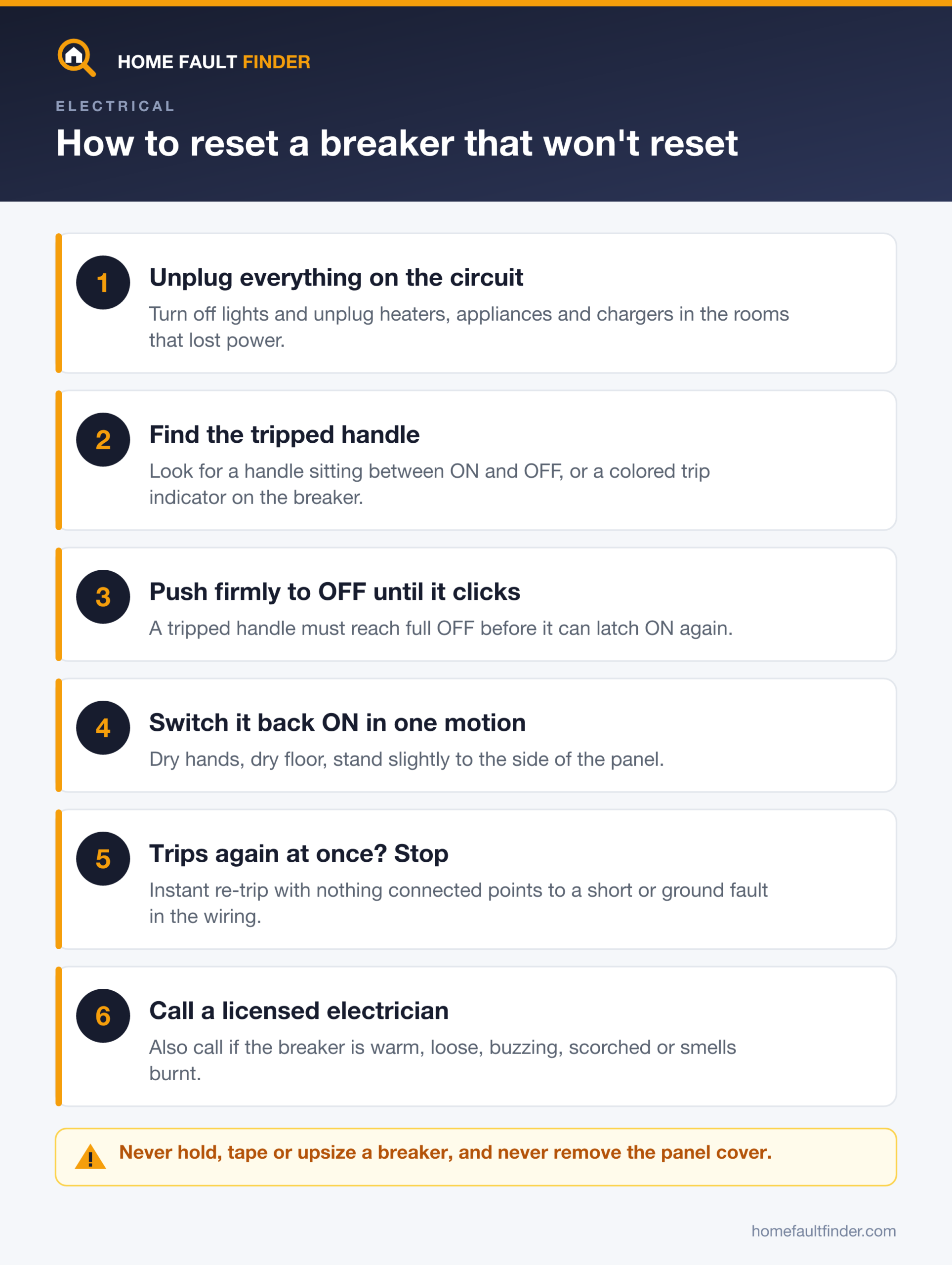
Resetting a tripped breaker correctly means removing the load, moving the handle firmly to the full OFF position until it clicks, and then switching it back to ON in one motion. Schneider Electric’s Square D guidance describes the same sequence: a tripped handle must first be pushed from the center position to OFF before the breaker can be closed.
-
Turn off and unplug everything on the dead circuit
Unplug everything in the rooms that lost power. Time: 2–5 minutes.
-
Find the tripped handle
Open only the panel door, not the cover. Look for a handle out of line with its neighbors, or a colored trip indicator on the breaker face.
-
Push the handle firmly to OFF
Press past center until it clicks and touches the OFF stop. Use your thumb, not a tool.
-
Switch it back ON in one motion
With dry hands and a dry floor, stand slightly to the side and push the handle firmly to ON.
-
Restore loads one at a time
Plug items back in a minute apart. If one item trips the breaker every time, the fault is in that item.
-
Stop after two attempts
If it trips again instantly on the second try with nothing connected, leave it OFF and call an electrician.
What does it mean when a breaker trips again immediately?
A breaker that trips again immediately after reset is reacting to a fault that is present the moment power returns, typically a short circuit, a ground fault or a defective appliance still connected. A trip that takes several minutes points instead to an overload. Timing is the most useful clue you can read without tools.
| What you see | Most likely cause | What to do |
|---|---|---|
| Handle snaps back as soon as you push ON, nothing plugged in | Short or ground fault in wiring or a hardwired device | Leave it OFF and call a licensed electrician |
| Trips instantly only when one appliance is plugged in | Fault in that appliance | Stop using it; repair or replace it |
| Holds for minutes, trips when heavy loads run | Overload | Move big loads to other circuits |
| Won’t latch right after a trip, works after 1–2 minutes | Thermal element still hot | Wait, reduce the load, then reset |
| Handle feels loose or mushy, no click, will not stay anywhere | Worn or broken breaker mechanism | Electrician replaces the breaker |
| Breaker is warm, buzzing, or you smell burning | Overheating connection | Leave it OFF; call an electrician today |
Overload math is simple: watts equal volts times amps, so a 1,500-watt space heater plus a 1,000-watt microwave already exceeds a 20-amp, 120-volt circuit (about 2,400 watts). Appliance-specific trips are covered in our guides to a space heater tripping the breaker and a microwave tripping the breaker.
Why won’t the breaker stay on with nothing plugged in?
A breaker that won’t stay on with nothing plugged in is almost always protecting a fault in the fixed wiring or in something permanently connected, such as a hardwired light fixture, a ceiling fan, a garbage disposal, a bathroom fan or a hardwired appliance. Unplugging cords removes only plug-in loads, so the remaining fault is still on the circuit.
Common culprits include a screw driven through a cable, a loose wire touching a metal box, water in an exterior box, or a failing hardwired appliance on a double-pole breaker.
The remaining checks involve working inside boxes on live wiring, so they belong to an electrician; mention any recent drilling or projects. If only some outlets are dead and the breaker is fine, see outlet not working but breaker is on.
Why won’t a GFCI or AFCI breaker reset?
A GFCI or AFCI breaker that won’t reset is usually detecting the specific hazard it was built to catch. A GFCI (ground-fault circuit interrupter) breaker trips when a few milliamps of current leak to ground, while an AFCI (arc-fault circuit interrupter) breaker trips when it senses the electrical signature of arcing in damaged cords or loose connections.
Both types reset with the same handle motion as a standard breaker: firmly to OFF, then to ON. The TEST button only trips the breaker; it does not reset it. Some newer models have a diagnostic light that shows the fault type; the breaker label explains the pattern.
If the trips started right after new electrical work, ask the installer to return; shared-neutral wiring errors are a known cause of instant tripping. Never swap one for a standard breaker to stop the trips. Our comparison of GFCI vs AFCI breakers explains what each one protects. For outlets, see how to reset a GFCI outlet.
Why won’t my breaker reset after rain or a power outage?
A breaker that won’t reset after rain is usually seeing a ground fault from water inside an outdoor outlet, a light fixture, landscape lighting, a pool or spa circuit, or an exterior junction box. Moisture gives current a path to ground, so GFCI-protected circuits trip and refuse to reset until the water is gone and the damage is checked.
Keep that circuit off and let it dry; do not open wet boxes. If the panel or any outlet has been under water, do not touch the panel; contact the utility and an electrician.
After a power outage, several breakers can trip as refrigerators, air conditioners, well pumps and furnaces all start at the same moment. Switch off major appliances and the HVAC, reset, then bring loads back gradually. See how to prepare your home for a power outage.
What if the main breaker won’t reset?
A main breaker that won’t reset, or a whole house with no power and no tripped breaker, needs a different response than a branch circuit. The main breaker is the large breaker, usually at the top of the panel, that disconnects the entire house; it is rated far higher than branch breakers, commonly 100 to 200 amps in homes.
First check whether neighbors lost power too; a utility outage looks like a tripped main. If it is only your home, switch off big loads and try the main once with the same OFF-then-ON motion. If it will not latch, stop: the main, meter and service cable are utility and electrician territory. If only part of the house is dark, see our guide on why half the house has no power.
How can you tell if the breaker itself has gone bad?
A circuit breaker has gone bad when it cannot latch even with no load and no fault downstream, or when it shows physical signs of heat damage. Breakers are mechanical devices with springs, latches and thermal elements, and repeated tripping, heat and age wear them out, although most last for many years in normal service.
Signs include a loose handle with no click, warmth, buzzing, scorch marks or a burning smell.
Replacing a breaker means removing the panel cover, which exposes conductors that stay energized even with the main off, and the new breaker must be a type listed on that panel’s label. Leave it to a licensed electrician.
What mistakes make a breaker problem worse?
The mistakes that make a breaker problem worse all share one theme: they defeat the protection instead of finding the fault. A breaker is sized to protect the wire in the walls, so anything that keeps it closed against a fault shifts the risk to overheated wiring, a common start of electrical fires.
- Holding or taping the handle ON.
- Installing a larger breaker. A 30-amp breaker on wire sized for 20 amps lets the cable overheat before anything trips.
- Resetting again and again. Each trip into a short stresses contacts and wiring.
- Running an extension cord from another circuit. The fault or overload simply moves.
- Removing the panel cover to look inside. Live parts remain energized even with every breaker off.
- Writing off GFCI or AFCI trips as nuisance. Let an electrician confirm it first.
When should you call an electrician for a breaker that won’t reset?
An electrician is the right call for a breaker that won’t reset whenever the trip happens with nothing plugged in, the breaker will not latch at all, the main breaker is involved, or you see heat, smell burning or hear buzzing. Those situations point to wiring, panel or breaker faults that cannot be fixed from outside the panel.
Call a licensed electrician for any of the situations above, or if water has reached the panel or any electrical box.
If you smell burning or see smoke from the panel, an outlet or a switch, leave the area and call 911 from outside.
Frequently asked questions
Is it dangerous if a breaker won’t reset?
A breaker that won’t reset is not dangerous by itself, because the circuit stays off. The risk comes from what caused it: a short circuit, ground fault or overheating connection. Leave the circuit off, avoid repeated resets, and have an electrician find the fault before you rely on that circuit again.
How many times should you try to reset a breaker?
Two attempts is a sensible limit. Try once after unplugging everything on the circuit and once more after waiting a minute or two for the breaker to cool. If it trips again instantly with nothing connected, further resets only stress the breaker and wiring, so stop and call an electrician.
Should I wait before resetting a tripped breaker?
Waiting one to two minutes helps after an overload trip, because the thermal element inside many breakers must cool before the latch will hold. Use that time to unplug heaters, kettles and other high-wattage items. Waiting does not help with a short circuit; that breaker will trip again immediately.
Why did my breaker reset but some outlets still have no power?
Outlets that stay dead after a successful reset are often downstream of a tripped GFCI outlet in a bathroom, kitchen, garage or outdoors. Press RESET on each GFCI outlet nearby. If they still have no power, a loose connection in a box may be to blame, which needs an electrician.
Can a breaker go bad without tripping?
Yes. A breaker can fail in the closed position, stop tripping at its rated current, or develop a poor connection that runs hot without ever tripping. Warning signs include warmth, buzzing, discoloration or a burning smell at the panel. An electrician can test the breaker and check the connection under load.