
A front-load washer is the better choice for most households that want the lowest water and energy bills and gentler cleaning: ENERGY STAR says certified front-loaders use about 50% less energy and water than top-load agitator washers. A top-load washer is better if you want a lower purchase price, shorter cycles, no bending and fewer odor problems.
- ENERGY STAR certified front-loaders use about 50% less energy and water than top-load agitator models and about 25% less than top-load impeller models.
- Front-load washers commonly cost roughly $590–$1,300 for the unit versus about $300–$500 for a top-loader (Fixr, as of October 2026).
- Front-loaders spin faster, so clothes come out drier and spend less time in the dryer.
- Top-loaders are easier on the back, finish sooner, let you add a forgotten item mid-cycle and are far less prone to the musty door-gasket smell.
- Neither style reliably outlasts the other; most washers last about 10–13 years with basic maintenance.
Choosing between a front-load and a top-load washer is mostly a trade between running costs and convenience. Front-loaders save water, energy and dryer time every week, while top-loaders save money at the store and ask less of you in daily care.
Below we compare the two designs line by line, explain agitator versus impeller top-loaders and end with a “which one fits my household” checklist. Efficiency figures come from ENERGY STAR and prices from a dated cost guide.
- What is the difference between front-load and top-load washers?
- Front-load vs top-load washer: side-by-side comparison
- Which washer uses less water and energy?
- Which washer cleans clothes better?
- Agitator or impeller: which top-loader is better?
- Which washer lasts longer and needs fewer repairs?
- Do front-load washers really get moldy?
- How much do front-load and top-load washers cost?
- Which washer is right for your household?
- Common mistakes when choosing a washer
- Frequently asked questions
What is the difference between front-load and top-load washers?
A front-load washer is a machine with a door on the front and a drum that rotates on a horizontal axis, lifting clothes and dropping them through a small pool of water. A top-load washer has a lid on top and a vertical tub, and it moves clothes with either a tall central agitator or a low impeller plate.
That design choice drives almost every other difference. A horizontal drum uses gravity to tumble laundry, so it needs only enough water to wet the load, not float it. Front-loaders also seal with a rubber door gasket, which is why they hold moisture after a cycle.
Front-load vs top-load washer: side-by-side comparison
Front-load and top-load washers differ most in water use, energy use, spin speed, purchase price and daily upkeep. The table below compares nine points buyers ask about, using ENERGY STAR figures for efficiency and a published cost guide for prices; other rows reflect patterns commonly seen in service work.
| Factor | Front-load washer | Top-load agitator | Top-load impeller (HE) |
|---|---|---|---|
| Water and energy use | Lowest; about 50% less than an agitator top-loader | Highest | Middle; front-loaders are still about 25% more efficient |
| Cleaning | Thorough, gentle tumbling | Strong scrubbing, rougher on fabric | Good; large items can tangle or float |
| Usable capacity | Large; no center post | Reduced by the agitator column | Large; no center post |
| Spin and drying time | Fastest spin, shortest dryer time | Slower spin, wetter clothes | Faster than agitator, usually below front-load |
| Cycle length | Longest; normal cycles often an hour or more | Shortest | Medium |
| Odor and mold risk | Highest; door gasket holds moisture | Low | Low to moderate |
| Ergonomics | Bending unless on a pedestal; stackable | No bending to load; deep tub to reach | No bending to load; deepest tub |
| Typical expensive repair | Drum bearing or spider arm | Transmission or drive coupler | Drive motor or shifter |
| Unit price (as of Oct 2026) | About $590–$1,300 | About $300–$500 (top-loaders overall) | About $300–$500 (top-loaders overall) |
Which washer uses less water and energy?
Front-load washers use the least water and energy of any washer design. According to ENERGY STAR, certified front-loaders use about 50% less energy and water than a top-load agitator washer and remain about 25% more energy and water efficient than a top-load impeller model, so they cost the least to run every week.
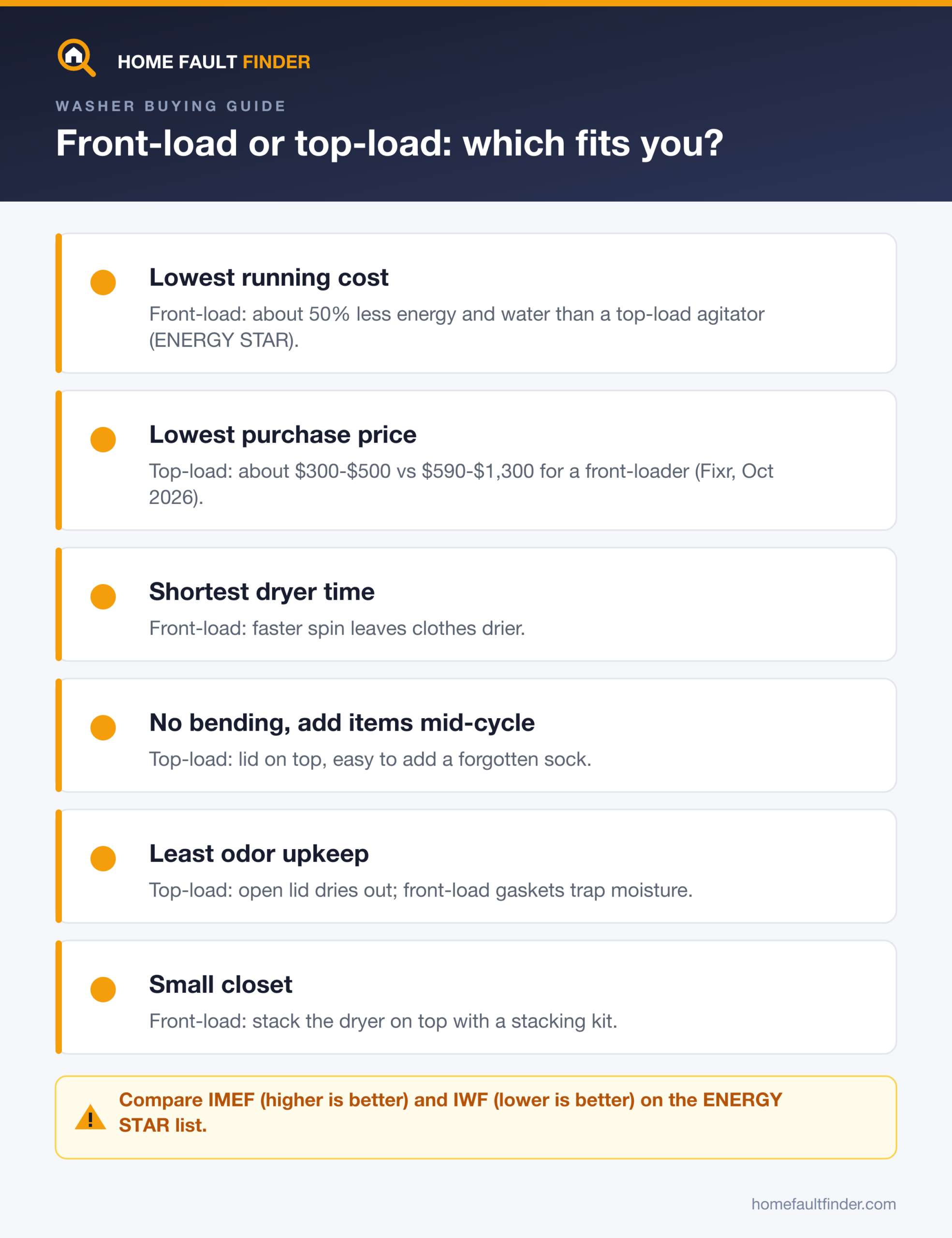
The reason energy and water move together is hot water. ENERGY STAR notes that water heating consumes about 90% of the energy it takes to operate a clothes washer, so a machine that fills with less water also asks your water heater for less. ENERGY STAR also reports that full-size certified washers use about 14 gallons per load, compared with about 20 gallons for a standard machine, and that certified models can save about $530 in energy costs over their lifetime.
Front-loaders also typically spin faster, and ENERGY STAR notes that a high spin speed removes more moisture and shortens drying time. To compare specific models, look for two numbers on the ENERGY STAR product list: a higher IMEF (Integrated Modified Energy Factor) means better energy efficiency, and a lower IWF (Integrated Water Factor) means better water efficiency. See whether ENERGY STAR appliances are worth it.
Which washer cleans clothes better?
Front-load washers and top-load impeller washers both clean well, but front-loaders tend to be the more consistent of the two because the tumbling action lifts and drops every item through the wash water. Top-load agitator washers scrub hard and handle heavy soil quickly, yet that same scrubbing is rougher on delicate fabrics and stretches knits over time.
Front-loaders and impeller top-loaders are high-efficiency (HE) designs, so they need HE detergent in the correct amount; too much soap leaves residue and can trigger the problem described in our guide to a washing machine with too many suds.
Agitator or impeller: which top-loader is better?
A top-load impeller washer is usually the better top-loader for efficiency and capacity, while an agitator top-loader is better for short, heavy-duty cycles. ENERGY STAR describes impeller models, which use a low-profile cone or disc instead of a center post, as a more energy- and water-efficient option than traditional top-load washers.
An agitator is the tall finned column in a classic top-loader; it twists to rub clothes together and needs enough water to submerge the load. An impeller is a low plate that rolls clothes through less water, leaving more room for a comforter, though cycles run longer and clothes can tangle. If you want a top-loader mainly to avoid bending and gasket care, an impeller model gives you most of a front-loader’s efficiency gains with top-load convenience.
Which washer lasts longer and needs fewer repairs?
Neither front-load nor top-load washers reliably outlast the other; most washing machines last roughly 10 to 13 years with basic maintenance. What differs is the type of failure. Front-loaders more often develop door-gasket, drain-filter and drum-bearing problems, while top-loaders more often need lid switches, drive couplers or transmissions on agitator models.
A basic top-load agitator machine with mechanical controls is commonly the easiest washer to repair. A worn front-load drum bearing, often announced by a loud roar during spin, is frequently the repair that tips an older machine toward replacement. Our washing machine repair cost guide lists which faults are cheap and which are not. If a current washer is acting up, start with our washing machine troubleshooting guide before replacing it. An unlevel washer of either style wears its suspension faster, as covered in our guide to a washing machine shaking on the spin cycle. Simple habits that add years to either type are collected in how to extend the life of your washing machine.
Do front-load washers really get moldy?
Front-load washers can grow mold and mildew because the airtight door and rubber gasket trap moisture after every cycle. The risk is real but manageable: leaving the door slightly open between loads, wiping the gasket, using HE detergent sparingly and running a monthly cleaning cycle prevent most musty smells before they start.
Top-loaders are not immune, but the open lid lets the tub dry far more easily. If you already have a smell, our step-by-step guide to a washing machine that smells musty covers the gasket, drain filter and dispenser in order.
How much do front-load and top-load washers cost?
Front-load washers cost more to buy than top-load washers. Fixr’s cost comparison, read in October 2026, puts a 4-cubic-foot front-loader at about $590 to $1,300 for the unit and a comparable top-loader at about $300 to $500, with professional installation adding about $100 to $165 either way.
| Cost item (4 cu ft washer) | Front-load | Top-load |
|---|---|---|
| Washer unit | $590–$1,300 | $300–$500 |
| Installation labor | $100–$165 | $100–$165 |
| Supplies (hoses, fittings) | $15–$25 | $15–$25 |
| Typical installed total | $705–$1,490 | $415–$690 |
A pedestal or stacking kit adds to a front-loader’s bill, so price accessories before comparing. Households that do many loads a week recover more of the price gap through lower running costs.
Which washer is right for your household?
The right washer depends on how much laundry you run, how much space you have and who will load it. Use this checklist as a decision guide: the line that best describes your home points to the better style, whatever is popular this year.
-
Large family or daily loads: choose a front-load washer.
Savings add up fastest when you wash often.
-
Tight laundry closet: choose a stackable front-loader.
Use the manufacturer’s stacking kit.
-
Back or knee problems: choose a top-loader or a front-loader on a pedestal.
A pedestal raises the door; a top-loader has a deep tub to reach into.
-
Tight budget today: choose a top-load impeller washer.
Lower price, and still more efficient than an agitator.
-
Heavy soil and short cycles: choose a top-load agitator washer.
Fastest option for muddy work clothes.
-
Low tolerance for upkeep: avoid a front-loader in a closed, unventilated space.
Without door-ajar habits, odor risk outweighs the efficiency gain.
Common mistakes when choosing a washer
The most common mistake is comparing only the purchase price. A front-loader can win back part of its higher price through lower running costs, while a cheaper top-loader suits light use.
- Measuring the space but not the doorways and stairs the washer must pass through.
- Forgetting door swing or lid clearance under shelves.
- Using regular detergent in an HE washer, which causes oversudsing and residue.
Call a licensed plumber or the retailer’s installer if the new washer needs a relocated drain, a new water supply line, a drain pan with a floor drain on an upper floor, or a dedicated electrical circuit. Do not modify wiring or the electrical panel yourself, and have an electrician confirm the outlet meets the washer’s requirements before plugging in a new machine.
Frequently asked questions
Are front-load washers worth the extra money?
Front-load washers are worth the extra money for households that run many loads, because ENERGY STAR certified front-loaders use about 50% less energy and water than top-load agitator models and spin clothes drier. For one or two loads a week, a top-load impeller washer usually recovers its lower price faster.
Do top-load washers use more water?
Top-load agitator washers use the most water because they fill the tub to submerge clothes. Top-load impeller washers use noticeably less, but ENERGY STAR still rates front-loaders about 25% more water and energy efficient than impeller models. Check the IWF on the ENERGY STAR list; lower is better.
Can you stack a top-load washer?
A top-load washer cannot be stacked because the lid opens upward and needs clear space above it. Only front-load washers paired with a matching dryer and the manufacturer’s stacking kit can be stacked. If floor space is the deciding factor, a stackable front-load pair or an all-in-one laundry center is the usual answer.
Why do front-load washers take so long?
Front-load washers take longer because they clean by repeatedly lifting and dropping clothes through a small amount of water instead of submerging them. Normal cycles often run an hour or more. Most models offer a quick or express cycle of roughly 30 minutes for small, lightly soiled loads.
Which type is better for hard water?
Neither type is immune to hard water, which leaves mineral scale and reduces detergent performance in both. Front-loaders and impeller top-loaders use less water, so correct HE detergent dosing matters more. Running a monthly cleaning cycle and, where scale is heavy, a water softener protects either style.
Is a front-load washer harder to maintain?
A front-load washer needs slightly more routine care: leave the door ajar after each load, wipe the rubber gasket weekly and clean the drain pump filter every one to two months. Top-loaders need a monthly cleaning cycle and dispenser cleaning but rarely develop gasket odors.