

Replace your washing machine when a repair quote is more than half the price of a comparable new washer and the machine is past about 8 years old, or when the bearings, transmission, drum or tub fail on an older unit. Cheap parts such as a lid switch, belt or inlet valve ($85–$190 installed) are worth fixing at almost any age.
- Most washing machines last roughly 10–13 years; past year 8, any major repair deserves a hard look.
- If a quote exceeds half the price of a comparable new washer, replacement usually wins on an older machine.
- Repairs under about $200 (lid switch, belt, coupling, inlet valve, door lock) are worth doing at almost any age.
- A full-size ENERGY STAR washer uses about 14 gallons per load versus 20 for a standard model, roughly 1,800 gallons a year saved.
- Two or more repairs in about two years is a stronger replacement signal than any single bill.
A washing machine rarely dies all at once. It starts making a new noise, leaks a little or throws an error code, and you are left holding a technician’s quote. This guide turns the general repair-or-replace rule into washer-specific numbers: dated repair costs by part, an age-based decision grid and a cost-per-remaining-year check you can run on your own quote.
How long does a washing machine last?
A washing machine typically lasts about 10 to 13 years in a household doing several loads a week, and some well-kept machines run past 15. Washer lifespan is the span of years before major parts wear out faster than repairs make sense, and it depends on load count, water hardness, detergent habits and maintenance.
Treat that range as a planning figure. A large family running two loads a day puts as many cycles on a washer in five years as a single person does in fifteen. Our guide to appliance lifespans and when repair stops making sense compares the washer with other major appliances.
What are the signs a washing machine needs replacing?
The clearest signs a washing machine needs replacing are a loud roar or grind during spin, water leaking from the tub itself, rust on the drum or cabinet, repeated breakdowns and a repair quote above half the price of a new washer. One sign alone calls for diagnosis; two or more on an older machine usually point toward replacement.
| Warning sign | What it usually means | Repair or replace? |
|---|---|---|
| Roar or grind that rises with spin speed | Worn tub/drum bearings | Often replace if 8+ years old |
| Water dripping from the outer tub, not a hose | Failed tub seal or cracked tub | Usually replace on older units |
| Rust on the drum, tub or cabinet floor | Corrosion of structural parts | Replace |
| Motor hums but drum will not turn | Coupling, belt or motor | Repair first |
| Error code returns after a board replacement | Fault upstream of the board | Get a second diagnosis |
| Second or third repair in about two years | General end-of-life wear | Lean toward replace |
A sharp rattle that comes and goes is often just a coin or button in the pump, which costs nothing to clear.
Is it better to repair or replace a washing machine?
Repairing a washing machine is usually better when the quote is under half the price of a comparable new washer and the machine is under about 8 years old. Replacing is usually better when the quote is over half and the washer is past the middle of its 10–13 year lifespan. Between those cases, the failed part decides.
The 50% rule compares the quote with the price of a comparable new machine, not with what you originally paid. If you own a basic top-loader, compare against a basic top-loader, not a premium front-loader.
How much do washer repairs cost compared with a new washer?
Washing machine repairs range from about $85 for a lid switch or coupling to $350–$550 for a drum, with a national average near $300, according to the Fixr cost guide. A new washer runs about $450–$700 for basic to mid-range models and $800–$1,800 for high-efficiency models.
| Part replaced (labor included) | Typical cost | Worth it at 10 years? |
|---|---|---|
| Coupling or lid switch | $85–$160 | Yes |
| Drain hose | $95–$170 | Yes |
| Water inlet valve | $95–$190 | Yes |
| Door lock | $110–$200 | Yes |
| Drive belt | $120–$175 | Yes |
| Bearings | $150–$225 (more if the tub is replaced) | Rarely |
| Transmission | $200–$350 | Rarely |
| Door gasket (front-load) | $230–$300 | Sometimes |
| Control board | $250–$400 | Rarely |
| Spider arm (front-load) | $275–$400 | Rarely |
| Motor | $300–$500 | Rarely |
| Pump | $300–$400 | Sometimes |
| Drum | $350–$550 | No |
Our washing machine repair cost guide explains what pushes an individual bill up or down.
Which washer repairs are almost always worth doing?
Washer repairs worth doing at almost any age are the inexpensive wear parts: lid switch, door lock, drive belt, motor coupling, water inlet valve and drain hose. Each costs roughly $85–$200 installed, under a third of a basic new washer, and none signals that the rest of the machine is failing.
Before paying for any of them, rule out the free causes: an unbalanced load, a clogged pump filter or a lid that is not latching fully. A clean pump filter alone resolves many draining and spinning complaints.
Which failures usually mean it is time to replace?
Failures that usually mean a washing machine should be replaced are worn tub bearings on a front-loader, a failed transmission on an older top-loader, a cracked outer tub, a corroded drum or spider arm, and a board or motor failure past about 8 years. These parts cost $200–$550 and often signal broader wear.
Bearings are the classic trap. On many front-load washers the bearings are pressed into the rear of the outer tub, and on some models the tub is a sealed one-piece unit, so the only fix is a complete tub assembly. Ask whether a quote covers bearings only or the full tub. Control boards are a second trap: a board can fail because a motor or wiring fault damaged it, so ask whether that cause was found.
Should you repair a 7- or 10-year-old washing machine?
A 7-year-old washing machine is usually worth repairing for any part under about $350, because it may still have 3–6 years of service left. A 10-year-old washing machine is worth repairing only for cheap parts under about $200; a bearing, transmission, motor or board failure at that age normally favors replacement.
| Machine age | Minor (under ~$200) | Mid ($200–$400) | Major ($400+) |
|---|---|---|---|
| 0–5 years | Repair | Repair (check warranty) | Repair if under warranty; else compare |
| 6–9 years | Repair | Repair if no earlier major repairs | Usually replace |
| 10+ years | Repair | Usually replace | Replace |
For a sharper answer, divide the quote by the years the machine can realistically still run, then compare it with a new washer’s price divided by its expected life. Example: a 9-year-old top-loader needs a $400 control board and might run 3 more years, about $133 per remaining year. A $700 replacement over 11 years costs about $64 per year, so replacement wins.
Run the same math on a $150 lid switch for that machine and it costs $50 per remaining year, so the repair wins.
Does a new washer save enough water and energy to matter?
A new ENERGY STAR washer saves meaningful water but rarely pays for itself through utility savings alone. ENERGY STAR reports that certified full-size washers use about 14 gallons per load versus 20 for a standard model, and about 20% less energy. At 300 loads a year, that is roughly 1,800 gallons saved annually.
ENERGY STAR also estimates about $530 in energy savings over a certified washer’s lifetime, under $50 a year across 11 years. That is why efficiency should tip a close decision rather than justify replacing a washer that still works. “Standard” here means a current minimum-efficiency model; a much older machine may use more. See whether ENERGY STAR appliances are worth it for rebates and payback.
Does front-load vs top-load change the decision?
Front-load versus top-load design changes which failures are expensive rather than how long the machine lasts. ENERGY STAR notes that certified front-loaders use about 50% less energy and water than top-load agitator washers and about 25% less than top-load impeller models, while front-loaders carry costlier bearing, gasket and spider arm repairs.
We have not found a primary source showing a consistent lifespan difference between the two designs. An older agitator top-loader is more likely to need a transmission or coupling; a front-loader is more likely to need a gasket, spider arm or bearings.
How to decide, step by step
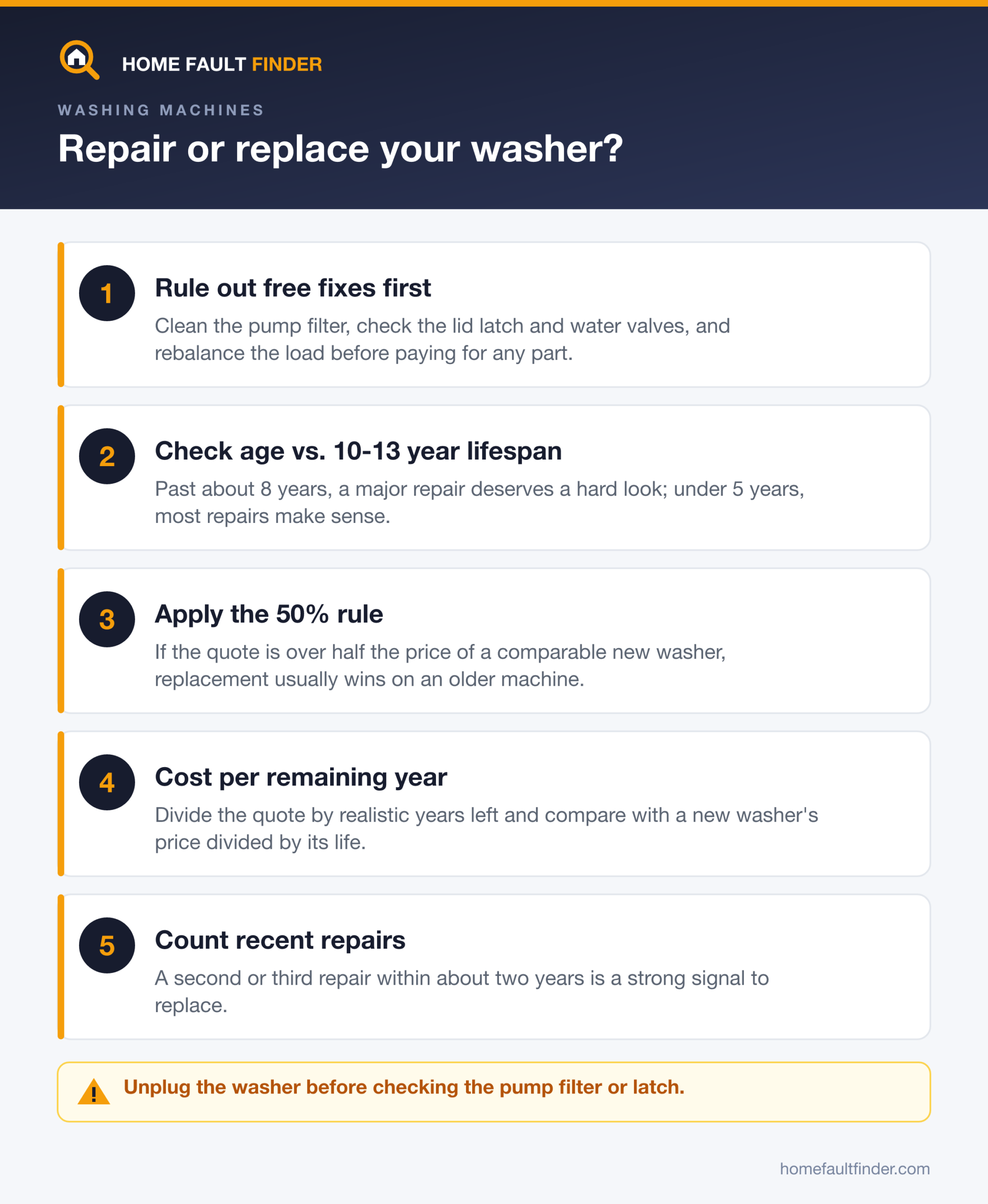
Deciding whether to repair or replace a washing machine takes about 30 minutes once you have a diagnosis. Work through the steps below in order, because a free fix, an active warranty or a cheap part can end the decision early and make the replacement question irrelevant.
-
Rule out the free fixes
Clean the pump filter, check the lid latch, open the water valves fully and rebalance the load. Time: 15–30 minutes. Cost: $0.
-
Find the model number and age
The rating label, usually inside the lid, around the door opening or on the back, lists the serial number, which often encodes the build date.
-
Check warranty coverage
Review the manufacturer warranty and any home warranty or extended plan before paying.
-
Get a written quote that names the part
Ask whether it covers a part or a full assembly, and whether the $50–$100 diagnosis fee is credited.
-
Apply the 50% rule and cost per remaining year
Compare the quote with a like-for-like new washer, then divide it by realistic remaining years.
-
Count recent repairs
A second or third repair in about two years tips the decision toward replacement.
Call an appliance technician for motor, control board, tub, bearing or transmission work; these jobs need the machine dismantled and often moved, and a washer is heavy enough to cause injury.
If you notice a burning smell, scorch marks on the plug or outlet, or a breaker that trips each cycle, stop using the washer. If water has reached the outlet, do not touch the plug; switch the circuit off at the breaker and call a licensed electrician.
If you keep your current machine, the habits in our guide to extending the life of your washing machine protect the repair you just paid for.
Frequently asked questions
How often should you replace washing machine hoses?
Washing machine inlet hoses should be inspected every 6–12 months and replaced at the first sign of bulging, cracking or kinking. Many owners fit new hoses whenever they install a new washer instead of reusing old ones. Check your manual for the interval.
Is it worth replacing the door seal on a front-load washer?
Replacing a front-load washer door seal is usually worth it on a machine under about 8 years old, since the job typically costs $230–$300 installed. On an older washer that also shows bearing noise or rust, put that money toward a replacement instead.
Can worn shock absorbers make a washer seem ready to replace?
Worn shock absorbers or suspension springs make a washer bang, shake and walk during spin, which owners often mistake for a dying machine. They are mid-cost parts and usually worth replacing. Rule out an unbalanced load and an unlevel floor first.
Should I replace my washer and dryer at the same time?
Replacing a washer and dryer together is only necessary if the dryer is also near the end of its life or you want a stacked or matching pair. A working dryer can stay.
Is a 15-year-old washing machine worth fixing?
A 15-year-old washing machine is worth fixing only for a cheap part such as a lid switch, belt or coupling, typically $85–$175 installed. It has passed the usual 10–13 year lifespan, so any mid-cost or major repair will very likely cost more per remaining year than a new washer.
When is the best time to buy a replacement washer?
The best time to buy a replacement washer is before the old one fails completely, so you can compare prices and wait for a seasonal sale instead of buying in a hurry. Measure doorways and the laundry space first, because many newer machines are larger.