Extended appliance warranties are usually not worth it for reliable, lower-priced appliances, because the average plan costs about 14% of the product price, according to a March 2026 Warranty Week study of 1,719 plans. A plan can make sense when one covered repair would cost far more than the plan, with a low or zero deductible.
- Appliance service contracts averaged 14% of the product price in 2026, rising from about 7% for 1-year plans to about 32% for 8-year plans.
- Many major appliances already carry a 1-year manufacturer warranty on parts and labor, so a 3-year plan often adds only 2 extra years.
- Typical single repairs ran $50–$650 by appliance type as of mid-2026, so a plan has to avoid at least one mid-size repair to pay for itself.
- Divide the plan price by the expected covered repair cost to get the break-even rate.
Buying a refrigerator, washer or dishwasher almost always ends with the same question at checkout: do you want to add a protection plan? This guide answers it with 2026 pricing data, typical repair costs and the Federal Trade Commission’s buying advice instead of sales pressure.
- What is an extended appliance warranty?
- How much does an extended warranty cost?
- What does the manufacturer’s warranty already cover?
- How do you know if a plan will pay for itself?
- When is an extended warranty worth buying?
- When should you skip the extended warranty?
- What do extended warranties usually exclude?
- How do you check a plan before you buy?
- Is a home warranty the same thing?
- Decision checklist
- Frequently asked questions
What is an extended appliance warranty?
An extended appliance warranty is a separately priced service contract that promises to pay for, or perform, certain repairs after the purchase. The Federal Trade Commission notes that it costs extra, is different from the warranty that automatically comes with the product, and may cover different problems than the manufacturer’s warranty does.
Retailers usually call them “protection plans.” The company that sells the plan at checkout is often not the company that pays the claims. Plans are typically run by a third-party administrator, and the plan is only as reliable as the company responsible for paying it.
How much does an extended warranty cost?
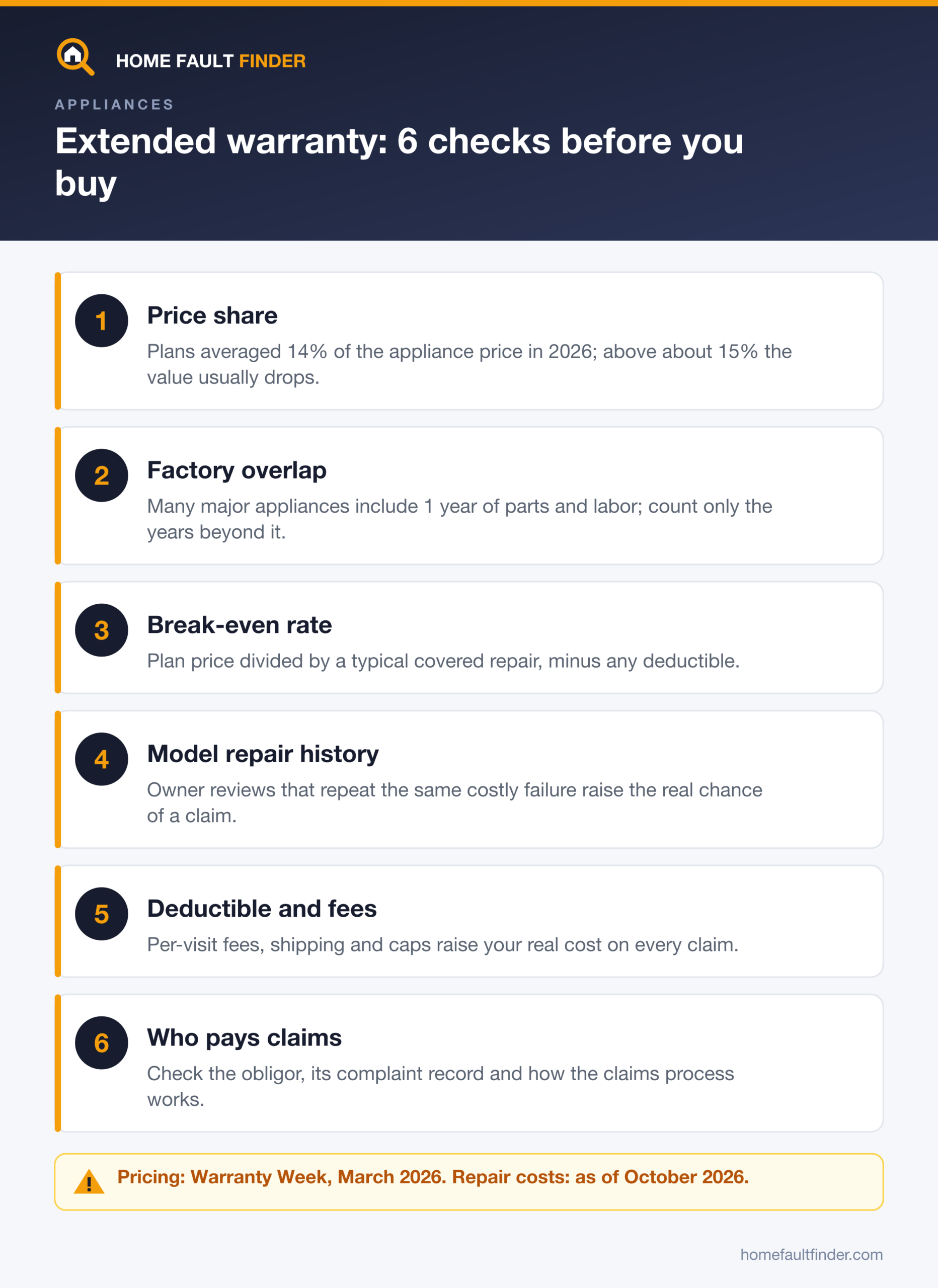
Extended warranty prices for home appliances averaged 14% of the appliance’s purchase price in Warranty Week’s March 2026 survey of 1,719 plans from 32 online retailers. Prices ranged from $3 to $2,250, and the share of the product price climbed steadily with the length of coverage, from about 7% for one year to about 32% for eight years.
| Plan length | Average price as % of appliance | Example on a $1,000 appliance |
|---|---|---|
| 1 year | ~7% | ~$70 |
| 2 years | ~9% | ~$90 |
| 3 years | ~13% | ~$130 |
| 4 years | ~14% | ~$140 |
| 5 years | ~15% | ~$150 |
| 7 years | ~28% | ~$280 |
| 8 years | ~32% | ~$320 |
Appliance type also changes the price. In the same study, plans for ranges averaged 10.5% of the product price, refrigerators 11.3%, dishwashers 15.8% and microwaves 19.1%. A separate February 2026 Warranty Week look at 352 refrigerator plans found prices running from about 1% to 56% of the refrigerator’s price, so always compare.
What does the manufacturer’s warranty already cover?
Manufacturer warranties on major appliances commonly cover parts and repair labor for one year from the purchase date, and some extend coverage on specific components. For example, one current KitchenAid refrigerator warranty covers sealed-system parts and labor in years two through five, then sealed-system parts only in years six through ten.
Overlap is the most overlooked factor. If a 3-year plan starts on the purchase date, the first year duplicates the factory warranty, so you are really paying for two extra years. If the factory warranty already covers the compressor for five years, a plan sold on compressor fears adds little. Read the manufacturer’s warranty card first.
How do you know if a plan will pay for itself?
The break-even rate shows whether an extended warranty can pay for itself: divide the plan price by the repair cost you expect it to cover, minus any deductible. The result is the share of buyers who would need at least one covered repair during the plan’s term for the plan to cost the same as paying for that repair yourself.
The repair costs below are This Old House averages updated June 2026: refrigerators about $400 ($200–$500), washers and dryers $300 ($100–$650), dishwashers $220 ($100–$300) and microwaves $200 ($50–$400).
| Scenario | Plan price | Typical covered repair | Break-even rate |
|---|---|---|---|
| $1,500 refrigerator, 3-year plan (~13%), no deductible | ~$195 | ~$400 | ~49% |
| Same refrigerator, $50 deductible per claim | ~$195 | ~$350 net | ~56% |
| $800 washer, 5-year plan (~15%) | ~$120 | ~$300 | ~40% |
| $1,000 dishwasher plan (~15.8% type average) | ~$158 | ~$220 | ~72% |
| $250 microwave plan (~19.1% type average) | ~$48 | ~$200 | ~24%, but repair often exceeds replacement value |
A 49% break-even rate means about half of all buyers would need a covered, average-cost repair just for the plan to come out even. If your model’s repair record suggests a clearly lower chance, the plan is likely to cost more than it returns.
Plans that pay for several repairs lower the hurdle; deductibles, fees and years that overlap the factory warranty raise it. When a repair costs close to the price of a new unit, as with many microwaves, replacement usually wins; our guide to repairing out-of-warranty appliances explains the 50% rule.
When is an extended warranty worth buying?
An extended appliance warranty is most likely to be worth buying when a single covered repair would cost several times the plan price, the deductible is zero, the coverage clearly extends beyond the factory warranty, and a sudden repair bill would disrupt your household budget. High-end built-in refrigerators and appliances with expensive control electronics fit that profile most often.
- Expensive built-in appliances. They cost more to repair and are hard to swap quickly.
- Known weak points. Owner reviews that repeat the same costly failure signal a higher chance of a claim.
- Broader coverage. In-home labor, replacement after repeated failures and food-loss coverage add real value.
- No room for a surprise bill. If an unexpected $500 repair would cause real hardship, a fixed one-time price buys predictability.
When should you skip the extended warranty?
An extended appliance warranty is usually poor value when the appliance is inexpensive, the plan costs more than about 15% of the purchase price, most of the term overlaps the factory warranty, or a typical repair costs less than twice the plan. In those cases, paying for repairs from your own reserve generally costs less over time.
Countertop microwaves, compact refrigerators and budget washers are classic examples, since an expensive failure often means replacement anyway. Our appliance lifespan guide shows where each appliance usually tips from repair to replacement.
What do extended warranties usually exclude?
Extended warranty contracts commonly exclude cosmetic damage, accidental damage unless purchased as an add-on, problems caused by skipped maintenance, consumable parts such as filters and bulbs, and commercial use. The FTC advises buyers to assume that anything not listed in the contract is not covered, and to check deductibles and per-visit fees before buying.
| Contract term to find | Why it matters |
|---|---|
| Deductible or per-visit fee | Raises your real cost on every claim and lifts the break-even rate |
| Start date of coverage | Coverage that begins at purchase overlaps the factory warranty year |
| Accidental damage | Often excluded unless you buy a separate add-on |
| Maintenance requirements | Skipped maintenance can lead to a denied claim; see what voids an appliance warranty |
| Reimbursement caps | A cap below the cost of a major repair limits what you get back |
| Transfer and cancellation | Fees to transfer or cancel the plan reduce flexibility |
How do you check a plan before you buy?
Checking an extended warranty takes about 15 minutes and starts with finding out who actually pays the claims. The FTC recommends confirming the company responsible for coverage, how long it has been in business, what reviews and complaints say about it, and how the claims process works, because a slow or difficult claims process erodes the value of the coverage.
-
Identify the obligor
Find the company named as responsible for paying claims. It is often not the retailer or the manufacturer.
-
Search reviews and complaints
Search the company name with “review” and “complaint,” and check with your state consumer protection office.
-
Calculate the yearly cost
Divide the plan price by the years that extend past the factory warranty. A $195 plan with two extra years costs about $98 per added year.
-
Run the break-even rate
Divide the plan price by a typical repair cost for your appliance, minus the deductible, as shown in the table above.
-
Confirm the claims process
Check whether a technician comes to your home and whether you must return the item to the store.
Be wary of calls and letters offering to “renew” or “extend” coverage on an appliance you bought months or years ago. The FTC warns that these marketers are usually unrelated to the company you bought from and may ask for payment before showing a contract.
Is a home warranty the same thing?
A home warranty is not the same as an extended appliance warranty. A home warranty is an annual, renewable service contract covering several home systems and appliances, usually with a fee per service visit, while an extended appliance warranty covers one specific product for a fixed number of years, usually bought at checkout.
Decision checklist
Use this checklist at the register or before clicking “add protection.” If you cannot answer yes to at least three of the six questions, the extended appliance warranty is unlikely to be worth its price, and putting the same amount into a dedicated repair fund is usually the better choice.
- Does the plan cost less than about 15% of the appliance price?
- Does it add at least two years beyond the manufacturer’s warranty?
- Is the break-even rate below what owner reviews suggest for your model?
- Is the deductible zero, with in-home labor included?
- Is the company responsible for claims established, with a clean complaint record?
- Would an unexpected repair bill of $300–$500 genuinely strain your budget?
The alternative the FTC itself suggests is simple: set aside money for repairs. Money you put into a repair fund stays yours when nothing breaks and covers any appliance in the house. For context on what common faults cost, see our breakdowns of refrigerator repair costs and washing machine repair costs.
If a covered appliance fails, contact the warranty provider or an authorized service company before opening any panel, because an unauthorized repair can void coverage. Sealed-system work on refrigerators and freezers requires a technician certified to handle refrigerant, and repairs on gas ranges or dryers should be left to a qualified appliance technician.
Frequently asked questions
Can I buy an extended warranty after purchasing an appliance?
Often, yes. Some manufacturers and retailers sell plans after the purchase, usually only during a limited window that the seller sets, and the price can rise as the appliance ages. Treat unsolicited calls or mailers offering late coverage with caution, and verify the company independently before you share payment details.
Can I cancel an extended appliance warranty?
Many service contracts can be canceled, but refund terms vary by company and state. Some refund the full price during an initial period and a prorated amount later, sometimes minus a cancellation fee. Read the cancellation section before buying, and keep your receipt, plan number and contract together with the appliance paperwork.
Do extended warranties cover normal wear and tear?
Many appliance service contracts cover mechanical and electrical failures from normal use, including wear on parts such as motors and pumps, which some factory warranties do not. Cosmetic wear, consumable parts like filters and bulbs, and damage from misuse or skipped maintenance are commonly excluded. Confirm the wording in your specific contract.
Is the manufacturer’s extended warranty better than the store’s plan?
Not automatically. A manufacturer plan often uses factory-authorized technicians and genuine parts, while a retailer plan may add accidental damage or replacement options. Compare the price, deductible, start date, coverage caps and who pays claims. The better plan is the one with fewer exclusions at the lower yearly cost.
What happens if the warranty company goes out of business?
Your options can be limited, which is why the FTC stresses checking the company before you buy. Look for the obligor and any insurer named in the contract, how long the company has operated and its complaint record. If a provider fails to honor a plan, report it to your state attorney general and the FTC.