

Condensation on the inside of windows forms when warm, humid indoor air touches glass colder than the air’s dew point. At 70°F and 50% relative humidity, any glass below about 50°F will fog. Lowering indoor humidity toward the 30-50% range the EPA recommends and venting kitchens, bathrooms and dryers outdoors fixes most cases.
- The EPA advises keeping indoor relative humidity below 60%, ideally between 30% and 50%.
- At 70°F indoors, dropping humidity from 50% to 30% lowers the dew point from about 50°F to about 37°F.
- Moisture between the two panes of a double-pane window means a failed seal, and only a new glass unit fixes it.
- Wet sills, peeling paint or dark spots on the frame mean the moisture has stayed too long and mold can follow.
- Sudden heavy condensation plus headaches or a gas appliance that is not venting properly is a reason to suspect carbon monoxide.
Foggy windows on a cold morning are a common winter complaint, but the glass is rarely the problem: the window is simply the coldest surface in the room, so it is where extra moisture in the air shows up first. Below: the numbers, the causes, a fix plan and the warning signs.
Why is there condensation on the inside of my windows?
Condensation on the inside of windows appears because indoor air holds water vapor, and air can only hold so much at a given temperature. When that air touches glass colder than its dew point, the vapor turns back into liquid water. Higher indoor humidity raises the dew point, so fogging starts on milder days.
The dew point is the temperature at which air becomes saturated and starts to release moisture as liquid. The glass does not need to be freezing; it only has to be colder than the dew point of the room air. The table below is our own calculation with the standard Magnus approximation for room air at 70°F, rounded to the nearest degree.
| Indoor humidity at 70°F | Approximate dew point | What it means for your windows |
|---|---|---|
| 30% | 37°F (3°C) | Glass must get very cold before it fogs; usually only the bottom edge on frigid nights |
| 40% | 45°F (7°C) | Light fogging on older single-pane or metal-frame windows in cold weather |
| 50% | 50°F (10°C) | Common morning condensation once outdoor temperatures drop |
| 60% | 55°F (13°C) | Heavy, dripping condensation; the EPA’s upper limit for avoiding mold |
Every 10 points of humidity removed lowers the fogging temperature by roughly 5-8°F, so humidity control is the core fix.
Inside, outside or between the panes: what does each mean?
Window condensation can form in three places, and each points to a different cause. Water on the room-side surface is an indoor humidity issue. Water on the exterior surface is normal outdoor dew. Fog trapped between the panes of a double-pane window means the sealed glass unit has failed and can no longer keep moist air out.
| Where the moisture is | Likely cause | What to do |
|---|---|---|
| Inside surface (room side) | Indoor humidity too high for the glass temperature | Lower humidity, improve ventilation and air movement |
| Outside surface | Outdoor dew on cool, clear mornings | Nothing; it usually clears by mid-morning |
| Between the panes | Failed seal on an insulated glass unit (IGU) | Replace the glass unit or sash; wiping cannot reach it |
Quick test: wipe the fog from inside. If it stays and the outside is dry, the water is between the panes. An insulated glass unit is two or three panes sealed around a spacer; once that seal fails, humidity control will not clear it.
Why is window condensation worse in winter and in the morning?
Window condensation peaks in winter because cold outdoor air chills the glass far below room temperature, while closed-up houses trap the moisture from daily living. Mornings are worst because outdoor temperatures bottom out before sunrise, bedroom doors stay shut, and hours of breathing by sleeping people add moisture to a small room.
Night thermostat setbacks, closed curtains and indoor laundry drying all make it worse.
What causes too much humidity in a house?
Excess indoor humidity comes from everyday activities that release water vapor faster than the house can get rid of it. The biggest sources are cooking, showering, drying clothes indoors, unvented combustion appliances, humidifiers set too high, and many houseplants or open aquariums. Tighter, well-sealed houses hold onto that moisture longer than drafty older homes.
| Moisture source | Why it adds humidity | Simple fix |
|---|---|---|
| Cooking | Boiling and simmering release steam into the kitchen | Use lids and a range hood that vents outdoors |
| Showers and baths | Hot water fills a small room with vapor | Run the bathroom exhaust fan during and after bathing |
| Laundry drying indoors | Wet clothes release their water into the room | Use a dryer vented outdoors |
| Humidifier set too high | Adds more moisture than the house needs in cold weather | Turn it down and watch a hygrometer |
| Gas range or unvented heater | Burning fuel produces water vapor | Vent to the outside; see the CO section |
| Aquariums, many houseplants | Constant evaporation from water and soil | Cover tanks; move plants away from windows |
| Damp basement or crawlspace | Ground moisture rises into living areas | Fix drainage; run a dehumidifier |
How do you stop condensation on the inside of windows?
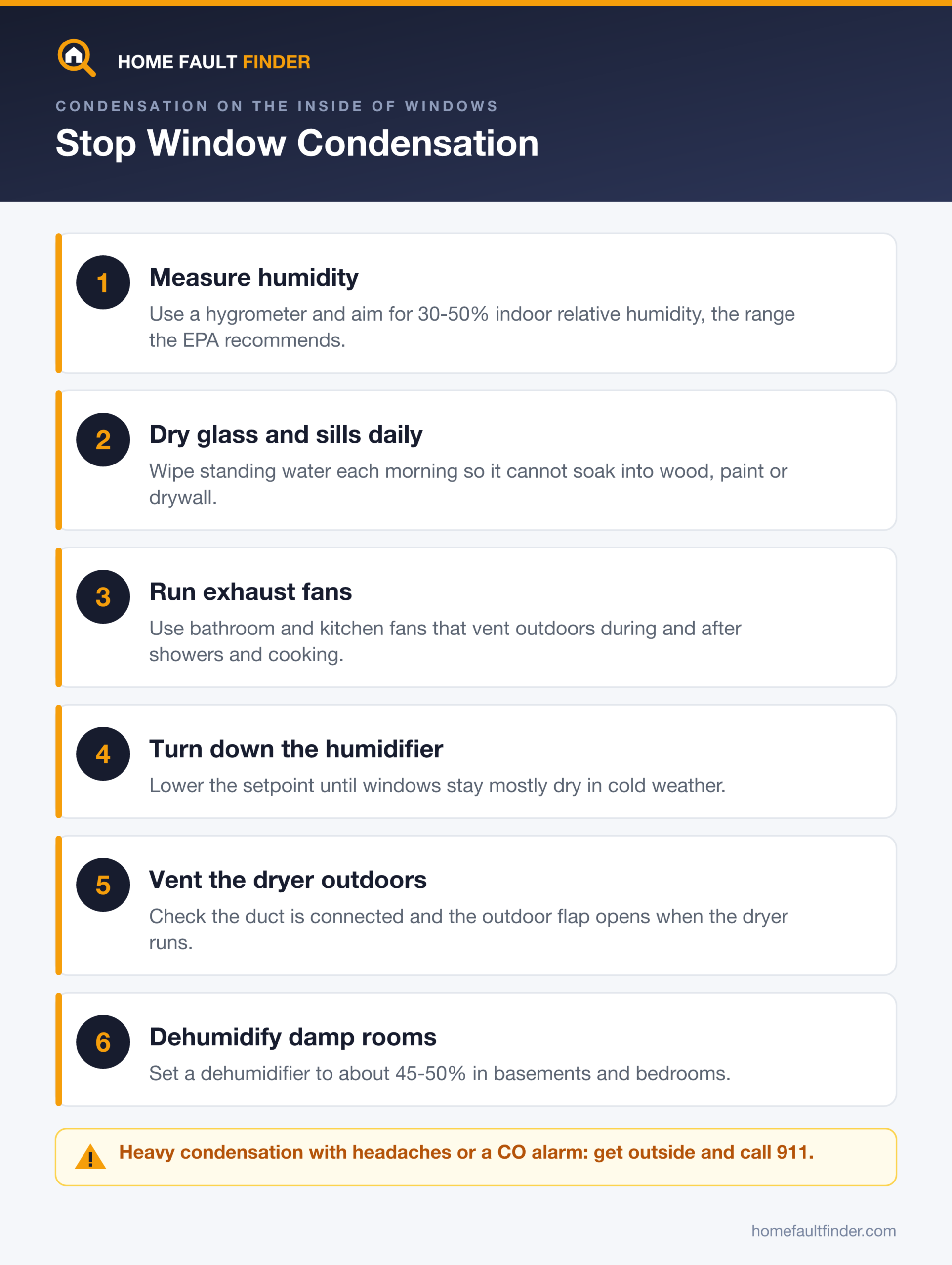
Stopping condensation on the inside of windows means lowering indoor humidity, removing moisture at its source, and keeping air moving across the glass. Most homes need a combination: a hygrometer to measure, exhaust fans that really vent outdoors, a lower humidifier setting, and a dehumidifier in damp rooms. Work through the steps in order, cheapest first.
-
Measure the humidity first
Put a digital hygrometer in the room with the worst windows for a few days. The EPA mold and moisture guide puts these meters at about $10-$50 (as of November 2026). Aim for 30-50%.
-
Dry the glass and sills each morning
Wipe standing water with a towel or squeegee so it cannot soak into wood, drywall or paint. Two minutes a day limits damage while you fix the cause.
-
Run bathroom and kitchen exhaust fans
Switch the fan on before showering or cooking and leave it running afterward. If it hums but barely moves air, see our guide to a bathroom exhaust fan that is not working.
-
Turn down the humidifier
Lower the setpoint until the windows stay mostly dry. If the unit behaves oddly, our humidifier troubleshooting guide covers the controls.
-
Vent the clothes dryer outdoors
Check that the duct is connected and the outdoor flap opens when the dryer runs.
-
Run a dehumidifier in damp rooms
Set it to about 45-50% in basements and bedrooms. If the bucket stays empty in a clearly damp room, read why a dehumidifier is not collecting water.
-
Let air reach the glass
Open blinds slightly, keep furniture off exterior walls and leave interior doors open.
Is condensation on the inside of windows bad?
Occasional light condensation on the inside of windows on the coldest mornings is not harmful, but daily fogging that runs down the glass and pools on the sill is a problem. Repeated wetting rots wood sills and frames, peels paint, stains drywall below the window, and gives mold the moisture it needs to grow.
The EPA treats condensation as a sign of high humidity and advises acting quickly to dry the wet surface and reduce the moisture source. Warning signs include dark spots on caulk or frame corners, soft wood on sills, and paint that bubbles below the window (see paint peeling and bubbling). For cleanup, the EPA says a moldy area under about 10 square feet, roughly 3 ft by 3 ft, can usually be handled by the homeowner following its guidelines; larger or recurring growth needs professional help. Never mix chlorine bleach with ammonia cleaners, which the EPA warns produces toxic fumes.
Why do new windows get more condensation?
New windows often seem to cause more condensation because replacing drafty old units makes the whole house tighter. Air leaks around old frames used to swap humid indoor air for dry outdoor air all winter. Once those leaks are sealed, everyday cooking, showering and breathing push humidity higher, so the remaining cold surfaces fog more easily.
The fix is the same humidity control described above, plus confirming that bathroom and kitchen fans truly vent outdoors. If a brand-new window shows fog between its panes, that is a seal defect, so contact the installer or manufacturer about the warranty.
When can window condensation signal a venting or CO problem?
Window condensation can sometimes point to a combustion appliance that is not venting properly. A furnace, boiler, gas water heater or wood stove whose exhaust spills back into the house releases water vapor along with carbon monoxide (CO), an odorless, colorless and toxic gas. Sudden, heavy condensation with no obvious new moisture source deserves attention.
According to the EPA page on carbon monoxide and indoor air quality, CO sources include unvented gas and kerosene space heaters, leaking chimneys and furnaces, back-drafting from furnaces, gas water heaters, wood stoves and fireplaces, and gas stoves. Symptoms include headaches, dizziness, nausea and flu-like symptoms that clear up after leaving home.
If condensation comes with headaches, nausea or dizziness in the household, or your CO alarm sounds, get everyone outside and call 911 or the fire department from outside. Do not hunt for the source yourself. Keep working CO alarms; see our guide to a carbon monoxide detector beeping. If you smell gas, leave the house and call the gas utility or 911 from outside.
What will not fix window condensation
Several popular quick fixes for window condensation hide the problem or make it worse. Heavier curtains, anti-fog sprays and endless wiping treat the symptom on the glass while the moist air keeps finding the next cold surface inside walls or behind furniture.
- Closing heavy curtains tighter traps cold air against the glass, so condensation increases behind them.
- Running a humidifier without measuring is a common cause; many homes with streaming windows are already above 50%.
- Replacing windows to fix inside fogging can backfire, because a tighter house holds more moisture unless ventilation improves too.
Our winterizing home checklist pairs well with these fixes, since ventilation is best serviced before the first cold snap.
Call a licensed HVAC or gas-appliance technician if heavy condensation appears suddenly while a furnace, boiler, gas water heater or fireplace is running, if you see soot or rust around appliance vents, or if anyone has CO-type symptoms. Vent and chimney inspections are not DIY jobs, and work on high windows or ladders is best left to professionals.
Call a window installer for fog between the panes or rotted frames, and a mold remediation professional if growth covers more than about 10 square feet or keeps returning.
Frequently asked questions
Does a dehumidifier stop window condensation?
A dehumidifier often stops window condensation in humid rooms such as basements and bedrooms by pulling water vapor out of the air. Set it to about 45-50% and confirm the reading with a hygrometer. During a severe cold spell, windows can still fog slightly at the bottom edge even when humidity is reasonable.
Is condensation on single-pane windows normal?
Condensation on single-pane windows is common in cold weather because a single sheet of glass gets much colder than insulated glass. Even moderate indoor humidity can fog it. Storm windows, interior film kits and lower humidity reduce it, but some fogging on the coldest mornings is expected with single-pane glass.
Why do only some of my windows get condensation?
Only some windows usually fog because they are the coldest or sit in the most humid rooms. North-facing glass, windows behind closed curtains, single-pane units, and windows in bedrooms, bathrooms and kitchens commonly fog first. A window much worse than its neighbors may also have worn weatherstripping or a cold metal frame.
Does condensation on the inside of windows mean the windows are bad?
Condensation on the inside surface usually does not mean the windows are bad; it means indoor humidity is high for the glass temperature. Old single-pane or metal-frame windows fog more easily, though. Fog trapped between the panes is different and does mean the sealed glass unit has failed and needs replacing.
Should I open windows in winter to reduce condensation?
Opening windows for 5-10 minutes in winter is an effective way to reduce condensation because cold outdoor air holds little moisture. A short, wide opening swaps humid indoor air without chilling walls and furniture. Leaving windows cracked all day wastes heat, so brief daily airing works better than a constant gap.