

A water stain on the ceiling almost always comes from one of six sources: a bathroom fixture above, a roof leak, an HVAC condensate drain, condensation on cold ducts, a leaking pipe, or an ice dam. Match the stain’s location and timing (after rain, after showers, during AC season) to the source, and dry the area within 24 to 48 hours.
- Growth after rain points to the roof, after showers to the bathroom above, and in AC season to the condensate drain.
- A damp or soft stain is an active leak; a dry, crisp ring unchanged for weeks is usually old.
- EPA advises drying wet materials within 24 to 48 hours; mold over about 10 square feet needs a professional.
- A sagging ceiling can collapse, and water near a light fixture is an electrical hazard: clear the room and cut that circuit.
This guide is for homeowners and renters who have just noticed a brown ring overhead. It shows how to read the stain, test whether the leak is active, and choose the right professional.
- What causes a water stain on the ceiling?
- What should you do first?
- Stain clue to likely source
- Is the stain active or old?
- Is the bathroom above leaking?
- Roof leak or ice dam?
- AC condensate or condensation?
- Does a stain mean mold?
- How to cover the stain
- Who should you call?
- Frequently asked questions
What causes a water stain on the ceiling?
A water stain on the ceiling is the mark left when water soaks into drywall or plaster and dries, carrying minerals and wood tannins to the surface. The six common sources are fixtures in the bathroom above, roof leaks, HVAC condensate, condensation on cold surfaces, leaking pipes, and ice dams along the eaves.
Water runs along joists and pipes to a low point, so the stain can sit several feet from the leak.
What should you do first when you find a ceiling stain?
The first step with a new ceiling stain is a safety check, not a repair. Look for sagging or bulging drywall, active dripping, and any light fixture, ceiling fan, or smoke alarm inside or near the wet area. Those three conditions decide whether you can investigate calmly or need to act within minutes.
A bulging or sagging ceiling may be holding pooled water and can give way without warning. Move people, pets, and belongings out from under it, set down a tarp and buckets, and do not push on it. Draining a bulge is a job for a plumber or water damage professional.
If water is near a light fixture or ceiling fan, do not touch it or its switch. Turn off that circuit at the breaker only if you can stand on a dry floor at the panel, and have an electrician check the fixture before power returns.
-
Stop the water you can control.
Stop using fixtures above the stain; close the fixture shutoff or main valve if water runs steadily.
-
Photograph and outline the stain.
Take dated photos and trace the edge in pencil to track growth.
-
Note the timing.
Write down whether it appeared after rain, a shower, AC use, or a cold snap.
-
Start drying.
Run a fan and a dehumidifier; EPA advises drying within 24 to 48 hours.
Which source matches your stain?
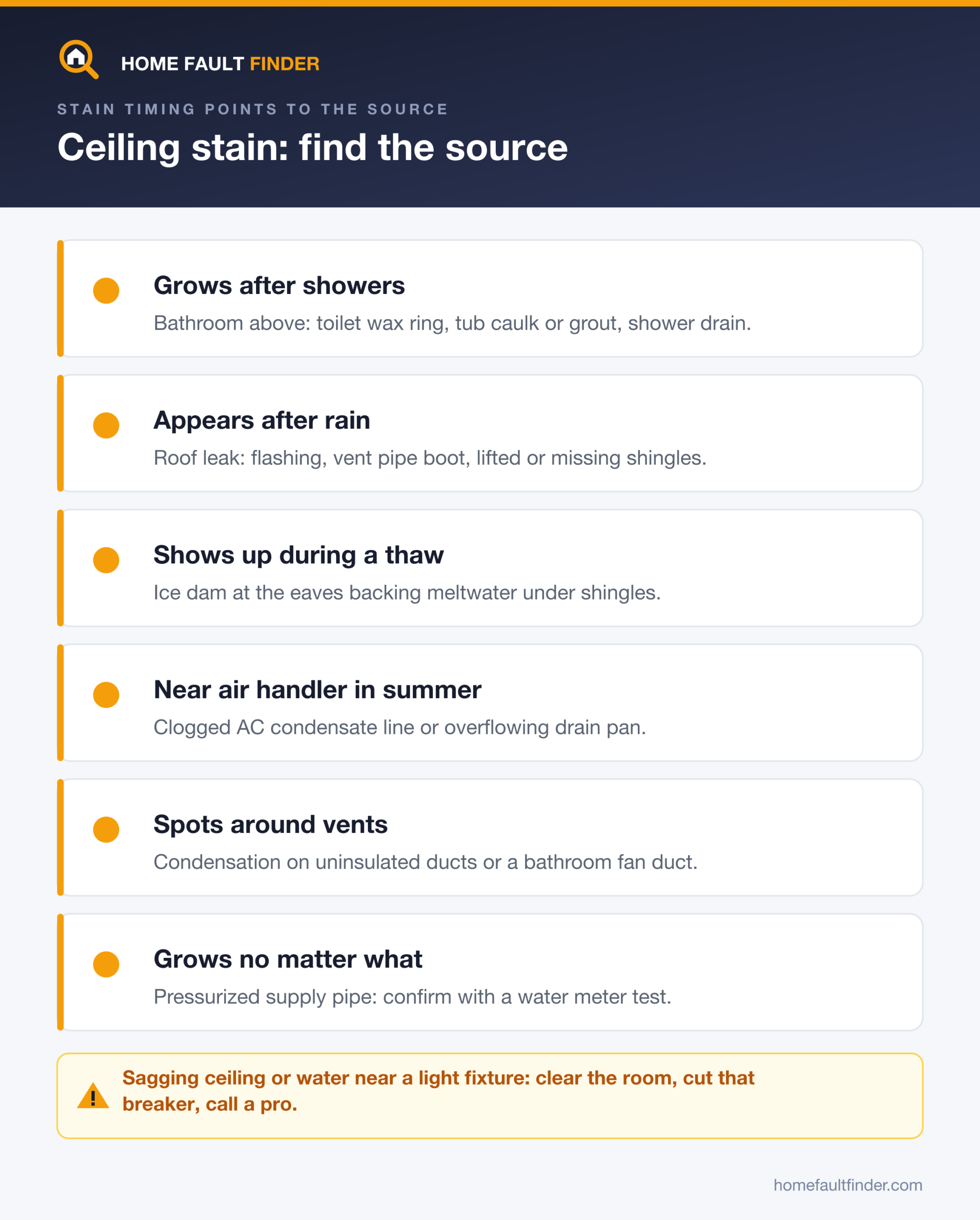
A ceiling stain decision table matches what you see, and when it changes, to the most likely source and the first thing to check. Start with the row that fits both the stain’s location and its timing. When two rows fit, check the easier fixture source first.
| What you notice | Likely source | Check first |
|---|---|---|
| Below a bathroom; grows after showers or flushing | Wax ring, tub caulk or grout, drain | Run each fixture separately |
| Grows only after rain | Flashing, vent pipe boot, shingles | Roof deck from the attic floor |
| Near an exterior wall during a snow thaw | Ice dam at the eaves | Ice ridge; attic insulation |
| Near the air handler in AC season | Clogged condensate line or pan | Drain pan at the indoor unit |
| Small spots around vents in humid weather | Sweating ducts or fan duct | Duct insulation in the attic |
| Grows regardless of weather or use | Pressurized supply pipe | Water meter test |
| Dry, crisp ring; no change for weeks | Old, repaired leak | Moisture reading, then prime |
How can you tell if a ceiling water stain is old or new?
A new or active ceiling water stain feels damp, soft, or cool, has darkening or fuzzy edges, and grows between checks. An old stain is dry and firm, with a crisp tide-line ring that stays the same size for weeks. Simple tests separate the two without opening the ceiling.
-
Touch test.
From a stable step stool, press gently near the edge; damp or soft drywall means water now. Skip it if the ceiling sags or a fixture is nearby.
-
Outline test.
Compare the pencil line after 24, 48, and 72 hours and after the next rain or shower.
-
Moisture meter test.
A clearly higher reading than dry ceiling nearby means trapped moisture.
-
Water meter test.
With every faucet and water appliance off, a meter that moves within 15 to 30 minutes suggests a hidden supply leak.
Is the bathroom above leaking through the ceiling?
A bathroom above the stain is the most common source of first-floor ceiling stains in two-story homes. The usual culprits are a failed toilet wax ring, cracked grout or missing caulk around a tub or shower, a loose shower drain, and slow drips at sink drain fittings. Testing each fixture separately usually finds the leak within an hour.
- Toilet: rock it gently; movement or water at the base points to the wax ring (see toilet leaking at the base).
- Tub and shower: look for gaps in caulk, cracked grout, and splash water over the tub edge.
- Shower drain: run only the shower at the drain for 10 minutes; a darkening stain implicates the drain gasket.
- Sink: check the P-trap and supply lines with a dry paper towel.
See also common plumbing problems.
Could a ceiling stain be a roof leak or an ice dam?
A roof leak is the likely cause of a top-floor ceiling stain that appears or grows after rain or wind-driven storms. Common entry points are flashing around chimneys and skylights, cracked rubber boots around plumbing vent pipes, and lifted or missing shingles.
An ice dam is a ridge of ice at the roof edge that forms when attic heat melts snow higher up and the water refreezes at the colder eaves. Meltwater backs up under the shingles and leaks near exterior walls, often during a thaw. Our home winterizing checklist covers insulation and gutter checks. From the attic floor, stepping only on joists, you can safely look for dark streaks or damp insulation under the roof deck.
Do not climb onto the roof or work from a ladder at the roof edge to find a leak or chip away an ice dam. Falls cause serious injuries. A licensed roofer can inspect flashing and shingles safely.
Could the air conditioner or condensation cause the stain?
An air conditioner produces condensate water whenever it cools, and in many homes the indoor air handler sits in the attic above a ceiling. When the condensate line clogs with algae or the drain pan rusts through, water overflows onto the drywall below, so these stains appear in summer near the air handler or a supply vent.
Our guide to an air conditioner leaking water inside explains how to clear the line; high-efficiency furnaces make condensate in winter, covered in furnace leaking water.
Condensation stains are small, scattered spots that grow in humid weather rather than after rain. Sweating attic ducts and bathroom fan ducts are typical; see bathroom exhaust fan not working.
What if there is no bathroom or fixture above the stain?
A ceiling stain with no fixture overhead often comes from a supply pipe, drain line, or appliance line running through the ceiling cavity. Pressurized supply leaks grow steadily whether or not anyone uses water, while drain leaks appear only when a specific sink, tub, or appliance upstairs drains.
In cold climates, a stain that appears during a thaw can mean a pipe split while frozen; our guide to frozen pipes explains where to shut the water off.
Does a water stain on the ceiling mean there is mold?
A water stain on the ceiling does not automatically mean mold, but drywall that stays damp for more than a day or two can grow it. The U.S. Environmental Protection Agency (EPA) says to dry water-damaged areas within 24 to 48 hours to prevent mold growth, and to fix the moisture source first.
According to EPA’s guide to mold and moisture, homeowners can usually clean mold covering less than about 10 square feet; larger areas call for professional help, and moldy ceiling tiles may have to be thrown away.
Popcorn and other textured ceilings in older homes, especially those built before the 1980s, may contain asbestos, and you cannot tell by looking. EPA advises treating doubtful material as if it contains asbestos and leaving it alone, because sanding, scraping, or drilling can release fibers. Have it tested by an accredited lab before cutting or scraping.
How do you cover a water stain on the ceiling?
Covering a water stain on the ceiling works only after the leak is repaired and the drywall has fully dried, which usually takes several days with fans running. A stain-blocking primer then seals the minerals and tannins so they do not bleed through.
-
Confirm the area is dry.
Repeat the outline or moisture test; early paint traps moisture.
-
Assess the drywall.
Soft or sagging drywall must be cut out and replaced, not painted.
-
Apply a stain-blocking primer.
Use one labeled for water stains and extend it a few inches past the edge.
-
Paint the whole ceiling plane.
Edge-to-edge paint hides the patch better than spot painting.
If paint has already bubbled over a past leak, see peeling or bubbling paint.
Who should you call for a water stain on the ceiling?
The right professional for a ceiling water stain depends on the source: a plumber for bathroom fixtures and pipes, a roofer for rain leaks and ice dams, and an HVAC technician for condensate and sweating ducts. A water damage restoration company handles sagging ceilings, large wet areas, and mold beyond about 10 square feet.
| Situation | Call | Why |
|---|---|---|
| Stain grows with bathroom fixture use | Plumber | Wax ring, drain, and supply repairs |
| Stain after rain or a snow thaw | Roofer | Flashing, shingles, and ice dams need roof access |
| Stain near air handler in AC season | HVAC technician | Condensate line, drain pan, duct insulation |
| Water near light fixtures or wiring | Electrician | Inspection before power is restored |
| Sagging ceiling or mold over about 10 sq ft | Water damage restoration | Controlled drying and removal |
Call a professional right away if the ceiling sags, water is near any electrical fixture, the leak needs roof or ladder work, mold covers more than about 10 square feet, or an older textured ceiling must be disturbed.
Frequently asked questions
Why is there a water stain on my ceiling but no leak?
A ceiling water stain with no visible leak is usually an old, repaired leak, an intermittent leak triggered only by wind-driven rain or certain fixtures, or condensation from ducts or a bathroom fan duct. Track the outline against the weather and check dampness with a moisture meter.
Can a ceiling water stain go away on its own?
A ceiling water stain does not fade on its own, because the brown color comes from minerals and tannins left in the drywall. The moisture can dry, but the mark stays. After the source is fixed and dry, stain-blocking primer and paint hide it.
Does homeowners insurance cover a ceiling water stain?
Coverage depends on your policy and the cause. Many policies cover sudden and accidental water damage, such as a burst pipe, but exclude long-term leaks, poor maintenance, or wear. Photograph the stain and call your insurer before repairs.
Why does my ceiling water stain keep coming back after painting?
A stain that returns after painting means the leak is still active or the stain bled through ordinary paint. If the area is truly dry, seal it with a stain-blocking primer before repainting.
Can a bathroom fan cause a water stain on the ceiling?
A bathroom exhaust fan can cause a ceiling stain when its duct runs through a cold attic without insulation or proper slope. Warm, humid air condenses inside the duct and drips back through the fan housing, leaving stains around the grille.