A furnace leaking water almost always has a drainage problem, not a broken burner. If the leak appears while the AC runs, the evaporator coil drain pan or condensate line is clogged or the coil froze. If it appears in heating mode, a high-efficiency (90%+ AFUE) furnace’s condensate line, trap or pump is blocked. Clearing a drain line costs about $75–$200.
- Set the thermostat to OFF and switch off the furnace service switch before you check any leak.
- Leaks during cooling usually come from the AC coil: a clogged condensate line, a cracked pan or a frozen coil.
- Leaks during heating usually come from a condensing furnace’s trap, drain line, pump or exhaust pipe joint.
- Drain clogs cost $75–$200 to clear; heat exchanger work runs $800–$3,000 or more (as of October 2026).
This guide is for homeowners who just found a puddle beside the furnace. The key clue is timing: the same puddle has different sources in summer and winter. We sort causes by when and where water appears, give safe checks, list costs, and mark where a licensed HVAC technician takes over.
- Why is my furnace leaking water?
- Is a furnace leaking water dangerous?
- Where is the water coming from?
- Why does the furnace leak when the AC is on?
- Why does the furnace leak when the heat is on?
- How do you fix a furnace leaking water?
- What will not fix a furnace leak?
- How much does it cost to fix a furnace leak?
- How do you stop the furnace from leaking again?
- Frequently asked questions
Why is my furnace leaking water?
A furnace leaking water is usually releasing condensation that lost its normal drain path. Two systems make water at the furnace: the air conditioner’s evaporator coil, which sits on top of the furnace and drips all summer, and a high-efficiency condensing furnace, which produces slightly acidic water whenever it heats.
A condensing furnace is a gas furnace that pulls extra heat from its exhaust with a secondary heat exchanger, turning water vapor into liquid that drains through a plastic trap to a floor drain or condensate pump. These furnaces are typically rated around 90% AFUE (Annual Fuel Utilization Efficiency) or higher and vent through white PVC pipes. Older 80% furnaces use metal flue pipe and should not make liquid water. Also rule out a nearby humidifier, water heater or overhead pipe.
Is a furnace leaking water dangerous?
Furnace leaks are usually a drainage nuisance, but water near a furnace becomes dangerous in two ways: it can reach the control board, wiring and blower motor, and it can signal corrosion of the heat exchanger that separates flames from your household air. Shut the system down first, then investigate.
Set the thermostat to OFF, then turn off the furnace service switch (a light-style switch on or near the cabinet) or the furnace breaker. If the floor around the switch is flooded, do not stand in the water; call a pro.
If you smell gas, do not operate any switches. Leave the house and call the gas utility or 911 from outside. If a carbon monoxide alarm sounds, get everyone outside and call 911; our guide to a carbon monoxide detector beeping explains the alarm patterns.
The serious warning signs are rust or water inside the burner compartment, scorch marks near the burners, or water dripping from the flue of an older 80% furnace. Carbon monoxide is odorless, and the EPA notes that faulty combustion appliances are a major indoor source, so leave the furnace off until a technician inspects it.
Where is the water coming from?
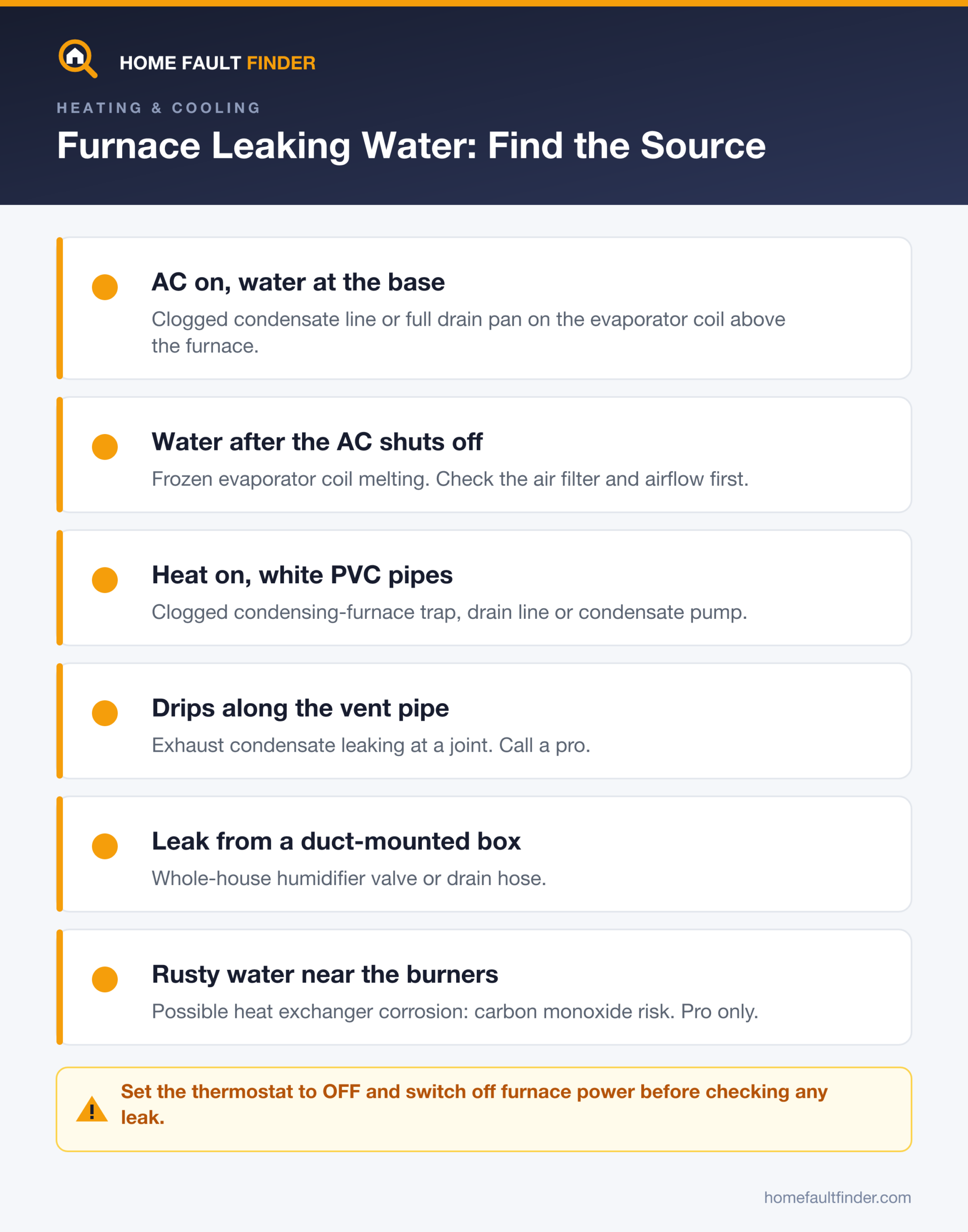
The fastest way to find a furnace leak is to match when the water appears with where it collects. The decision table below sorts the common failure points of central HVAC systems; start at the first row that fits and check the cheapest, most accessible part first.
| When and where you see water | Most likely source | Who checks it |
|---|---|---|
| Summer, AC running; water around the furnace base | Clogged AC condensate line or full coil drain pan | Homeowner (line), pro (pan) |
| Summer, water after the AC shuts off; weak airflow | Frozen evaporator coil melting | Homeowner (filter), pro (refrigerant) |
| Any season, leak beside a small box with a tube | Failed or unplugged condensate pump | Homeowner (power, float) |
| Winter, heat running; white PVC pipes on the furnace | Clogged condensing-furnace trap or drain line | Homeowner (visual), pro (trap) |
| Winter, drips along PVC vent pipe joints | Exhaust condensate leaking at a joint | Pro |
| Winter, leak from a box on the duct above | Whole-house humidifier valve or drain | Homeowner (supply valve), pro |
| Rusty water inside the burner compartment | Corroded heat exchanger | Pro only; carbon monoxide risk |
Why does the furnace leak when the AC is on?
A furnace leaking water while the air conditioner runs is really an AC leak. The evaporator coil sits in a cabinet on top of the furnace, pulls humidity from the air and drips it into a drain pan that empties through a condensate line. When that path fails, water spills onto and around the furnace.
- Clogged condensate line. Algae and sludge build up inside the PVC line, water backs up and the pan overflows. Many systems have a safety float switch that shuts the AC off when the pan fills.
- Frozen evaporator coil. A dirty filter, closed vents or low refrigerant let ice build, then it melts faster than the pan drains. See our guide to an air conditioner freezing up.
- Cracked or rusted drain pan. Water bypasses the drain entirely.
- Failed condensate pump or a disconnected, badly sloped line.
More detail from the AC side: air conditioner leaking water inside.
Why does the furnace leak when the heat is on?
A furnace leaking water in heating mode is almost always a high-efficiency condensing furnace. Condensing models produce acidic condensate whenever they run, and the water travels through a trap, internal hoses and a drain line or pump. A blockage or failed part anywhere along that path sends water out of the cabinet.
- Clogged trap or drain line. Sediment collects in the plastic trap. Many furnaces then stop with a pressure switch fault, so a leak plus a furnace that will not start often share one cause; see furnace not turning on.
- Failed condensate pump. Winter is peak load, and a worn motor or stuck float shows up first as a puddle.
- Exhaust vent problems. Condensate in the PVC exhaust should drain back into the furnace; a loose or wrongly sloped joint leaks instead.
- Humidifier leaks. A stuck valve or plugged drain hose on a duct-mounted humidifier drips onto the furnace.
- Cracked secondary heat exchanger. Rusty water inside the cabinet is the clue; only a technician can confirm it.
How do you fix a furnace leaking water?
Fixing a furnace leak yourself is limited to the drain parts: the filter, the condensate line, the condensate pump’s power and float, and visible tubing. With the thermostat off and furnace power switched off, work through these steps in order; most take 10–30 minutes and cost little or nothing.
-
Shut down and dry the area
Thermostat OFF, service switch off. Soak up water with towels or a wet/dry vacuum so you can see where new water appears.
-
Replace a dirty air filter
A clogged filter is the most common reason a coil freezes, and it is the cheapest fix on this list. Our HVAC filter replacement schedule shows how often to change each type.
-
Inspect the condensate line
Find the 3/4 in. PVC pipe leaving the coil cabinet or furnace trap, often with a capped T-vent. Follow it to the floor drain, pump or outside and look for kinks or a loose joint.
-
Clear the line
Hold a wet/dry vacuum on the outlet end for 1–2 minutes. Then remove the T-vent cap and pour about a cup of warm water, or distilled white vinegar if your manual allows it, to confirm it flows.
-
Check the condensate pump
Confirm it is plugged in and the outlet works. With power restored, pour water into the reservoir: the float should lift and the motor run. If not, the pump likely needs replacing. Never tape, prop or bypass a safety float switch.
-
Inspect the trap and hoses
On a condensing furnace, look for loose clamps, cracks or a slipped hose. Remove and rinse the trap only if your manual shows how; otherwise leave it to a technician.
-
Restart and watch one cycle
Run the mode that leaked for 20–30 minutes. If the leak returns, turn the system off and book a service visit.
What will not fix a furnace leak?
Furnace leak shortcuts often hide the real problem or create a new one. The goal of every fix is to restore the drain path so water leaves the house, not to stop it from showing up, and a few popular shortcuts can damage the furnace or mask a carbon monoxide warning sign.
- Bypassing a safety float switch trades a no-cooling call for a flooded floor or ceiling.
- Bleach or harsh drain cleaner can damage pump and drain parts; check the manual.
- Running the furnace with water inside the cabinet can short the control board.
- Taping a leaking vent joint can hide an exhaust leak.
- Ignoring rust near the burners overlooks a heat exchanger warning.
How much does it cost to fix a furnace leak?
Furnace leak repairs range from about $75 for clearing a drain line to $3,000 or more for a heat exchanger, as of October 2026. Drain and pump problems cause most leaks, so the typical bill stays at the low end. A diagnostic visit usually adds $75–$150, often credited toward the repair.
| Repair (parts and labor) | Typical cost range | Notes |
|---|---|---|
| Condensate drain line clearing | $75–$200 | Snaking, flushing, minor trap work |
| Humidifier repair or seal | $100–$350 | Valve, gasket or bypass work |
| Secondary drain pan replacement | $100–$400 | Metal pans cost more |
| Condensate pump replacement | $150–$400 | Depends on pump type and access |
| Exhaust pipe re-route or repair | $200–$800 | Stops condensate leaking from the vent |
| Heat exchanger repair or replacement | $800–$3,000+ | Often tips older furnaces toward replacement |
For a broader view of furnace parts and when replacement beats repair, see our guide to furnace repair cost.
How do you stop the furnace from leaking again?
Preventing furnace leaks comes down to keeping the condensate path clean and the airflow strong. A clogged drain and a dirty filter cause most repeat leaks, and both are cheap to maintain with a short checklist before cooling season and before heating season.
- Check the air filter every 1–3 months.
- Flush the AC condensate line with warm water each spring.
- Listen for the condensate pump cycling and clean its reservoir yearly.
- Book an annual tune-up covering the trap, drain, venting and combustion; high-efficiency equipment such as ENERGY STAR furnaces relies on a working condensate drain.
Call a licensed HVAC technician if water is inside the burner compartment, the cabinet shows rust or scorch marks, the leak comes from the exhaust pipe, the coil stays iced after a filter change (possible low refrigerant, which needs an EPA-certified technician), or the leak returns after you cleared the drain.
Do not attempt repairs on the burners, gas valve, heat exchanger or venting. If you smell gas, leave the house and call the gas utility or 911 from outside.
Frequently asked questions
Is it normal for a furnace to leak a little water?
No visible water should leave a working furnace. A condensing furnace makes water all winter, but it should travel through the trap and drain line without dripping. Even small, repeated drips mean a loose fitting or partial clog that tends to grow.
Can I still run my furnace if it is leaking water?
Running a leaking furnace is not recommended. Water can reach the control board and blower motor, and some leaks signal a heat exchanger problem. Turn the system off, dry the area and fix the drain first.
Why is my furnace leaking water when the AC is off?
A furnace leaking water with the AC off usually points to the furnace itself or nearby equipment. On a high-efficiency furnace, check the condensate trap, drain line and pump. Also check a duct-mounted humidifier and the water heater beside the furnace, since both often leak onto the same floor area.
Can a clogged furnace filter cause a water leak?
A clogged filter can cause a leak indirectly. It cuts airflow across the AC evaporator coil, the coil freezes, and the melting ice overwhelms the drain pan. Replacing a dirty filter is an inexpensive DIY job and should be the first check whenever water appears during cooling season with weak vent airflow.
Does homeowners insurance cover a leaking furnace?
Homeowners policies typically cover sudden water damage to floors and walls but exclude wear, corrosion and poor maintenance, so the furnace part itself is rarely covered. Coverage varies, so call your insurer before repairs if water damaged finished surfaces.