Furnace repair cost in the US typically runs $349–$650, with a national average near $485 (Fixr), as of October 2026. Small fixes such as a flame sensor or limit switch can stay under $130, while an inducer motor costs $300–$900 and a cracked heat exchanger $1,000–$3,200 or more, which usually tips the decision toward replacement.
- Most furnace repairs land between $349 and $650; the full range runs from about $66 to over $2,600.
- A diagnostic or service call costs $75–$150 and is often credited toward the repair if you hire the same company.
- After-hours and emergency calls commonly add $100–$350 or raise the hourly rate by 50% or more.
- Multiply the furnace’s age by the repair quote: above roughly $5,000, replacement usually makes more financial sense.
- A gas smell, a carbon monoxide alarm or a cracked heat exchanger is a safety emergency first and a cost question second.
This guide is for homeowners who have a quote in hand, or are about to call a technician, and want to know whether the number is fair. We break the bill into parts, labor and fees, and give a simple test for when repairing an older furnace stops making sense.
Every price below is a dated range from published cost guides; use it to judge a quote, not to replace one.
- How much does furnace repair cost on average?
- What does each furnace repair cost?
- How much is a furnace service call?
- Why do furnace repair quotes vary so much?
- Which checks can you do before paying for a visit?
- Is it worth repairing an old furnace?
- What does a cracked heat exchanger mean for cost?
- When is a furnace problem a safety emergency?
- How can you lower repair costs safely?
- Frequently asked questions
How much does furnace repair cost on average?
Furnace repair in the United States costs $349–$650 for most jobs, with a national average of about $485, according to Fixr’s cost guide (updated August 2025, still the current version as of October 2026). The cheapest visits, around $66, cover a simple switch; the most expensive, near $2,673, involve a heat exchanger.
A furnace repair bill has three parts: the service call or diagnostic fee, labor, and the part itself. Fixr puts HVAC technician labor at $87–$162 per hour depending on region. Most repairs take one to two hours on site, so labor often costs more than the part itself.
What does each furnace repair cost?
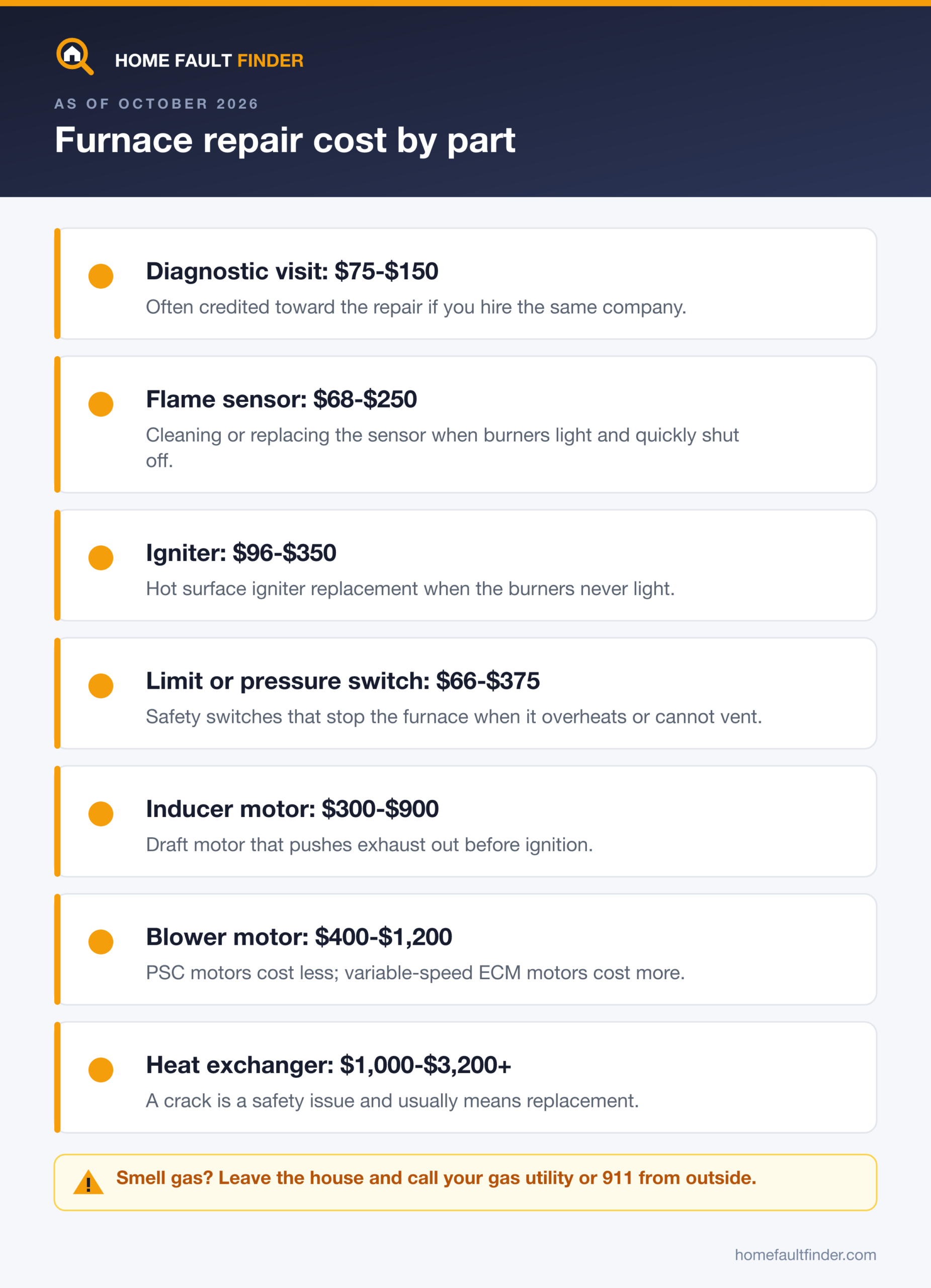
Furnace repair prices by part range from under $130 for a flame sensor or limit switch to several thousand dollars for a heat exchanger, as of October 2026. The table below combines published ranges for part plus labor; where sources disagree, we show the full spread so you can see where a quote falls.
| Repair (part + labor) | Typical cost range | What it fixes |
|---|---|---|
| Diagnostic / service call | $75–$150 | Visit and fault diagnosis; often credited toward the repair |
| Flame sensor clean or replace | $68–$250 | Burners light, then shut off after a few seconds |
| Limit switch | $66–$375 | Furnace overheats or shuts down and restarts repeatedly |
| Thermocouple (standing-pilot furnaces only) | $80–$150 | Pilot light will not stay lit |
| Hot surface igniter | $96–$350 | Inducer runs but burners never light |
| Pressure switch | $150–$350 | Inducer runs, no ignition, pressure-switch error code |
| Gas valve | $150–$750 | No gas flow to burners despite a good igniter |
| Control board | $200–$725 | No response, random shutdowns, error codes |
| Draft inducer motor | $300–$900 | Loud whine or no venting, furnace will not start |
| Blower motor (PSC to ECM) | $400–$1,200 | No airflow from vents, humming without air |
| Heat exchanger | $1,000–$3,200+ | Cracks, soot, carbon monoxide risk |
Variable-speed ECM blower motors cost far more than single-speed PSC motors, which explains most of the blower spread. If your symptom matches a specific fault, our guides to a furnace that is not turning on and a furnace blowing cold air explain which part is most likely behind it, so you can ask better questions when the technician arrives.
How much is a furnace diagnostic or service call?
A furnace diagnostic or service call usually costs $75–$150, according to PICKHVAC’s 2026 parts guide, and many companies apply that fee to the repair if you approve the work the same day. The fee pays for travel and the time needed to test the ignition sequence, safeties and electrical components.
Ask on the phone whether the fee is credited and whether it changes after hours. A written diagnosis that names the failed part and lists the part and labor costs separately makes it much easier to compare a second quote.
Why do furnace repair quotes vary so much?
Furnace repair quotes vary because five things change the labor, the part price or both: the time you call, the fuel type, how easy the furnace is to reach, the brand and model, and local labor rates. Two homeowners with the same failed igniter can pay bills that differ by $200 or more.
- Emergency, weekend and holiday calls. PICKHVAC reports after-hours premiums of $100–$350, or 50% or more on the hourly rate, and Fixr notes some companies raise winter fees.
- Fuel type. Electric furnaces have no burners, gas valve, igniter or inducer, so repairs are simpler; oil furnaces add burner service.
- Access and parts. Attic and crawl-space furnaces take longer, and proprietary boards or back-ordered parts can add a second trip charge.
- Region. Labor runs $87–$162 per hour across the US (Fixr), so the same job costs more in high-cost metro areas.
Which checks can you do before paying for a visit?
Several furnace no-heat calls turn out to be a setting, a switch or a clogged filter, and checking them first can save a $75–$150 service call. These checks are safe for homeowners because none of them involves opening the burner compartment, touching gas parts or working inside the electrical panel.
-
Check the thermostat
Set it to Heat, 3–5°F above room temperature, and replace weak batteries. Time: 5 minutes. Cost: $0–$5.
-
Replace a dirty air filter
A clogged filter can trip the limit switch and shut the burners off. Swap it for one of the size printed on the frame; see our guide on how often to change an HVAC filter. Time: 5 minutes. Cost: about $10–$40.
-
Confirm the furnace switch is on
Make sure the light-switch-style service switch near the unit is on and the blower door is fully closed.
-
Look for a tripped breaker
Check whether the furnace breaker handle sits in the middle or off position and reset it once. Do not remove the panel cover. If it trips again, stop and call an electrician or HVAC technician.
-
Clear the condensate drain and vent pipes
High-efficiency furnaces shut down when the condensate line backs up. Look for standing water and clear snow or leaves from outdoor vent pipes.
Do not adjust the gas valve, remove burners, bypass a limit or pressure switch, or open the furnace’s control compartment. Those parts are safety devices on a gas appliance; work on them belongs to a licensed technician.
Is it worth repairing an old furnace?
Repairing an old furnace is worth it when the repair cost multiplied by the furnace’s age stays under about $5,000, and when the quote is less than half the price of a new installed furnace. Fixr puts a new furnace at $2,800–$7,500, with a $4,800 national average, as of its January 2026 update.
Most furnaces last 15 to 20 years with routine maintenance, according to Fixr, and electric furnaces often run longer. The rules of thumb below turn age and price into one comparable number; for furnaces over 12 years old, the age-times-cost result is usually the better guide.
| Example | Age × repair | Share of a $4,800 new furnace | Usual call |
|---|---|---|---|
| 8-year-old gas furnace, $450 inducer motor | 8 × $450 = $3,600 | 9% | Repair |
| 12-year-old furnace, $350 igniter | 12 × $350 = $4,200 | 7% | Repair |
| 16-year-old furnace, $725 control board | 16 × $725 = $11,600 | 15% | Plan replacement; repair only as a stopgap |
| 14-year-old furnace, $2,500 heat exchanger | 14 × $2,500 = $35,000 | 52% | Replace |
Repair history matters too: two major repairs in two winters usually signal more to come. So does efficiency: an older unit near 80% AFUE wastes far more fuel than a modern 95%+ model, and ENERGY STAR’s furnace guidance lists the efficiency levels that qualify. If you are weighing cooling at the same time, our AC repair vs replace cost guide uses the same math.
What does a cracked heat exchanger mean for cost?
A cracked heat exchanger is the most expensive common furnace repair, at about $1,000–$3,200 or more installed as of October 2026, and it is also a safety problem. The heat exchanger is the metal chamber that keeps combustion gases, including carbon monoxide, separated from the air blown through your home.
A crack in a furnace older than about 10–12 years almost always points to replacement. On a newer furnace, check the manufacturer’s warranty first, since it may cut the bill to labor only. A technician who finds a crack will usually shut the furnace off; do not restart it.
When is a furnace problem a safety emergency?
A furnace problem becomes a safety emergency when you smell gas, a carbon monoxide alarm sounds, you see soot or scorch marks around the furnace, or anyone in the home has headaches, dizziness or nausea that ease outdoors. In those cases cost comes second; the first step is getting everyone out.
If you smell gas, leave the house now without flipping switches, and call your gas utility or 911 from outside. Do not try to find the leak.
If a carbon monoxide alarm sounds, get everyone outside and call 911. Our guide to a carbon monoxide detector beeping explains alarm patterns.
Call a licensed HVAC technician for any gas valve, burner, igniter, inducer, heat exchanger, flue or control board work, and for odd odors described in our furnace smells bad guide.
How can you lower furnace repair costs without cutting corners?
Lowering furnace repair costs safely comes down to avoiding emergency rates, preventing the failures that cause most calls, and comparing written quotes. None of these steps requires touching gas or electrical parts, and together they can trim a bill by a few hundred dollars.
- Schedule a fall tune-up. Off-season visits avoid peak pricing and catch a dirty flame sensor early.
- Change filters on schedule. Restricted airflow overheats the furnace and trips the limit switch, a common cause of furnace short cycling.
- Wait for business hours when it is safe. A furnace that runs poorly but poses no safety risk can often wait until morning.
- Get an itemized quote and check the warranty. Ask for the part name, part cost and labor hours; a manufacturer parts warranty may cut the bill to labor only. Over about $500, a second opinion is reasonable.
A small annual home maintenance fund makes a surprise furnace bill much easier to absorb without borrowing.
Frequently asked questions
How long does a typical furnace repair take?
Most single-part furnace repairs, such as an igniter, flame sensor, limit switch or pressure switch, take about 30 minutes to 2 hours on site once the technician has the part. Blower motors, inducer motors and control boards can take 2–4 hours, and a heat exchanger can take a full day.
Is it cheaper to get a furnace repaired in summer?
Furnace repair is often cheaper outside the heating season because technicians have open schedules, emergency and after-hours premiums do not apply, and some companies raise fees in winter. A fall tune-up also catches worn igniters and dirty flame sensors before the first cold snap.
Can I replace a furnace igniter myself?
We recommend leaving igniter replacement to a licensed HVAC technician. The igniter sits in the burner compartment of a gas appliance, the correct replacement depends on the model, and a wrong part or poor connection can cause failed ignition. The part is cheap, but the diagnosis is what you pay for.
What is the most expensive furnace repair?
A cracked heat exchanger is the most expensive common furnace repair, at about $1,000 to $3,200 or more as of October 2026. Variable-speed blower motors and proprietary control boards are next, often $600 to $1,200 and $390 to $725 respectively.
Why does my furnace keep needing the same repair?
A repeat repair usually means the root cause was missed. A limit switch that keeps tripping often points to a clogged filter or closed vents, a flame sensor that keeps fouling can signal combustion problems, and repeat pilot failures may trace to a draft or a worn thermocouple. Ask the technician what caused the failure.