

Heat pump vs furnace comes down to climate and fuel prices. A heat pump (about $5,000–$15,000 installed as of October 2026) heats and cools, and fits mild, mixed, and many cold climates. A gas furnace ($3,800–$10,000) is cheaper to run where natural gas is cheap and winters often drop below 5°F.
- Fixr puts a heat pump at $5,000–$15,000 installed and a natural gas furnace at $3,800–$10,000 (January 2026).
- At October 2026 national-average prices, a 95% AFUE gas furnace delivers heat for about $15 per million Btu, versus roughly $21 for a typical heat pump.
- A heat pump beats propane ($31), heating oil ($52), and electric resistance heat ($53) per million Btu by a wide margin.
- ENERGY STAR cold-climate heat pumps must keep at least 70% of their capacity and a COP of 1.75 at 5°F.
Choosing between a heat pump and a furnace locks in your heating costs for 10 to 20 years. This guide is for homeowners whose furnace or AC is aging.
- What is the difference between a heat pump and a furnace?
- Heat pump vs furnace side by side
- Which costs more to install?
- Which is cheaper to run?
- Is a heat pump more efficient than a furnace?
- Do heat pumps work in cold climates?
- What is a dual-fuel (hybrid) system?
- Which lasts longer and needs less maintenance?
- Which should you choose for your climate?
- What should a contractor check before you switch?
- Frequently asked questions
What is the difference between a heat pump and a furnace?
A heat pump is an electric system that moves heat from outdoor air into your home in winter and reverses to pull heat out in summer. A furnace creates heat by burning natural gas, propane, or oil, or by running electric resistance coils, and blows that warm air through ducts. Only the heat pump also cools.
Because a heat pump moves heat rather than making it, it can deliver two to three units of heat for each unit of electricity in mild weather, a coefficient of performance (COP) of 2 to 3. A furnace always delivers less heat than the fuel it burns.
A ducted heat pump replaces the outdoor AC unit too, so the real comparison is usually heat pump versus furnace plus AC.
Heat pump vs furnace side by side
Heat pumps and furnaces differ on eight practical points: installed price, running cost, efficiency rating, cold-weather output, cooling, fuel and hookups, lifespan, and combustion safety. Sources and dates sit under the table; running costs come from our calculation below.
| Factor | Air-source heat pump (ducted) | Gas furnace |
|---|---|---|
| Installed cost | $5,000–$15,000 (average $8,350) | $3,800–$10,000 natural gas; all furnaces $2,800–$7,500 (average $4,800) |
| Heat cost per million Btu delivered (national average prices) | About $21 seasonal; $18 in mild weather; $30 at 5°F | About $15 at 95% AFUE; $18 at 80% AFUE |
| Efficiency rating | HSPF2 (heating) and SEER2 (cooling); ENERGY STAR split systems ≥7.8 HSPF2 and ≥15.2 SEER2 | AFUE; ENERGY STAR gas furnaces ≥95% (US South) or ≥97% (US North) |
| Cold-weather output | Capacity and efficiency drop as it gets colder; cold-climate models keep ≥70% capacity at 5°F | Full output at any outdoor temperature |
| Cooling | Yes, built in | No; needs a separate central AC ($5,000–$12,000) |
| Fuel and hookups | Electricity only; may need a larger breaker or panel upgrade | Gas line, meter, and venting; new gas line $500–$2,000 |
| Typical lifespan | 10–15 years | 15–20 years |
| Carbon monoxide risk from the unit | None (no combustion) | Yes; needs working CO alarms and sound venting |
Which costs more to install?
A heat pump costs more to install than a furnace alone, but often less than a furnace plus central air. Fixr lists heat pump installation at $5,000–$15,000 with an $8,350 national average, against $4,800 on average for a furnace, as of its January 2026 updates. Add a $5,000–$12,000 central AC and the furnace route usually costs more.
Fixr shows electric furnaces at $1,800–$7,300, natural gas at $3,800–$10,000, propane at $3,700–$14,200, and oil at $6,700–$10,000. A new gas line adds $500–$2,000, per Fixr’s gas line guide. Heat pump extras can include a new circuit or panel upgrade and duct repairs; our AC installation cost guide explains what to check in each quote.
Which is cheaper to run?
Running cost for a heat pump versus a furnace depends almost entirely on your local electricity and fuel prices. At October 2026 national averages, a 95% AFUE natural gas furnace delivers heat for about $15.19 per million Btu, a typical heat pump for about $21.36, and propane about $31.42.
We converted each price to the cost of one million Btu (MMBtu) of heat delivered, using EIA heat contents: 1,036 Btu per cubic foot of natural gas, 91,452 Btu per gallon of propane, 138,500 Btu per gallon of heating oil, and 3,412 Btu per kWh. Heat pump seasonal efficiency is HSPF2 divided by 3.412, so an 8.5 HSPF2 unit averages a coefficient of performance (COP) of about 2.5.
| System | Price used | Efficiency | Cost per MMBtu delivered | Example: 50 MMBtu winter |
|---|---|---|---|---|
| Gas furnace, 95% AFUE | $14.95 per Mcf | 95% | $15.19 | $760 |
| Gas furnace, 80% AFUE | $14.95 per Mcf | 80% | $18.04 | $902 |
| Heat pump, mild weather | 18.16¢ per kWh | COP 3.0 | $17.74 | — |
| Heat pump, seasonal average | 18.16¢ per kWh | COP 2.5 (8.5 HSPF2) | $21.36 | $1,068 |
| Heat pump at 5°F | 18.16¢ per kWh | COP 1.75 | $30.41 | — |
| Propane furnace, 95% AFUE | $2.730 per gallon | 95% | $31.42 | $1,571 |
| Oil furnace, 87% AFUE | $6.233 per gallon | 87% | $51.73 | $2,587 |
| Electric furnace or baseboard | 18.16¢ per kWh | COP 1.0 | $53.22 | $2,661 |
Against propane, oil, or baseboard heat, the heat pump wins easily; against gas, local rates decide. Quick rule: take your gas price per therm from your bill and multiply it by 0.09. If your all-in electricity price per kWh is lower than that number, a heat pump averaging COP 2.5 is cheaper to run than a 95% gas furnace. At $1.50 per therm the break-even is about 13.4¢ per kWh; at $2.00 per therm it is about 17.9¢.
Is a heat pump more efficient than a furnace?
A heat pump is more energy efficient than any furnace, because it moves two to three units of heat for each unit of electricity in mild weather, while a furnace converts at most about 98% of its fuel into heat. Efficiency is not cost: electricity usually costs more per Btu than gas.
The two systems use different ratings. HSPF2 (Heating Seasonal Performance Factor 2) measures seasonal heating output in Btu per watt-hour; SEER2 measures cooling. AFUE (Annual Fuel Utilization Efficiency) is the share of a furnace’s fuel that becomes heat. The ENERGY STAR heat pump criteria require at least 7.8 HSPF2 and 15.2 SEER2 for split systems; ENERGY STAR oil furnaces need at least 87% AFUE.
Do heat pumps work in cold climates?
Heat pumps do work in cold climates, but a standard model loses heating capacity and efficiency as outdoor temperatures fall, so many need backup heat on the coldest days. Cold-climate heat pumps are built for this: ENERGY STAR requires them to keep a COP of at least 1.75 and at least 70% of their rated capacity at 5°F.
At 5°F that COP costs about $30 per MMBtu in our table, roughly double a gas furnace, so hours spent in the single digits matter more than the record low. Weeks below 0°F usually call for fuel-fired backup. If yours blows cold air for long stretches, see our guide to a heat pump not heating.
What is a dual-fuel (hybrid) system?
A dual-fuel system, also called a hybrid heat pump, pairs an electric heat pump with a gas or propane furnace on the same ducts. The heat pump handles cooling and most heating, and the thermostat switches to the furnace below a set outdoor temperature or when gas becomes cheaper.
To estimate the economic switchover, divide your electricity cost per MMBtu by your gas cost per MMBtu delivered; the furnace is cheaper whenever the heat pump’s COP falls below that ratio. At national prices that ratio is about 3.5; at 12¢ per kWh it falls to about 2.3, and the heat pump carries most of the winter.
Which lasts longer and needs less maintenance?
A furnace usually lasts longer than a heat pump. Fixr gives most furnaces 15 to 20 years with annual tune-ups, oil furnaces up to 25, and electric furnaces 20 to 30, while heat pumps typically last 10 to 15 years because the compressor also runs all summer.
Both need regular filter changes and a yearly tune-up (Fixr lists $70–$300 for a furnace); keep the outdoor unit clear of snow. A furnace also needs its venting and heat exchanger inspected; a cracked heat exchanger is a CO hazard and a costly fix in our furnace repair cost guide. Keep working CO alarms; if one chirps, see our guide to a carbon monoxide detector beeping.
Which should you choose for your climate?
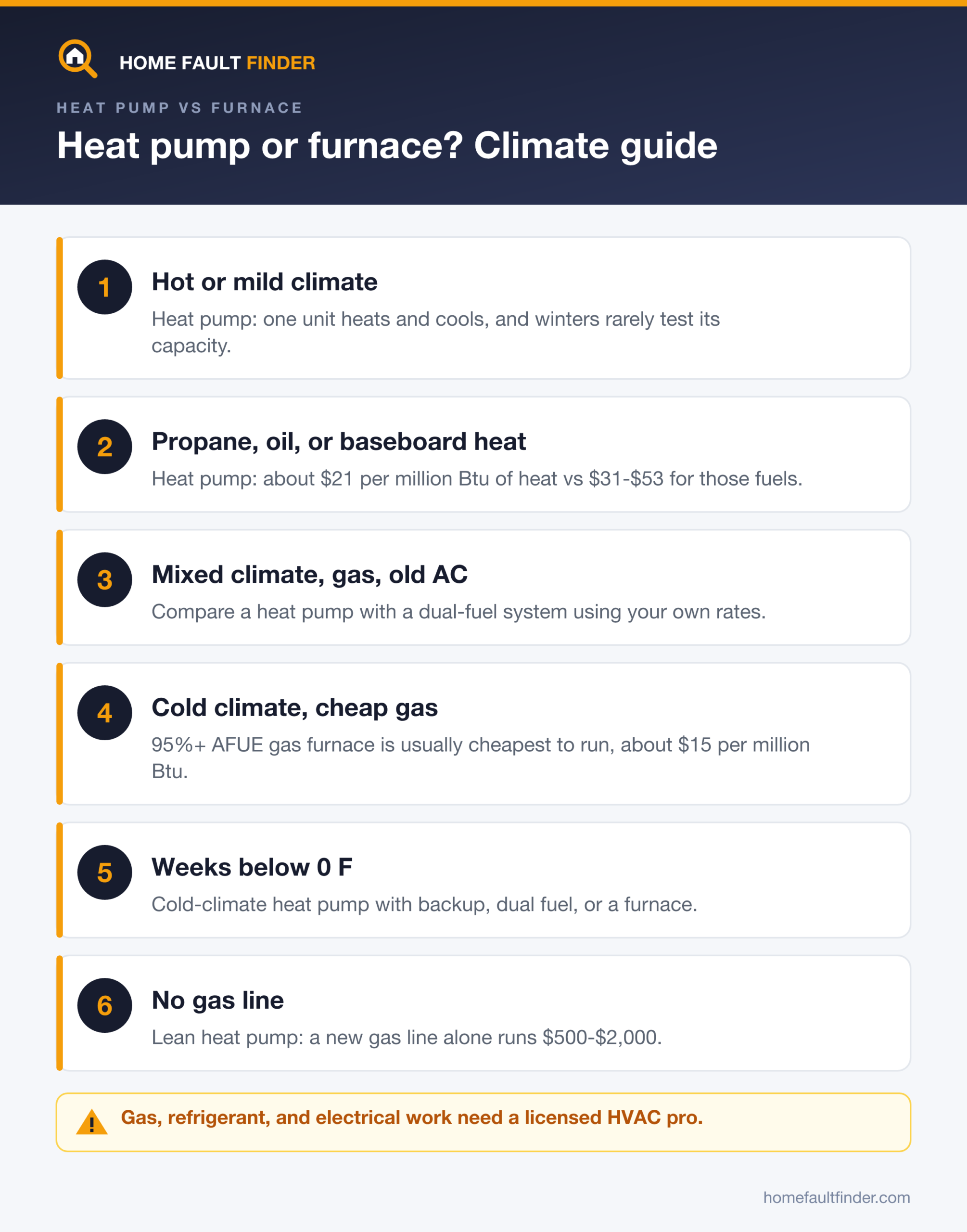
The right choice between a heat pump and a furnace follows from four facts: how cold your winters get, which fuel you have, your local energy rates, and whether your AC also needs replacing. The first match in the checklist below usually decides it.
-
Hot or mild climate (South, coastal West)
Choose a heat pump; winters rarely test it.
-
Heating with propane, oil, or electric baseboard
Choose a heat pump; it costs about 32% less to run than propane and 60% less than oil or baseboard.
-
Mixed climate with gas, and the AC is also old
Quote a heat pump and a dual-fuel system, then apply the 0.09 × therm-price rule to your bill.
-
Cold climate with cheap gas and a newer AC
A 95%+ AFUE gas furnace is usually cheapest to run; revisit a heat pump when the AC fails.
-
Very cold climate (weeks below 0°F)
Choose a cold-climate heat pump with backup, dual fuel, or a furnace; compare capacity at 5°F with your home’s heat loss.
-
No gas line at the house
Lean heat pump: a gas line, venting, and separate AC all add cost.
Common mistakes: sizing by square footage instead of a load calculation, keeping leaky ducts, and buying a standard heat pump for a cold climate.
What should a contractor check before you switch?
A licensed HVAC contractor should run a heat-loss calculation, check duct size and leakage, confirm your panel can carry a heat pump and backup strips, and for a furnace confirm gas supply and venting. A good heat pump quote lists capacity at 47°F and 5°F.
Hire a licensed HVAC contractor for any heat pump or furnace installation. Refrigerant work requires an EPA Section 608 certified technician, and gas piping and new circuits usually need a permit. Do not open gas, refrigerant, or panel components yourself.
If you smell gas, leave the house now and call your gas utility or 911 from outside. If a CO alarm sounds, get everyone outdoors and call 911.
Frequently asked questions
Can a heat pump use my existing ductwork?
Yes, a ducted heat pump usually connects to the same supply and return ducts as your furnace and AC. A contractor should check that the ducts are sized for heat pump airflow and sealed, because heat pumps deliver cooler air and suffer more from leaks.
Should I replace a working gas furnace with a heat pump?
Replacing a working gas furnace rarely pays off on energy savings alone at national-average prices. The better moment is when the furnace or AC fails. If only the AC is failing, adding a heat pump to the existing furnace as a dual-fuel system is a common middle path.
Is there a federal tax credit for a heat pump in 2026?
No. The IRS says the Energy Efficient Home Improvement Credit (Section 25C) applies to qualifying property placed in service from 2023 through 2025, so equipment installed in 2026 does not qualify. Some utilities and states still offer rebates, so ask your utility before signing.
Do heat pumps need backup heat?
Most heat pumps in places with freezing winters have backup heat, usually electric resistance strips in the air handler or a gas furnace in a dual-fuel setup. Backup covers defrost cycles and the coldest hours, when the heat pump alone cannot keep up with heat loss.
What size heat pump do I need?
The right heat pump size comes from a heat-loss and heat-gain calculation, usually ACCA Manual J, not from square footage alone. In cold areas, ask for the unit’s heating capacity at 5°F and compare it with your home’s design heat loss.