Tankless vs tank water heater comes down to usage and installation cost. A tankless unit suits small-to-medium households that want endless hot water and a 20-year lifespan, and it is 24%–34% more energy efficient in homes using 41 gallons a day or less. A tank heater suits tight budgets, big simultaneous demand, and straight swaps, costing roughly $882–$1,825 installed.
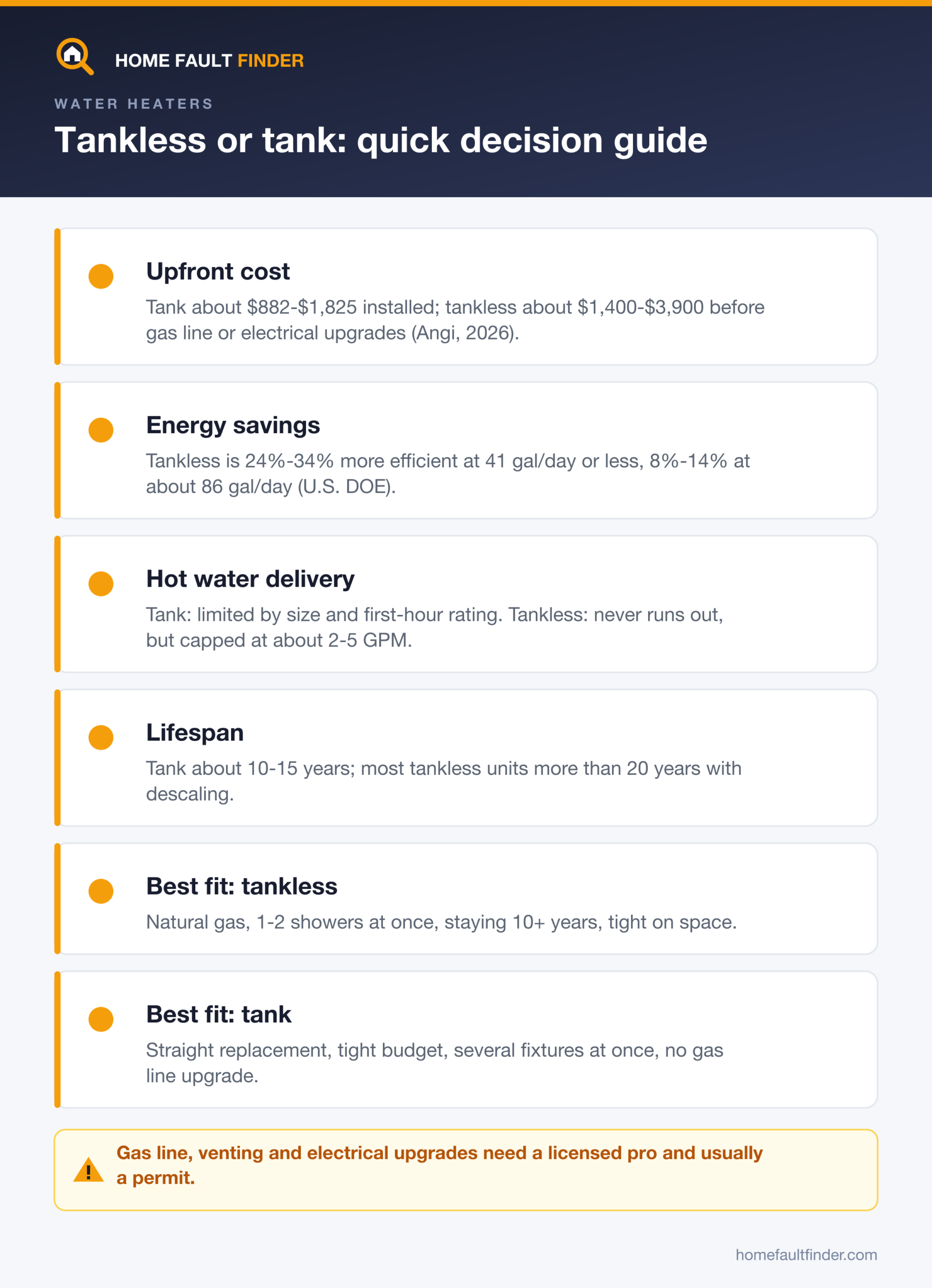
- Angi’s 2026 guide puts tank replacement at about $882–$1,825 and tankless at about $1,400–$3,900, before gas line or electrical upgrades.
- DOE rates tankless 24%–34% more efficient at 41 gallons a day or less, but only 8%–14% at around 86 gallons.
- ENERGY STAR estimates a certified gas tankless unit saves a family of four about $95 a year versus a standard gas tank.
- Tankless units deliver about 2–5 gallons per minute; tanks last about 10–15 years versus 20+ for most tankless units.
This guide compares the two on real numbers: upfront cost, installation work, savings, flow rate, lifespan and maintenance, plus a sizing example and a payback calculation. If your current unit is only struggling, check our water heater troubleshooting guide first; a cheap repair buys time to decide calmly.
What is the difference between a tankless and a tank water heater?
A tank (storage) water heater is an insulated tank, usually 30 to 80 gallons, that keeps a reserve of water hot around the clock with a gas burner or electric elements. A tankless water heater, also called on-demand, has no reserve: a flow sensor fires a burner or element only when a hot tap opens.
A tank loses heat through its walls all day, which the U.S. Department of Energy (DOE) calls standby heat loss, but it can deliver a big burst at once. A tankless unit avoids standby loss and never runs out over time, but its output is capped in gallons per minute (GPM); past that cap, water comes out cooler.
Tankless vs tank water heater side by side
Tankless and tank water heaters differ on cost, installation work, energy use, delivery rate, lifespan, maintenance and space. The comparison below uses figures from the U.S. Department of Energy, ENERGY STAR and Angi’s 2026 cost guide, so each number has a named source you can check against local quotes.
| Factor | Tank (storage) | Tankless (on-demand) |
|---|---|---|
| Installed cost | About $882–$1,825 (Angi) | About $1,400–$3,900 (Angi) |
| Installation work | Usually reuses gas line, vent or circuit | Often larger gas line, new vent or bigger electrical service |
| Energy savings | Baseline; standby loss | 24%–34% at ≤41 gal/day; 8%–14% at ~86 gal/day (DOE) |
| Hot water supply | Limited by tank size | Unlimited, capped at about 2–5 GPM (DOE) |
| Lifespan | About 10–15 years (DOE) | 20+ years for most units (DOE) |
| Maintenance | Flush sediment, check anode and relief valve | Descale, clean inlet filter, check vent |
| Space | Closet or utility corner | Wall-mounted, suitcase-sized |
| Typical failure | Tank leak means replacement | Parts or scale, usually repairable |
Which costs more to buy and install?
A tankless water heater costs more to buy and install than a tank heater in almost every home. As of October 2026, Angi’s replacement cost guide lists tank-style replacement at $882–$1,825 (average $1,346) and tankless at $1,400–$3,900, and notes that a tank-to-tankless conversion can take twice as long.
Conversions often add work a like-for-like tank swap avoids:
- Gas supply: a whole-home gas tankless burner draws far more gas at full fire, so the line may be too small. Angi lists new gas line work at about $260–$820.
- Venting: condensing units, per ENERGY STAR, vent through PVC pipe and need a condensate drain.
- Electrical: Angi notes whole-home electric tankless units can draw 120–160 amps, which may require 200-amp service; new wiring or a sub-panel runs about $500–$1,000 and can exceed $2,300.
For tank-to-tank and conversion quotes in detail, see our water heater replacement cost guide.
Gas line resizing, combustion venting and high-amperage circuits affect fire and carbon monoxide (CO) safety and usually need a permit. If you smell gas, leave the house and call your gas utility or 911 from outside.
Is a tankless water heater more energy efficient?
A tankless water heater is more energy efficient than a standard tank in most homes because it skips standby heat loss. DOE’s Energy Saver guidance puts the gain at 24%–34% for households using 41 gallons or less of hot water a day, falling to 8%–14% for heavy users near 86 gallons.
The gain shrinks in big households because standby loss is a fixed overhead. ENERGY STAR estimates a certified gas tankless heater saves a family of four about $95 a year, about $1,800 over its life, versus a standard gas tank, and certified condensing units use about 9% less energy than conventional tankless models. DOE adds one caveat: a standing pilot light can eat into the savings, so look for intermittent electronic ignition.
When does a tankless water heater pay for itself?
A tankless water heater pays for itself only when yearly savings cover the extra installation cost within its service life. Using ENERGY STAR’s $95-a-year gas savings for a family of four, a $500 premium pays back in about 5 years, while a $2,000 premium takes about 21 years.
| Scenario (gas, family of four) | Extra cost vs tank | Yearly savings | Simple payback |
|---|---|---|---|
| Easy swap, no gas or vent changes | about $500 | about $95 | about 5 years |
| New venting, minor gas work | about $1,200 | about $95 | about 13 years |
| Larger gas line, relocation, permits | about $2,000+ | about $95 | 21+ years |
Lifespan tilts the math toward tankless: over 20 years a tank owner may buy a second tank. In the high-cost scenario, savings alone rarely justify the switch, and the choice rests on endless hot water and space.
How big a tankless water heater does your home need?
Tankless water heater sizing depends on peak flow in gallons per minute and the temperature rise from incoming water to your set point. ENERGY STAR’s average fixture flows are 2.5 GPM for a shower or tub, 3.3 GPM for a clothes washer, 2.2 GPM for a sink and 1.3 GPM for a dishwasher.
-
Add up your peak overlap
Two showers at once is about 5 GPM; a single-shower household may need only 2.5–3.5 GPM.
-
Find your temperature rise
A 120°F set point with 50°F winter groundwater is a 70°F rise; see our water heater temperature guide.
-
Convert to heating power
Each GPM per degree of rise needs about 500 BTU/hr (8.33 lb × 60 minutes). 5 GPM × 70°F × 500 = 175,000 BTU/hr, so a 90%-efficient gas unit needs about 195,000 BTU/hr input.
-
Check the electric limit
The same load needs about 51 kW electric; a typical 36 kW whole-home unit delivers only about 3.5 GPM at that rise.
-
Confirm with the installer
Ask for the maker’s flow chart at your rise and confirm the gas line, vent and electrical service.
Tanks are sized by capacity and first-hour rating on the yellow EnergyGuide label. If yours already runs short, our guide on hot water running out fast separates sizing from faults.
Which lasts longer and needs less maintenance?
Tankless water heaters last longer: DOE says most are rated for more than 20 years with replaceable parts, while storage tanks last about 10–15 years. ENERGY STAR adds that tankless units remove the risk of a tank leak flooding a basement. Maintenance differs by type rather than disappearing.
A tank needs sediment flushing (see our water heater flushing guide), an anode rod check and a working temperature and pressure (T&P) relief valve. A tankless unit needs heat exchanger descaling, often yearly in hard water per many manuals; skipped descaling drives many faults in our tankless water heater problems guide. Never cap or remove a relief valve on either type.
What are the downsides of a tankless water heater?
The main downsides of a tankless water heater are higher upfront cost, a hard cap on simultaneous flow, and installation upgrades a tank swap avoids. Smaller drawbacks include a minimum flow needed to fire the burner and, for most gas models, no hot water during a power outage.
- Cold water sandwich: after a shower is turned off and on again, a brief cold slug passes while the unit re-fires.
- Power dependence: gas tankless controls and fans need electricity.
- Repair cost: Angi lists tankless repairs at about $100–$1,300 versus $100–$500 for tanks.
Tanks have their own weaknesses: standby loss, a reserve that back-to-back showers can drain, and eventual tank corrosion.
Where does a heat pump water heater fit in?
A heat pump water heater, or hybrid electric water heater, is a tank model that moves heat from the surrounding air into the water. ENERGY STAR’s fact sheet says certified models use less than half the energy of a standard electric storage heater, making them the main rival to electric tankless in all-electric homes.
ENERGY STAR recommends a space that stays between 40°F and 90°F year-round with about 1,000 cubic feet of air; in cold climates the unit may fall back to resistance heating in winter.
Which water heater should you choose?
The better water heater depends on household size, fuel, budget and how long you will stay. Use this guide as a starting point, then confirm sizing and installation requirements with a licensed installer, because gas line capacity and electrical service often decide the question for you.
- Tankless: natural gas with adequate line, one or two showers at a time, staying 10+ years, tight on space.
- Tank: straight replacement, tight budget, several fixtures at once, or a conversion needing new gas line and vent.
- Heat pump tank: all-electric home with a space that stays above 40°F.
- Avoid whole-home electric tankless in cold climates or on 100-amp service unless an electrician approves it.
Deciding because the old unit is failing? Check the signs you need a new water heater first.
Hire a licensed plumber or gas fitter for any tankless conversion, gas line, venting or relief valve problem, and a licensed electrician for new circuits or service upgrades; most areas require a permit. Keep a CO alarm near any fuel-burning heater, and if you smell gas, leave the house and call your gas utility or 911 from outside.
Frequently asked questions
Can I install a tankless water heater myself?
Installing a tankless water heater yourself is not recommended. Gas units involve gas line sizing, combustion venting and condensate drainage, and electric units need high-amperage circuits. Most jurisdictions require a permit and inspection, and some manufacturers limit warranty coverage when a licensed installer did not do the work.
Do tankless water heaters work during a power outage?
Most tankless water heaters stop during a power outage, including gas models, because their controls, ignition and exhaust fans need electricity. Many gas tank heaters with a standing pilot keep heating without power, which is a practical advantage of a tank in areas with frequent outages.
Is a 50-gallon tank or a tankless better for a family of four?
Both can serve a family of four. Tankless fits better when showers are staggered and the gas line is adequate, saving about $95 a year per ENERGY STAR. A 50-gallon tank costs less to install and handles two showers at once until the reserve runs low.
Can a tankless water heater be installed outside?
Many gas tankless water heaters come in outdoor models built for exterior wall mounting, which saves indoor space and simplifies venting. Outdoor units rely on built-in freeze protection that needs power, so they are most common in mild climates. Check the manufacturer’s rating and local code before choosing an outdoor location.
Why does my tankless water heater go lukewarm with two showers running?
Lukewarm water with two showers running usually means demand exceeds the unit’s GPM rating at your temperature rise. Winter makes it worse because colder incoming water needs more heating. Low-flow showerheads, staggered use, descaling, or a larger or second unit are the usual fixes.