
A gas vs electric dryer choice comes down to your hookup. With an existing gas line, a gas dryer usually costs less to run: roughly $0.17–$0.30 per load versus about $0.40 for electric at mid-2026 U.S. average rates. With only a 240-volt outlet, or a move coming within a few years, buy electric.
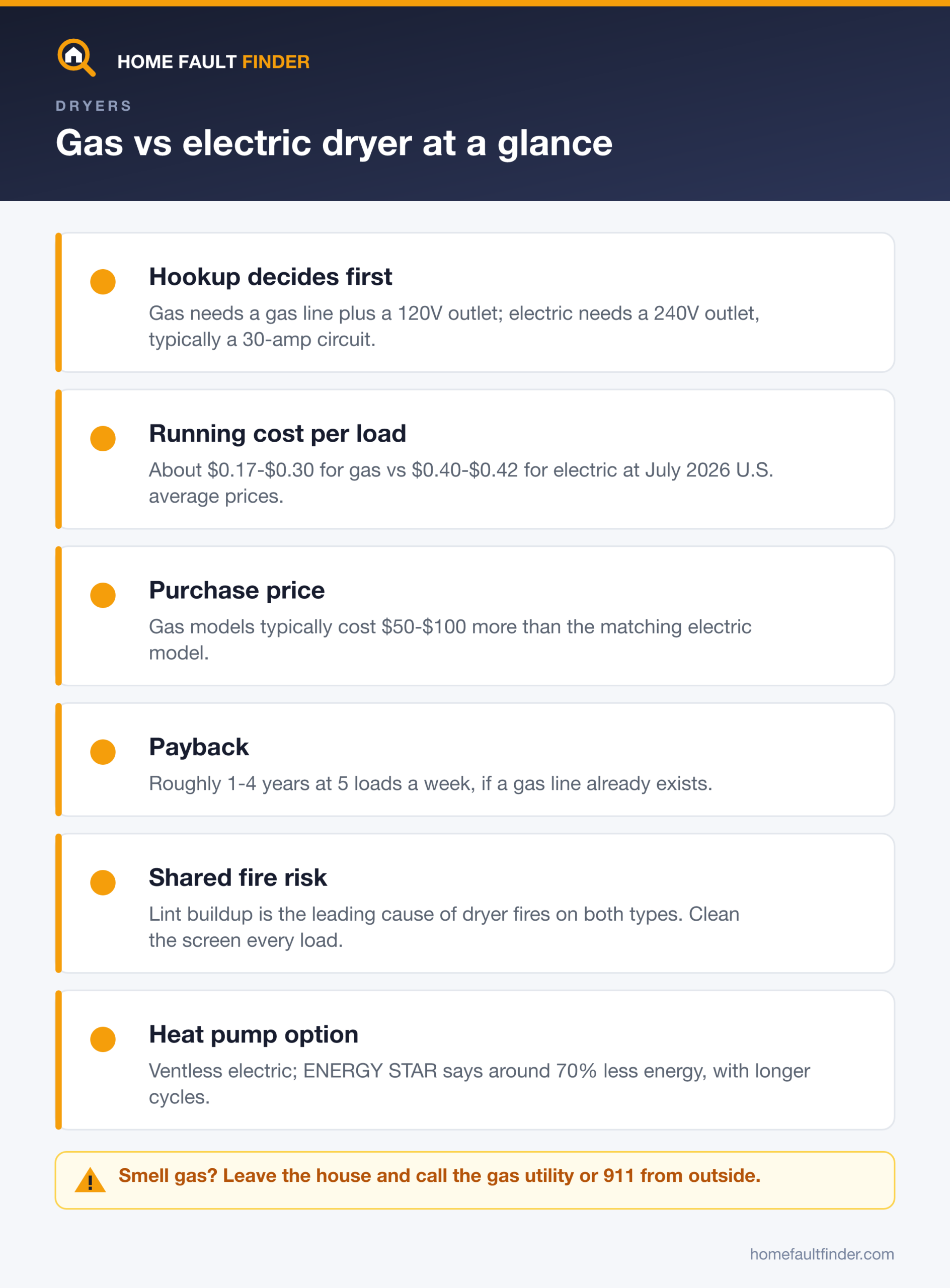
- At July 2026 U.S. average prices, a standard electric dryer costs about $0.40–$0.42 per load to run; a gas dryer about $0.17–$0.30.
- Gas models usually cost $50–$100 more and need a gas line plus a 120-volt outlet.
- Electric dryers need a 240-volt outlet, typically on a dedicated 30-amp circuit.
- Lint buildup is the leading cause of dryer fires on both types, according to NFPA.
Choosing between gas and electric is one of the few appliance decisions where the cheapest machine on the sales floor is not always the cheapest to own. This guide compares both types side by side, works out per-load running cost from federal efficiency standards and U.S. Energy Information Administration (EIA) prices, and flags exactly where gas or electrical work becomes a job for a pro.
Is a gas or electric dryer better?
A gas dryer is better for households that already have a gas line in the laundry area, run several loads a week and plan to stay for years, because natural gas heat usually costs less than electric heat. An electric dryer is better when only a 240-volt outlet is available, a move is near, or you want the simplest installation.
Neither type dries clothes better in a meaningful way. A gas dryer burns natural gas or propane (LP) in a burner; an electric dryer heats a resistance element. Drums, belts, moisture sensors and controls are largely shared, and many manufacturers sell the same model in both versions. The better dryer is usually the one your house is already set up for.
How do gas and electric dryers compare side by side?
Gas and electric dryers differ mainly in purchase price, installation needs and operating cost, while capacity, features and drying performance are broadly similar. The table below uses national figures, so local quotes and utility rates will shift the numbers somewhat.
| Factor | Gas dryer | Electric dryer |
|---|---|---|
| Purchase price | Typically $50–$100 more than the matching electric model | Lower; widest selection |
| Hookup | Gas line with shutoff valve + 120-volt outlet | 240-volt outlet, typically a dedicated 30-amp circuit |
| Running cost per load (July 2026) | About $0.17–$0.30 | About $0.40–$0.42 |
| Installation | Professional connection and leak check | Plug in and vent if a 240-volt outlet exists |
| Typical heat-system failures | Igniter, flame sensor, gas valve coils | Heating element, thermal fuse, high-limit thermostat |
| Extra safety concerns | Gas leaks; carbon monoxide if venting fails | Cord or terminal block faults |
How much does it cost to run a gas vs electric dryer per load?
A gas vs electric dryer cost-per-load estimate can be built from two public sources: the federal minimum efficiency standard, which limits how much energy a new dryer may use on a test load, and EIA average residential energy prices. Combined, they put a minimum-efficiency electric dryer near $0.40 per load and a gas dryer near $0.17–$0.30.
The U.S. Department of Energy rates dryers by Combined Energy Factor (CEF), pounds of dry laundry per kWh, on an 8.45-pound test load. For dryers made since January 1, 2015, the minimum CEF is 3.73 for a standard vented electric dryer and 3.30 for a vented gas dryer (10 CFR 430.32(h)), with gas converted at 3,412 Btu per kWh. That gives about 2.27 kWh per electric load and about 2.56 kWh-equivalent per gas load, or roughly 0.087 therm if treated as all gas.
EIA puts the U.S. average residential electricity price at 17.45 cents per kWh in July 2025 and 18.31 cents in July 2026. Residential natural gas ranged from $13.96 per thousand cubic feet (January 2026) to $26.45 (July 2026), about $1.35–$2.55 per therm at EIA’s 1,036 Btu per cubic foot.
| Standard load | Electric dryer | Gas dryer |
|---|---|---|
| Energy per load | 2.27 kWh | ≈0.087 therm + motor electricity |
| Fuel cost | $0.40–$0.42 | $0.12–$0.22 |
| Drum motor and controls | Included | About $0.05–$0.07 (our estimate, 0.3–0.4 kWh) |
| All-in per load | $0.40–$0.42 | About $0.17–$0.30 |
| Per year at 260 loads (5/week) | About $103–$108 | About $44–$78 |
That is a gap of roughly $25–$64 a year, so a $50–$100 gas premium pays back in about one to four years when the gas line already exists. A new gas line is priced by distance, routing and permits and can push payback past the dryer’s life, so get a written quote first. Propane usually costs more per Btu than utility gas, which shrinks the savings. Efficiency labels are covered in our guide to whether ENERGY STAR appliances are worth it.
What hookups does a gas or electric dryer need?
An electric dryer needs a 240-volt receptacle, typically on a dedicated 30-amp circuit, plus an outdoor vent. A gas dryer needs a gas supply line with an accessible shutoff valve, an ordinary 120-volt outlet for the motor and controls, and the same outdoor vent. The hookup already behind your dryer is the deciding factor for most buyers.
A large three- or four-slot receptacle means a 240-volt dryer circuit; a capped pipe with a valve near the floor means a gas stub. Do not add either hookup yourself. A new circuit means work inside the electrical panel, sized to your local electrical code (requirements depend on the code edition your local authority adopted). A new gas line or a natural gas-to-propane conversion belongs to a licensed plumber or gas technician; manufacturers sell LP conversion kits, and their installation instructions call for a qualified installer.
Which dries clothes faster, gas or electric?
A gas dryer usually reaches drying temperature faster than an electric dryer because a burner delivers full heat almost as soon as it ignites, while an element warms more gradually. The per-load difference is modest; vent condition and load size matter far more.
If either type suddenly takes longer, suspect airflow: a clogged lint screen, crushed transition duct or packed wall vent. Clearing those restores normal drying times on either type.
Is a gas dryer safe? Gas vs electric dryer safety
A gas dryer is safe when it is professionally connected, leak-tested and vented outdoors through an unobstructed duct. Gas and electric dryers share the main hazard, lint fires, and NFPA (the National Fire Protection Association) names failure to clean as the leading cause of home dryer fires. Gas adds two risks: fuel leaks and carbon monoxide.
Carbon monoxide (CO) is a colorless, odorless gas produced by burning fuel. A gas dryer sends combustion gases out through its exhaust duct, so a blocked or disconnected vent can push CO back indoors. NFPA advises having gas dryers inspected by a professional for leaks and using rigid or flexible metal venting. Install CO alarms on every level of a home with fuel-burning appliances.
Do not operate the dryer, light switches or anything that could spark. Leave the house with everyone in it, then call your gas utility or 911 from outside.
On either type, clean the lint screen every load, keep combustibles away, do not run the dryer while asleep or away, and clean the full vent at least yearly. See how to clean a dryer vent for the safe DIY parts.
Call a licensed plumber or gas appliance technician to connect, move or convert a gas dryer, or if you smell gas, see a yellow or lazy burner flame, or hear a CO alarm. Call a licensed electrician to add or change a 240-volt dryer circuit; never open the electrical panel yourself.
Which needs more maintenance and repairs, gas or electric?
Gas and electric dryers share most wear parts, including belts, idler pulleys, drum rollers, door switches and thermal fuses, so routine maintenance is identical. The heat system differs: electric models often lose heat to a burned-out element or blown thermal fuse, while gas dryers more often need an igniter, flame sensor or gas valve coils.
Gas heat repairs are slightly more involved because the burner connects to the fuel supply, and any work that opens the gas connection is for a technician. A failed electric element is usually a simple swap, though often a sign of restricted airflow. Start with dryer not heating or, on gas models, gas dryer igniter not working. Lifespans do not reliably differ by fuel, since drums, motors and bearings are shared designs.
What about heat pump dryers?
A heat pump dryer is an electric, closed-loop dryer that reheats and reuses its air, condensing moisture into a drain or tank instead of venting outdoors. ENERGY STAR says heat pump models use around 70% less energy than conventional dryers and all meet its Most Efficient criteria. Trade-offs are a higher price and longer cycles.
With no outdoor vent, heat pump dryers suit apartments and closets where a duct is impractical, and they remove gas and CO concerns entirely. ENERGY STAR notes the biggest savings go to heavy users paying high electricity rates.
How do you decide between a gas and electric dryer?
Deciding between a gas and electric dryer takes five quick checks: the hookup you have, local energy prices, per-load math, the upfront cost gap and how long you plan to stay. Most households can finish in about 15 minutes with two recent utility bills on hand.
-
Check the hookup behind your dryer
Look for a 240-volt receptacle, a capped gas valve, or both. Two minutes with a flashlight.
-
Read your utility rates
Note the price per kWh and per therm on recent bills; average 12 months if gas swings by season.
-
Run the per-load math
Multiply 2.27 kWh by your electric rate and 0.087 therm by your gas rate, then multiply the gap by loads per year.
-
Compare against the upfront gap
Add the gas premium (often $50–$100) and any quote for a new gas line or circuit, then divide by yearly savings.
-
Match payback to your plans
If payback is shorter than your expected stay, gas usually wins; otherwise choose electric or a heat pump model.
The most common mistake is buying gas for a room with only an electric outlet, then finding the gas line quote erases years of savings. When in doubt, buy the type your hookup supports.
For any fault on either type, start with our full dryer troubleshooting guide.
Frequently asked questions
Can I use an electric dryer instead of a gas dryer?
Yes, you can replace a gas dryer with an electric one, but only if a 240-volt dryer receptacle is available or a licensed electrician installs a new circuit. The existing gas line must then be properly capped by a qualified plumber or gas technician; never leave an open valve behind the machine.
Do gas or electric dryers cause more fires?
Both gas and electric dryers catch fire mainly for the same reason: lint buildup in the lint trap, cabinet and vent. NFPA lists failure to clean as the leading cause of home dryer fires. Keeping the lint screen and the full vent run clean matters far more than which fuel the dryer uses.
How can I tell if my dryer is gas or electric?
Look behind the dryer. A gas dryer has a gas pipe or flexible connector attached to the back plus an ordinary three-prong 120-volt plug. An electric dryer has a thick cord with a large three- or four-prong plug and no gas connection. The rating plate inside the door also lists the fuel type.
Does a gas dryer need electricity?
Yes, a gas dryer needs electricity to run its drum motor, controls, igniter and gas valve. It plugs into a standard 120-volt outlet rather than a 240-volt one. During a power outage, a gas dryer will not run, even though the gas supply is still on.
Is propane cheaper than natural gas for a dryer?
Propane is usually more expensive than utility natural gas per unit of heat, so an LP dryer saves less over electric than a natural gas model does. A dryer must also be converted with the manufacturer’s LP kit, installed by a qualified technician, before it can safely burn propane.