
AC installation cost in the US runs about $5,000–$12,000 for a typical central air system as of October 2026, with a 3-ton unit averaging around $6,000 according to Fixr. A single-zone ductless mini-split costs roughly $2,000–$5,000, while adding new ductwork, an electrical service upgrade, or a high-SEER2 unit can push a whole-home project past $15,000.
- A standard central AC installation costs about $5,000–$12,000 installed as of October 2026 (Fixr).
- Each extra mini-split zone adds roughly $2,000–$3,000, so a 4-zone system lands near $7,000–$14,000.
- New ductwork alone can add $3,600–$9,500, which is why homes without ducts often choose ductless.
- The federal 25C tax credit only covered equipment placed in service through 2025, so do not count on it for a 2026 install.
This guide is for homeowners pricing a new air conditioning system and breaks the price into the pieces a contractor actually bills for. If your current system still runs and you are weighing a repair against a replacement, start with our AC repair vs. replace cost comparison instead.
- How much does AC installation cost by system type?
- What does central AC cost by size and SEER2 rating?
- How much does a ductless mini-split cost per zone?
- Is a heat pump more expensive to install than central AC?
- What extra charges show up on an AC installation quote?
- Worked example: replacing a 3-ton system
- Why does Manual J sizing affect the price?
- What makes AC installation more expensive?
- How do you compare AC installation quotes?
- Can you install an air conditioner yourself?
- Is there a federal tax credit for a new AC in 2026?
- Frequently asked questions
How much does AC installation cost by system type?
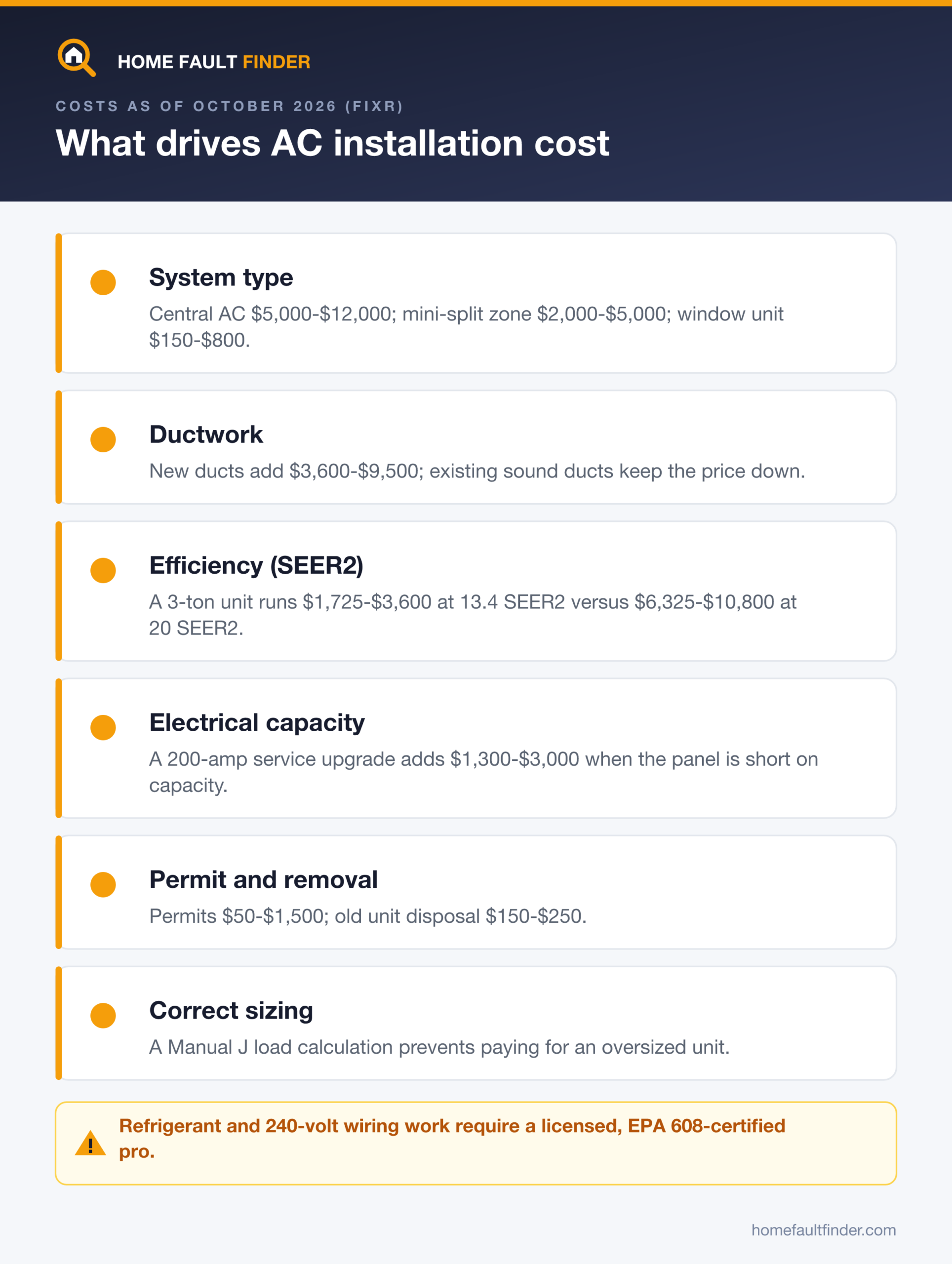
AC installation cost depends first on the type of system, because a window unit and a whole-home central system are different projects. As of October 2026, Fixr lists central air at $5,000–$12,000 installed, air-source heat pumps at $4,000–$11,000, and window units at $150–$800, with ductless systems ranging widely by the number of indoor heads.
| System type | Typical installed cost | Best fit |
|---|---|---|
| Central air (split system, existing ducts) | $5,000–$12,000 | Homes that already have usable ductwork |
| Air-source heat pump (ducted) | $4,000–$11,000 | Cooling plus electric heating in one system |
| Ductless mini-split | $1,000–$14,500+ | Homes without ducts, additions, single rooms |
| Window unit | $150–$800 | One room, renters, short-term needs |
| Portable unit | $100–$500 | Temporary or movable cooling |
| Geothermal heat pump | $11,000–$38,000 | Long-term owners with yard space for loops |
This Old House (updated June 2026) lists central AC at $4,000–$8,000 installed; the gap between sources mostly reflects whether ductwork and thermostats are counted.
What does central AC cost by size and SEER2 rating?
Central AC cost rises with both capacity (measured in tons, where 1 ton equals 12,000 BTU per hour) and efficiency (measured as SEER2, the seasonal energy efficiency ratio used for systems sold since 2023). For a 3-ton unit, Fixr shows the equipment price roughly tripling between a basic 13.4 SEER2 model and a premium 20 SEER2 model.
| Efficiency (SEER / SEER2) | 3-ton unit price range |
|---|---|
| 14 / 13.4 | $1,725–$3,600 |
| 15 / 14.3 | $2,300–$4,800 |
| 16 / 15.3 | $2,875–$6,000 |
| 17 / 16.2 | $3,450–$6,600 |
| 18 / 17.2 | $4,100–$7,800 |
| 20 / 19.1 | $5,750–$9,600 |
| 21 / 20 | $6,325–$10,800 |
Size matters less than expected: This Old House estimates a complete system with ductwork at about $8,100–$8,400 for 1.5 to 3 tons, rising to roughly $12,700 for 4 tons and $17,100 for 5 tons as larger homes need more duct runs.
How much does a ductless mini-split cost per zone?
A ductless mini-split is a system with one outdoor condenser connected by refrigerant lines to one or more wall, ceiling, or floor indoor heads, each called a zone. Fixr puts the first zone at $2,000–$5,000 installed and each additional zone at $2,000–$3,000 as of October 2026.
| Number of zones | Installed cost range |
|---|---|
| 1 zone | $2,000–$5,000 |
| 2 zones | $3,000–$8,000 |
| 3 zones | $5,000–$11,000 |
| 4 zones | $7,000–$14,000 |
| 5 zones | $9,000–$16,500 |
Labor for a single-zone install runs about $300–$2,000, or 15%–25% of the total, according to the same Fixr guide.
Mini-splits win on cost when a home has no ducts, because the $3,600–$9,500 ductwork retrofit disappears. Once you need four or five zones, the price approaches a ducted system. If an existing unit is underperforming instead, our guide to a mini-split not cooling covers the usual causes before you pay for a new one.
Is a heat pump more expensive to install than central AC?
A ducted air-source heat pump costs about the same to install as central AC, and sometimes less, because it replaces both the air conditioner and part of the heating system. Fixr lists heat pumps at $4,000–$11,000 and central AC at $5,000–$12,000 installed as of October 2026; a separate Fixr heat pump guide puts the national average near $8,350.
A heat pump is an air conditioner that can run in reverse to heat the house; cold-climate models and backup heat raise its price.
With a healthy gas furnace, a straight AC replacement is usually cheaper; if the furnace is aging too (see our furnace repair cost guide), get one heat pump quote as well.
What extra charges show up on an AC installation quote?
Extra charges on an AC installation quote are the line items beyond the condenser, coil, and basic labor, and they explain most of the gap between a $5,000 quote and a $15,000 quote. As of October 2026, the biggest ones are new ductwork, an electrical service upgrade, permits, and old-equipment removal.
| Add-on | Typical cost range | When it applies |
|---|---|---|
| New ductwork (retrofit) | $3,600–$9,500 | Home has no ducts, or ducts are leaking, crushed, or undersized |
| Electrical service upgrade to 200 amps | $1,300–$3,000 | Panel lacks capacity for the new compressor circuit |
| Subpanel installation | $400–$2,000 | Main panel is full but service size is adequate |
| Permit and inspection | $50–$1,500 | Most jurisdictions for central, heat pump, and mini-split work |
| Old unit removal and disposal | $150–$250 | Replacements; some installers include it free |
| Line set, pad, disconnect, thermostat | Often bundled into labor | Ask whether reused or replaced |
The line set (the copper refrigerant tubes between units) is either replaced or flushed and reused; the quote should say which.
Worked example: replacing a 3-ton system
A worked example shows how the line items add up for the most common job: replacing an old 3-ton central AC in a home with usable ductwork. Using Fixr ranges as of October 2026 for a mid-range 15.3 SEER2 unit, the total comes to roughly $4,325–$10,750 before any electrical upgrade.
| Line item | Low | High |
|---|---|---|
| 3-ton unit, 16 SEER / 15.3 SEER2 | $2,875 | $6,000 |
| Split-system labor (lines and pad included) | $1,250 | $3,000 |
| Old unit removal and disposal | $150 | $250 |
| Permit | $50 | $1,500 |
| Estimated total | $4,325 | $10,750 |
That total sits inside Fixr’s own $5,500–$10,000 range for replacements with existing ducts; a quote far above it usually includes duct or panel work.
Why does Manual J sizing affect the price?
Manual J is the Air Conditioning Contractors of America (ACCA) method for calculating how much heating and cooling a specific house needs, based on its insulation, windows, orientation, and air leakage. ENERGY STAR advises homeowners to make sure the contractor verifies system size with Manual J rather than guessing from square footage.
Sizing affects cost in two directions. An oversized unit costs more to buy, and ENERGY STAR notes that an oversized conventional system cycles on and off frequently, causing humidity problems and inefficient operation. After insulation or window upgrades, the old size may now be too big. ENERGY STAR also states that improper installation can reduce system efficiency by up to 30 percent.
What makes AC installation more expensive?
AC installation becomes more expensive when the job needs more labor hours, more materials, or more permits than a straight swap. The factors below explain why two neighbors with similar homes can receive quotes thousands of dollars apart, even from the same contractor.
- No existing ductwork, or ducts that need replacing.
- An electrical panel without room or capacity for a new 240-volt circuit.
- Hard access: attic air handlers, crawl spaces, rooftop condensers.
- Higher SEER2 or variable-speed equipment, and premium brands.
- Regional labor rates; Fixr lists HVAC labor at $75–$250 per hour.
- Emergency, weekend, or peak-summer scheduling, which can add hundreds.
Installers are busiest in midsummer, so replacing an aging system in spring or fall usually brings faster scheduling. Our checklist to prepare your air conditioner for summer helps you spot a failing unit before peak season.
How do you compare AC installation quotes?
Comparing AC installation quotes works best when every contractor prices the same scope of work. Ask for at least three written bids; ENERGY STAR recommends an on-site inspection, a detailed bid, and proof of licensing and insurance before you choose a contractor.
-
Confirm a load calculation
Ask whether the size comes from a Manual J calculation and request a copy.
-
Match the equipment
List tonnage, SEER2 rating, and model numbers for the outdoor unit and indoor coil.
-
Check ductwork scope
Note whether ducts are sealed, repaired, or replaced, and at what price.
-
Check electrical scope
See whether a new circuit, disconnect, or panel upgrade is included, and who performs it.
-
Confirm permit and removal
Make sure the permit, inspection, and old-unit disposal are listed rather than assumed.
-
Compare warranties
Separate the manufacturer parts warranty from the installer labor warranty.
Can you install an air conditioner yourself?
Installing a window or portable air conditioner is a homeowner job, but installing central AC, a heat pump, or a mini-split is not a DIY project. Federal rules under EPA Section 608 limit the purchase and handling of most refrigerants to certified technicians, and the work also involves a high-voltage dedicated circuit.
Hire a licensed HVAC contractor for any split system, heat pump, or mini-split. Connecting refrigerant lines, pulling a vacuum, and charging the system require EPA Section 608 certification and specialized tools, and the outdoor unit needs a dedicated 240-volt circuit that should be installed by a licensed electrician or HVAC contractor under a local permit.
Do not open your electrical panel or attempt refrigerant work yourself.
For an existing system, our air conditioner troubleshooting guide lists the safe checks you can do yourself.
Is there a federal tax credit for a new AC in 2026?
The federal Energy Efficient Home Improvement Credit (Section 25C) no longer applies to new installs in 2026. The IRS states that the credit is allowed for qualifying property placed in service from January 1, 2023, through the end of 2025, so a central AC or heat pump installed in 2026 does not qualify.
State programs and utility rebates are separate and change often, so check your electric utility and state energy office before signing.
Frequently asked questions
How long does a central AC installation take?
A straight central AC replacement with existing ducts usually takes one day, often 4 to 10 hours for an experienced crew. A first-time installation that needs new ductwork, an electrical upgrade, or a permit inspection can stretch across two to five days, depending on access and the local inspection schedule.
What size AC do I need for a 2,000 sq ft house?
Many 2,000 sq ft homes end up with a 3- to 4-ton system, and Fixr’s sizing table lists 3–4 tons for that size. The correct answer depends on insulation, windows, climate, and ceiling height, so ask the contractor to confirm with a Manual J load calculation rather than square footage alone.
Should I replace the indoor coil when I replace the outdoor unit?
Replacing the indoor evaporator coil with the outdoor condenser is generally recommended, because the two are rated as a matched pair and older coils may not suit current refrigerants. Mismatched components can lower efficiency and complicate warranty coverage, so confirm the model numbers match before signing.
Does a new AC need a permit?
Most US cities and counties require a mechanical permit, and often an electrical permit, for central AC, heat pump, and mini-split installations. Fixr lists permit costs at $50–$1,500 as of October 2026. Window and portable units generally need no permit. Your contractor normally pulls it and schedules the inspection.
How long does a new central air conditioner last?
A well-installed central air conditioner commonly lasts 15 to 20 years with regular maintenance, such as changing filters and keeping the outdoor coil clean. Coastal salt air, poor installation, and an oversized unit that short-cycles can shorten that lifespan noticeably.