Carrier air conditioner error codes come from two different systems. Two-stage Infinity outdoor units flash two-digit codes on an amber light (31 means the high-pressure switch tripped, 47 means no 230 V at the unit), while Carrier ductless mini-splits show letter codes such as E1 or EC on the indoor display. Always match the code to your exact model’s manual.
- On Carrier two-stage outdoor units, 3 short plus 2 long amber flashes means code 32.
- Lockout codes 81 to 84 hold the unit off for 4 hours or until control power is cycled.
- On Carrier 40MAQ/38MAQ ductless systems, EC means a refrigerant leak was detected.
- Homeowners can check the thermostat, filter, breaker and outdoor debris; pressure, contactor and refrigerant codes need a pro.
A Carrier error code tells you what the control board noticed, not which part failed. A code 31 can come from a dirty outdoor coil or from a refrigerant problem only a technician can measure. This guide helps homeowners judge how serious a blinking light or code is before calling for service.
The tables below come from Carrier’s own service manuals, cross-checked against independent HVAC references; codes we could not confirm are left out on purpose.
- How do Carrier AC error codes work?
- How to read the amber flashing light
- Carrier two-stage outdoor unit codes
- Carrier ductless mini-split codes
- What you can safely check
- Pressure codes 31, 32, 83, 84
- Power and contactor codes
- How to reset a Carrier AC code
- Code-by-code decision table
- Frequently asked questions
How do Carrier air conditioner error codes work?
Carrier air conditioner error codes are diagnostic signals from a control board that monitors pressure switches, temperature sensors, line voltage and compressor current. Central split systems with a communicating or two-stage board flash numeric codes on the outdoor unit, while ductless mini-splits display letter-number codes on the indoor head and the wall controller.
Not every Carrier central air conditioner has a code light. Many single-stage condensers have no diagnostic board and simply stop running when something fails. If you see no status light, our air conditioner troubleshooting guide is the better start.
Infinity variable-speed units use a separate, model-specific table; read those faults on the Infinity wall control.
How do you read the amber flashing light on a Carrier outdoor unit?
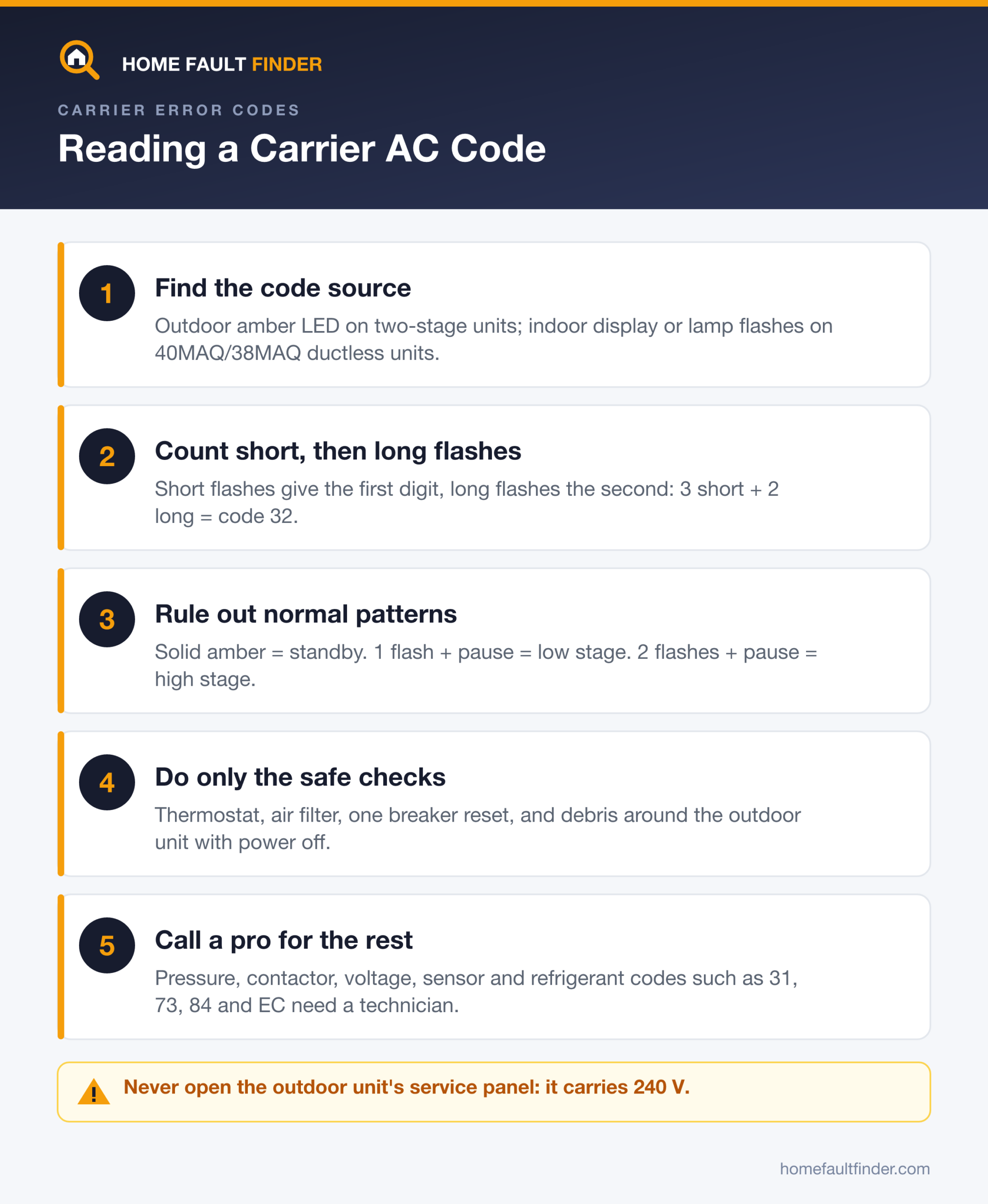
Carrier two-stage outdoor units report status with an amber LED on the control board. Short flashes of 0.25 seconds give the first digit, long flashes of 1.0 second give the second digit, and the LED stays dark for 2.5 seconds before the code repeats. Three short flashes followed by two long flashes therefore mean code 32.
Not every flash pattern is a fault. Per Carrier’s manual, solid amber means standby, one flash and a pause means low stage, and two flashes and a pause means high stage. Five or six flashes then a pause only show the brownout-protection setting. Never remove a panel to see the board; it carries 240 V.
What do Carrier two-stage outdoor unit codes mean?
Carrier two-stage outdoor unit codes are the two-digit amber flash codes used on Infinity two-stage condensers and heat pumps such as the 24ANB and 25HNB families. Each code points to a switch, sensor or voltage condition the board detected, and codes 81 through 84 are lockouts that follow three repeated trips of the same kind.
Other Carrier platforms may number codes differently; confirm with your model’s manual.
| Code | Meaning | Common cause |
|---|---|---|
| 16 | System communication failure | Wall control link lost; wiring |
| 25 | Invalid model plug | Missing or wrong plug; unit will not run |
| 31 | High-pressure or discharge-temperature switch open | Dirty coil, outdoor fan problem, refrigerant charge |
| 32 | Low-pressure switch open | Low refrigerant charge or poor indoor airflow |
| 45 | Control fault | Outdoor control board has failed |
| 46 | Brownout (230 V) | Line voltage under 187 V for 4 seconds |
| 47 | No 230 V at unit | No power at contactor during a call for cooling |
| 53 | Outdoor air temperature sensor fault | Sensor or wiring open or out of range |
| 55 | Outdoor coil sensor fault | Sensor or wiring open or out of range |
| 56 | Thermistors out of range | Coil and air sensors disagree |
| 71 / 72 | Low- / high-stage thermal cutout | Compressor internal overload tripped |
| 73 | Contactor shorted | Contactor stuck closed or wiring error |
| 74 | No 230 V at compressor | Contactor stuck open or wiring error |
| 81 / 82 | Low- / high-stage thermal lockout | 3 cutouts in a row; 4-hour lockout |
| 83 | Low-pressure lockout | 3 trips in a row; 4-hour lockout |
| 84 | High-pressure lockout | 3 trips in a row; 4-hour lockout |
Codes 31, 32, 71 and 72 trigger a retry sequence rather than an instant lockout. The compressor stops, the outdoor fan may run up to 15 minutes, and the control retries every 15 minutes; three failures in a row bring up lockout codes 81 to 84.
What do Carrier ductless mini-split error codes mean?
Carrier ductless mini-split error codes are two-character codes shown on the indoor unit’s display on high-wall systems such as the 40MAQ indoor and 38MAQ outdoor units. If the display is turned off, the same fault shows as a number of flashes on the operation lamp, which is why people search for a Carrier AC light blinking 5 or 7 times.
Carrier ductless lines come from more than one platform and meanings differ between them, so compare with your indoor model’s manual. For a broader look at cooling problems on these systems, see our guide to a mini split that is not cooling.
| Display | Operation lamp flashes | Meaning |
|---|---|---|
| E0 | 1 | Indoor unit EEPROM parameter error |
| E1 | 2 | Indoor / outdoor unit communication error |
| E3 | 4 | Indoor fan speed out of control |
| E4 | 5 | Indoor room temperature sensor (T1) open or shorted |
| E5 | 6 | Evaporator coil temperature sensor (T2) open or shorted |
| EC | 7 | Refrigerant leakage detected |
| F1 | 2 | Outdoor ambient temperature sensor (T4) open or shorted |
| F2 | 3 | Condenser coil temperature sensor (T3) open or shorted |
| F3 | 4 | Compressor discharge temperature sensor (T5) open or shorted |
| F4 | 5 | Outdoor unit EEPROM parameter error |
| F5 | 6 | Outdoor fan speed out of control |
| P0 | 1 | IPM malfunction or IGBT overcurrent protection |
| P1 | 2 | Over-voltage or under-voltage protection |
| P2 | 3 | Compressor top high-temperature protection |
| P4 | 5 | Inverter compressor drive error |
Which Carrier error codes can a homeowner safely check?
Homeowners can safely work through the checks that do not involve opening the unit: confirming thermostat settings, replacing a dirty air filter, resetting a tripped AC breaker once, and clearing leaves or grass from around the outdoor unit with the power off. Everything inside the service panels, including the contactor, capacitor and refrigerant circuit, belongs to a licensed technician.
The outdoor unit runs on 240 V and its capacitor can stay charged after power is off. Do not remove panels or open the outdoor disconnect box.
-
Check the thermostat or wall control
Confirm it is in Cool, set at least 3 °F below room temperature, and has working batteries if it uses them. Infinity controls also show fault history.
-
Replace or clean the air filter
A clogged filter starves the indoor coil of airflow and can cause low-pressure trips (32). It takes 5 minutes.
-
Reset the AC breaker once
Switch a tripped AC breaker fully off, then on, once only. If it trips again, leave it off and call a pro.
-
Clear around the outdoor unit with the power off
Turn the thermostat to Off and switch off the AC breaker first. Clear about 2 feet of space and rinse the coil gently with a garden hose, never a pressure washer.
-
Restore power and watch the light
Turn the breaker on, set Cool, and watch the light or display for 15-20 minutes. If the code returns, schedule service.
Why does my Carrier AC show code 31, 32, 83 or 84?
Carrier codes 31 and 84 point to the high-pressure side, and codes 32 and 83 point to the low-pressure side. Code 31 is a single high-pressure or discharge-temperature switch trip, and 84 means that trip happened in three consecutive cycles. Code 32 is a single low-pressure trip, and 83 is the three-strike lockout of the same fault.
High-pressure trips often come from a matted outdoor coil, a stopped fan or an overcharge. Low-pressure trips usually mean a blocked filter, a frozen indoor coil or a leak. Our guide to an AC that is not cooling enough covers the airflow side in more depth.
Adding refrigerant or opening the refrigerant circuit requires EPA Section 608 certification.
What do Carrier power and contactor codes 46, 47, 73 and 74 mean?
Carrier codes 46, 47, 73 and 74 describe electrical conditions at the outdoor unit. Code 46 is a brownout: line voltage below 187 V for at least 4 seconds, with the compressor and fan held off until voltage climbs above 190 V. Code 47 means no 230 V reached the contactor during a cooling call.
Code 73 is urgent: the compressor may run nonstop, so switch the system off and call a technician. For code 74, see our guide to an AC compressor that is not starting.
How do you reset a Carrier air conditioner error code?
A Carrier air conditioner error code resets on its own once the fault clears, or after the control board loses and regains power. Carrier’s manual states that lockout codes 81 to 84 hold the stage or unit off for 4 hours or until 24 V control power is recycled, which a single breaker cycle at the AC accomplishes.
A reset only lets the board retry; repeated resets on pressure or thermal lockouts can stress the compressor.
Code-by-code decision table: DIY check or call a pro?
The decision table below groups the verified Carrier codes by what a homeowner can safely do about each one, from normal patterns that need no action to faults that call for a same-day technician visit.
| Code(s) | What it points to | Your next step |
|---|---|---|
| Solid amber, 1 or 2 flashes and pause | Normal standby or running | Nothing; not a fault |
| 16, 25, 45 | Communication, model plug or board fault | Call a pro |
| 31, 84 | High pressure | Clear coil area with power off, then call a pro if it returns |
| 32, 83 | Low pressure | Replace filter, check vents are open, then call a pro |
| 46, 47 | Supply voltage | Reset breaker once; if repeated, call a pro or your utility |
| 73 | Contactor stuck closed | Shut the system off and call a pro the same day |
| E1, F1-F5, P0-P4 | Ductless board, sensor or inverter fault | Power-cycle once, then call a pro |
| EC | Refrigerant leak detected | Stop using cooling and call an EPA-certified pro |
For an older system with compressor or refrigerant codes, our AC repair vs replace cost guide helps you weigh the quote.
Call a licensed HVAC technician for refrigerant codes (EC, repeated 31, 32, 83, 84), contactor and voltage codes (73, 74, or 47 after one reset), and board, sensor or inverter codes.
Shut the system off if you smell burning or the compressor runs with the thermostat off. Never bypass a pressure switch or jumper the contactor.
Frequently asked questions
Why is my Carrier AC light blinking but the unit is running?
A Carrier outdoor board that flashes once or twice and pauses while the unit runs is reporting normal low-stage or high-stage operation, not a fault. A solid amber light means standby. Only two-digit short-and-long patterns are fault codes.
What does EC mean on a Carrier mini split?
On Carrier 40MAQ and 38MAQ high-wall ductless systems, EC means the outdoor unit detected a refrigerant leak while cooling. Carrier says the check runs only in cooling mode to protect the compressor. Turn cooling off and call an EPA-certified technician to repair the leak.
What does E1 mean on a Carrier ductless unit?
E1 on Carrier 40MAQ and 38MAQ ductless systems is an indoor and outdoor unit communication error, shown as 2 flashes of the operation lamp. Causes include a damaged interconnecting cable or a failed board. Power-cycle once; if E1 returns, call a technician.
How long does a Carrier AC lockout last?
A Carrier two-stage outdoor unit stays locked out for 4 hours after codes 81, 82, 83 or 84, or until 24 V control power is recycled. Single pressure and thermal trips (31, 32, 71, 72) retry every 15 minutes first, and three failures in consecutive cycles become the 4-hour lockout.
Does a Carrier AC have a reset button?
Most Carrier central air conditioners have no homeowner reset button. The board resets after the fault clears or after power is cycled at the AC breaker, and lockout codes 81 to 84 also clear after 4 hours. On ductless systems, switching the breaker off for a few minutes does the same job.