

A leak under a kitchen sink usually comes from the P-trap slip nuts, the strainer seal, the supply lines and shut-off valves, the faucet or sprayer hose, the dishwasher drain hose, or the garbage disposal. Timing narrows it: a leak only while water runs is drain-side; a leak with the faucet off is the pressurized supply side.
- Drain-side leaks appear only when water flows; supply-side leaks drip 24 hours a day.
- A loose P-trap slip nut is the most common cause and often needs only a quarter turn by hand.
- The EPA says to dry water-damaged areas within 24-48 hours to prevent mold growth.
- This Old House puts a plumber’s leaking-pipe repair at $150 to $450 (June 2026 update).
A wet cabinet floor, a swollen base panel, or a musty smell under the sink means something has been leaking for a while. Water runs along pipes and drips from the lowest point, which is rarely where it starts, so this guide shows how to trace the real source and which fixes are safe DIY jobs. Under-sink leaks rank among the most common plumbing problems, and most are cheap to fix.
- What is leaking under my kitchen sink?
- Leak timing decision table
- How do you find the exact leak?
- How do you fix a leaking P-trap?
- Why is the drain leaking around the basket?
- Why does it leak when the water is off?
- Faucet, sprayer and dishwasher leaks
- Is the garbage disposal leaking?
- How much does a repair cost?
- What about water damage and mold?
- Mistakes that bring leaks back
- FAQ
What is leaking under my kitchen sink?
A leak under a kitchen sink is water escaping from a joint, seal, or hose inside the sink cabinet. The usual suspects are the P-trap and slip nuts, the strainer basket seal, the hot and cold supply lines, the shut-off valves, the faucet base, the pull-out sprayer hose, the dishwasher drain hose, and the garbage disposal.
The drain side carries water only during use and is not pressurized. The supply side holds full house pressure all the time, so even a pinhole there releases a lot of water.
When does the sink leak? Use timing to find the source
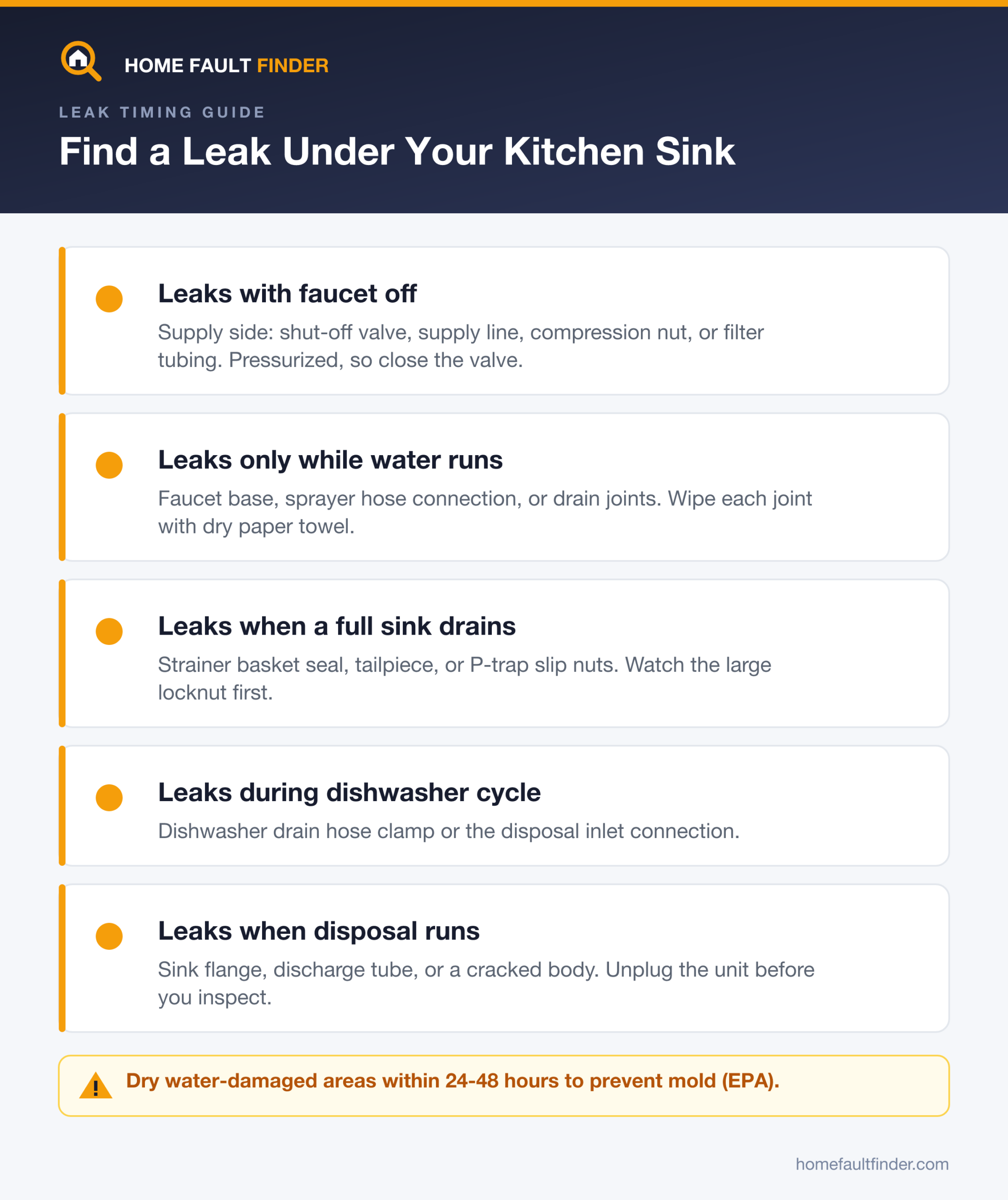
Leak timing is the fastest clue for a kitchen sink leak, because each part carries water only at certain moments. Note whether the cabinet gets wet with the faucet off, while the faucet runs, when a full sink drains, or during a dishwasher cycle, then match your answer to the table before you pick up a wrench.
| When it leaks | Most likely source |
|---|---|
| All the time, faucet off | Shut-off valve, supply line, compression nut, or filter tubing |
| Only while the faucet runs | Faucet base, sprayer hose fitting, or drain joints |
| Only when a full sink drains | Strainer seal, tailpiece, or P-trap slip nuts |
| Only during a dishwasher cycle | Dishwasher drain hose clamp or disposal inlet |
| Only when the disposal runs | Disposal sink flange, discharge tube, or cracked body |
How do you find the exact leak under the sink?
Finding the exact source of a kitchen sink leak takes about 20 minutes with a flashlight, dry paper towels, and food coloring. Start with every surface dry, then send water through one part at a time, so the first damp towel shows where the leak begins rather than where it drips off.
-
Empty and dry the cabinet
Clear the cabinet, set a shallow pan on the floor, and wipe every pipe, valve, and hose dry.
-
Wrap each joint in paper towel
Wrap dry paper towel around the valves, supply line ends, strainer, slip nuts, and disposal connections.
-
Test the supply side
Leave the faucet off for 15 minutes. A damp towel at a valve or supply line means a pressurized leak.
-
Test the drain side
Run water for two minutes, then fill the basin, add a few drops of food coloring, and pull the stopper. Colored water on a towel confirms a drain leak.
-
Test the sprayer and appliances
Use the sprayer, then run the dishwasher and the disposal one at a time, checking towels after each.
Cold supply lines can sweat in humid weather; sweating covers the whole pipe evenly, while a real leak starts at one joint.
How do you fix a leaking P-trap or slip nut?
A P-trap is the U-shaped drain pipe under the sink that holds water to block sewer gas. Plastic traps join with slip nuts and tapered washers that loosen from vibration, disposal use, or bumps from stored items. A loose or misaligned slip nut is the most common cause of a drip that appears only while water runs.
-
Hand-tighten first
Turn each slip nut about a quarter turn clockwise by hand. Pliers crack plastic nuts.
-
Remove the trap if it still drips
Set a bucket below, loosen both nuts, and take the trap off. Clean out any debris.
-
Check washers and alignment
The beveled side of each washer faces the fitting it seals. Replace flattened or cracked washers, and line the pipes up straight; angled joints never seal.
-
Reassemble and retest
Hand-tighten, fill and drain the sink twice, and repeat the towel test. Replace a cracked trap with a standard 1-1/2 inch kitchen trap kit.
Why is the sink drain leaking around the basket?
A sink strainer leak happens when the seal between the sink and the strainer basket fails, letting water slip past the drain opening and run down the tailpiece. The seal is plumber’s putty or a rubber gasket, and it dries out or breaks loose after years of hot water and disposal vibration.
The clue is water on top of the large locknut directly under the drain. Remove the strainer, scrape off old putty, press fresh putty under the flange, and retighten the locknut while a helper holds the basket. Some composite and stone sinks call for silicone or the gasket alone, so check the sink maker’s instructions first.
Why does the kitchen sink leak when the water is off?
A kitchen sink that leaks with the faucet off has a supply-side leak, because only the shut-off valves, supply lines, and faucet inlet connections hold water when nothing runs. That water is under full house pressure, so treat it as urgent. A failed braided supply line can flood a cabinet and the floor below within minutes.
Close the shut-off valve by turning it clockwise. Old multi-turn valves often seize, leak at the stem, or snap when moved after years of disuse. If a valve will not turn by hand or will not stop the flow, close the main instead with our guide to shutting off the water main.
Typical causes are a loose packing nut behind the valve handle, a compression nut that is not fully tight, a kinked or bulging braided line, and a corroded valve body. A stem drip can sometimes be stopped by snugging the packing nut slightly; a bulging or rusted line should be replaced, not tightened. Under-sink water filters and reverse osmosis (RO) systems add push-to-connect fittings that leak if the tubing is not fully seated; follow the filter maker’s manual.
Can the faucet, sprayer or dishwasher cause the leak?
The faucet, the pull-out sprayer hose, and the dishwasher drain hose are frequent sources of water in a sink cabinet that people overlook. Each leaks only while in use, so a cabinet that gets wet after washing dishes often has one of these at fault rather than the drain pipes.
Water at the faucet base can seep through the mounting hole and run down the shank, usually from a worn base gasket or loose mounting nut. If the spout drips into the bowl, see our guide to fixing a dripping faucet. Sprayer hoses also split where they bend.
The dishwasher drain hose attaches to the disposal inlet or a tailpiece fitting with a clamp, and a loose clamp leaks only during the drain part of a cycle. If water appears on the floor in front of the dishwasher instead, read about a dishwasher leaking from the bottom.
Is the garbage disposal leaking?
A garbage disposal leak usually comes from one of three points: the sink flange at the top where the unit hangs, the side connections for the dishwasher inlet and discharge tube, or the bottom of the housing. Where the water appears tells you what failed and whether the disposal can be saved.
Unplug the disposal or switch off its circuit breaker before you inspect or touch it, and never put a hand inside the grinding chamber.
A top-flange leak is usually a loose mounting ring or failed putty. A discharge-tube leak typically needs a new gasket. Water dripping from the bottom of the housing generally means worn internal seals or a cracked body, and the unit should be replaced. If it also hums or will not start, see our guide to a garbage disposal that is not working.
How much does it cost to fix a leak under the sink?
The cost to fix a leak under a kitchen sink depends mostly on whether you do it yourself. Retightening a slip nut is free, and washers, trap kits, and supply lines are inexpensive hardware-store parts. Hiring a plumber adds an hourly rate and a service fee, and replacing a disposal or faucet raises the bill.
| Job (professional) | Typical range |
|---|---|
| Plumber hourly rate | $25–$200 per hour (about $100 average, plus service fee) |
| Leaking pipe repair | $150–$450 |
| Garbage disposal repair | $100–$300 |
| Faucet replacement | $150–$600 |
Waiting costs money too: EPA WaterSense says the average household’s leaks can waste more than 9,300 gallons a year, and particleboard cabinet floors swell beyond repair.
What should you do about water damage and mold under the sink?
Water damage under a kitchen sink should be dried fast, because the U.S. Environmental Protection Agency says water-damaged areas and items should be dried within 24-48 hours to prevent mold growth. Fix the leak, empty the cabinet, and run a fan with the doors open until it is dry.
Soft or swollen particleboard usually needs replacement. The EPA says most people can clean a moldy area smaller than about 10 square feet themselves; larger growth or mold inside the wall calls for a professional. If a stain appears on the ceiling below, see our guide to a water stain on the ceiling.
What mistakes keep a sink leak coming back?
Repeat under-sink leaks usually come from a repair that treated the drip point instead of the source, or from damaging a part during the fix. Most of them come down to forcing parts, reusing worn seals, or treating a temporary patch as the final repair, and each one is easy to avoid.
- Overtightening plastic slip nuts with pliers.
- Putting thread tape on slip joints, which seal with the washer, not the threads.
- Forcing a seized shut-off valve.
- Covering a leak with tape or sealant as a permanent fix.
Call a licensed plumber if a shut-off valve is corroded, seized, or leaks when turned, if you cannot stop a supply leak at the main, or if the leak returns after new washers and fresh putty. A leak inside the wall, water reaching the room below, or any wiring problem at the disposal outlet also needs a pro.
Frequently asked questions
Can a clogged drain cause a leak under the sink?
Yes. A clog backs water up into the tailpiece and P-trap, and joints that seal under normal flow start to seep under the extra weight. Clear the clog first (see our clogged kitchen sink guide), then retest each joint with dry towels.
Is it safe to use the sink while it is leaking?
A slow drain-side drip is usually fine to live with briefly if a pan catches the water and you dry the cabinet afterward. A leak with the faucet off is a pressurized supply leak, so close the shut-off valve until it is repaired.
How long do braided supply lines last?
Braided stainless supply lines commonly last years, but water quality, kinks, and pressure shorten their life. Replace any line showing rust, bulging, fraying, or a kink, and follow the replacement interval the manufacturer prints on the packaging.
Will homeowners insurance cover a leak under the kitchen sink?
Coverage depends on the policy. Many cover sudden water damage, such as a burst supply line, but exclude slow long-term leaks and the failed part itself. Photograph the damage and call your insurer before major repairs or demolition.
Why does my sink cabinet smell musty but feel dry?
A musty smell with dry surfaces often means an earlier leak soaked the particleboard or the space under the cabinet floor. Look for swelling, dark stains, or soft spots and dry the area with a fan. Odor that returns may signal hidden mold.