
Replace your refrigerator when a repair would cost more than half the price of a comparable new model, or when a compressor or sealed-system failure hits a unit that is 10 or more years old. As of October 2026, cost guides put sealed-system repair at $800–$1,200, against $1,000–$3,000 for a new refrigerator.
- A refrigerator typically lasts about 12–13 years; ENERGY STAR uses a 12-year lifetime in its savings estimates.
- The 50% rule: if the repair quote is more than half the price of a comparable new fridge, replacement usually wins.
- Door gaskets, fans, thermostats and condenser-coil cleaning cost $60–$260 and are worth doing at almost any age.
- Compressor and sealed-system repairs ($500–$1,200) only make sense on younger units or ones still under sealed-system warranty.
- An old fridge must be recycled with its refrigerant recovered, and its door removed before it is stored or discarded.
This guide is for anyone holding a repair quote for a refrigerator that is no longer young. We turn the general appliance rule of thumb into a refrigerator-specific calculation: which failures are cheap wear parts, which mean the cooling system is giving out, how age changes the answer, what a newer model saves on electricity, and how to get rid of an old unit safely.
- How long should a refrigerator last?
- What are the signs a refrigerator needs replacing?
- Is it worth repairing a refrigerator?
- How do you run the repair-or-replace math?
- Should you replace a refrigerator with a bad compressor?
- How much does a new refrigerator save on energy?
- What should you check before deciding?
- How do you dispose of an old refrigerator safely?
- Frequently asked questions
How long should a refrigerator last?
A household refrigerator typically lasts about 12 to 13 years. ENERGY STAR builds its savings estimates on a 12-year product lifetime, and the Fixr refrigerator repair cost guide gives 13 years as the average. Simple top-freezer models often run longer; units with ice makers and dispensers tend to need more repairs.
A fridge in a hot garage or with dusty coils ages faster than one in a cool kitchen. What matters for your decision is age relative to that span: a 6-year-old fridge has roughly half its life left; a 12-year-old one is living on borrowed time.
Unsure of the age? The serial number on the rating plate usually encodes the manufacture date — see how to find your appliance model and serial number.
What are the signs a refrigerator needs replacing?
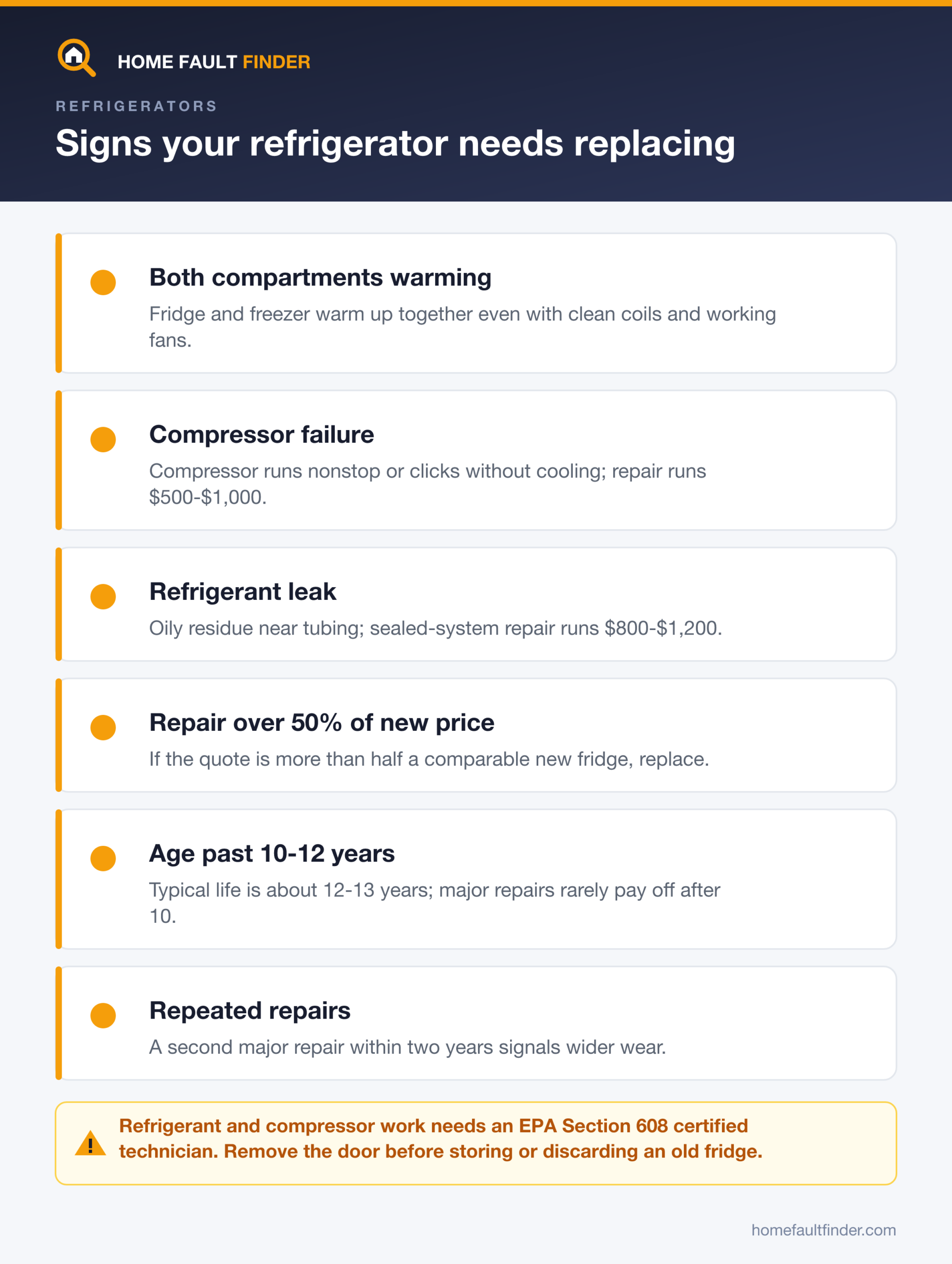
The signs a refrigerator needs replacing are failures of the cooling system itself, not of the parts around it. Warm temperatures in both the fridge and the freezer even though the coils are clean and the fans spin, a compressor that runs nonstop or clicks on and off without cooling, and repeated repairs within a year or two all point toward replacement.
Other warning signs worth taking seriously:
- Both compartments are warming at once, not just the fresh-food side (a warm fridge with a cold freezer is usually a cheaper airflow or defrost fault).
- An oily residue near the compressor or tubing, a common sign of a refrigerant leak.
- The compressor runs almost constantly and your electricity bill has crept up.
- Rust on the cabinet or a cracked inner liner.
- Replacement parts are listed as discontinued for your model.
Is it worth repairing a refrigerator?
Repairing a refrigerator is worth it when the failed part is a wear item — a gasket, fan, thermostat or water valve — because those repairs cost a few hundred dollars at most and restore full function. Repairs to the compressor, sealed system or main control board cost $500–$1,200 and are only worth it on younger refrigerators.
The table sets typical installed costs against the age of the unit, assuming a refrigerator that would cost $1,000–$3,000 to replace; on a budget model the expensive rows tip toward replacement sooner.
| Repair | Typical cost (parts + labor) | Under 5 years | 5–10 years | Over 10 years |
|---|---|---|---|---|
| Condenser coil cleaning | $60–$100 (free DIY) | Repair | Repair | Repair |
| Door gasket | $60–$100 | Repair | Repair | Repair |
| Thermostat | $100–$260 | Repair | Repair | Usually repair |
| Evaporator or condenser fan | $120–$200 | Repair | Repair | Usually repair |
| Water dispenser | $170–$500 | Repair | Repair | Weigh it |
| Ice maker | $350–$500 | Repair | Weigh it | Often skip or replace fridge |
| Main control board | $500–$1,000 | Repair | Weigh it | Usually replace |
| Compressor | $500–$1,000 | Repair (check warranty) | Weigh it | Replace |
| Sealed system (leak + recharge) | $800–$1,200 | Repair (check warranty) | Usually replace | Replace |
Age barely matters for the cheap rows: a $100 gasket on a 14-year-old fridge still buys real time; a $1,000 compressor does not. Many brands cover sealed-system parts longer than the standard one-year warranty, so on a fridge under five years old, read the warranty first.
How do you run the repair-or-replace math?
The repair-or-replace math for a refrigerator combines two ratios: repair cost divided by the price of a comparable new model, and current age divided by a 12–13 year expected life. When the cost ratio is above 50%, or the age ratio is above about 75% and the repair is a major one, replacement is usually the better use of money.
-
Get a written diagnosis and quote.
Pay the $70–$120 service call and ask the technician to name the failed part.
-
Price a comparable new refrigerator.
Same style and size; include delivery and haul-away.
-
Divide the quote by the new price.
Under 25%: repair almost regardless of age. 25–50%: age decides. Over 50%: lean toward replacement.
-
Divide the fridge’s age by 12.
Under 0.5 means plenty of life left; over 0.75 means the unit is near the end of its expected life.
-
Add the repair history.
A second major repair within two years signals the rest of the system is wearing out.
An 11-year-old side-by-side stops cooling. The technician finds a failed compressor and quotes $850. A comparable new model costs $1,400 delivered. Cost ratio: 850 ÷ 1,400 = 61%. Age ratio: 11 ÷ 12 = 0.92. Both numbers point the same way — replace.
Now take a 6-year-old fridge with a dead evaporator fan quoted at $180 against the same $1,400 replacement. Cost ratio: 13%. Age ratio: 0.5. Repair it without hesitation; the fan is a wear part and the cooling system is sound.
Should you replace a refrigerator with a bad compressor?
A refrigerator with a bad compressor should usually be replaced if it is more than about 8–10 years old. Compressor replacement means opening the sealed system, recovering the refrigerant, brazing in new parts and recharging — work that typically costs $500–$1,200, often half the price of a new fridge.
A sealed system is the closed refrigerant loop of compressor, condenser, evaporator and tubing; any repair that opens it carries the same recovery-and-recharge labor.
Confirm the diagnosis first: a compressor that clicks but will not start is sometimes a far cheaper start relay, and one that never stops may be fighting dirty coils or a failed fan — see our guide to a refrigerator compressor that won’t turn off.
Refrigerant work is not a DIY job. Under the Clean Air Act, EPA requires technicians who maintain, service, repair or dispose of equipment that could release refrigerants to hold Section 608 certification; household refrigerators fall under the Type I (small appliance) category.
Do not cut, drill or puncture refrigerant tubing, and skip online “recharge kits”, which only delay the failure. If you smell a sharp chemical odor or see oily residue near the tubing, unplug the refrigerator and call a certified appliance technician.
How much does a new refrigerator save on energy?
A new ENERGY STAR refrigerator saves a modest but real amount of energy. According to ENERGY STAR, certified refrigerators are about 9% more efficient than the federal minimum, an old refrigerator uses about 20% more energy than a certified model, and a fridge over 15 years old could be costing you about $95 a year more to run.
ENERGY STAR also estimates that recycling an old fridge and replacing it with a certified model saves about $150 over a 12-year lifetime — not enough on its own to replace a refrigerator that works well. Treat energy savings as a tiebreaker when a repair is borderline.
ENERGY STAR also notes that top-freezer models tend to use the least energy and that the most efficient sizes are typically 16–20 cubic feet. Our look at whether ENERGY STAR appliances are worth the price runs the numbers for other appliances. The biggest waste is an old second fridge in a hot garage: ENERGY STAR recommends replacing it with a certified model if you need it year-round, and otherwise recycling it.
What should you check before deciding?
Several free checks should come before any refrigerator replacement decision, because many “dying fridge” complaints turn out to be maintenance problems. Confirm the settings, clean the condenser coils, test the door seal and listen for both fans before paying for a diagnosis. Our refrigerator troubleshooting guide covers each symptom in depth.
-
Check the temperature settings.
Aim for 37°F (3°C) in the fresh-food section and 0°F (−18°C) in the freezer, and give the fridge 24 hours after any change. A thermometer costs a few dollars.
-
Clean the condenser coils.
Unplug the fridge first. Dust-matted coils make the compressor run longer and hotter. See how to clean refrigerator condenser coils; 20–30 minutes with a coil brush and vacuum.
-
Test the door gasket.
Close the door on a dollar bill; if it slides out easily, cold air is leaking. A new gasket costs $60–$100 installed.
-
Listen for the fans.
With the door open and the switch pressed, you should hear the evaporator fan inside the freezer; the condenser fan at the back should run whenever the compressor does.
How do you dispose of an old refrigerator safely?
An old refrigerator should be disposed of through a recycler that recovers its refrigerant and insulation foam, and its door should come off before it sits anywhere a child could reach. Retailer haul-away and utility recycling programs are usually the easiest routes.
ENERGY STAR’s fridge and freezer recycling finder lists four routes: retailers that partner with EPA’s Responsible Appliance Disposal (RAD) program, local utility programs, your local waste management division, and scrap metal recyclers. Under EPA rules, the final person in the disposal chain must ensure the refrigerant is recovered before the appliance is scrapped.
Child entrapment is the safety issue people forget. The U.S. Consumer Product Safety Commission reports suffocation deaths of children who hid inside old latch-type refrigerators and freezers. CPSC says the surest prevention is to take the door off completely before storing or discarding the appliance, and notes that many local jurisdictions make it unlawful to discard an old refrigerator with the door still attached.
Frequently asked questions
Is it worth fixing a 10-year-old refrigerator?
A 10-year-old refrigerator is worth fixing when the repair is a wear part such as a gasket, fan, thermostat or water valve costing under about $260. A compressor or sealed-system repair on a 10-year-old fridge usually costs $500–$1,200, which is often half the price of a new unit, so replacement tends to win.
Can a refrigerator last 20 years?
A refrigerator can last 20 years, especially a simple top-freezer model kept in a cool kitchen with clean coils, but that is well beyond the typical 12–13 year lifespan. A 20-year-old unit also uses noticeably more electricity than a current ENERGY STAR model, so it is worth replacing once a major repair comes up.
What usually fails first on a refrigerator?
The parts that usually fail first on a refrigerator are wear items: door gaskets, evaporator and condenser fan motors, defrost components, ice makers and water inlet valves. These are inexpensive to fix. Compressor and sealed-system failures are less common but far costlier, and they usually end a refrigerator’s life.
Is a refrigerant leak worth repairing?
A refrigerant leak is worth repairing only on a fairly new refrigerator or one still covered by a sealed-system warranty. Finding and repairing the leak, then evacuating and recharging the system, requires an EPA Section 608 certified technician and often runs $800–$1,200 including the sealed-system work, which rarely makes sense on an older unit.
Do utilities pay you to recycle an old refrigerator?
Some utilities pay you to recycle an old refrigerator. ENERGY STAR notes that local utilities and energy-efficiency organizations run fridge and freezer recycling programs, and that some offer cash or a utility bill credit for the old unit. Availability varies by region, so check your electric utility’s website before booking a paid haul-away.