An outlet sparking when plugging in is usually normal if you see one tiny, quick blue flash that vanishes instantly while a device that was switched on draws power. Large, white-yellow or orange sparks, repeated sparking, popping, a burning smell, scorch marks or a warm faceplate mean stop using the outlet and call a licensed electrician.
- The CPSC says outlet faceplates may feel warm but should never be hot, painful to touch or discolored from heat.
- Switching the appliance off before plugging in removes most normal sparks.
- U.S. fire departments responded to an estimated 23,700 residential electrical malfunction fires in 2023, according to the USFA.
- Smoke or flame means leave and call 911; never use water on an electrical fire.
We wrote this guide for homeowners and renters who just saw a flash at the wall and want to know, quickly, whether to shrug it off or stop using the outlet. Nothing here asks you to remove a cover plate, pull an outlet from the wall or open the breaker panel; work inside the box is a job for a licensed electrician.
- Is it normal for an outlet to spark when you plug something in?
- How do you tell a normal spark from a dangerous one?
- Why does my outlet spark when I plug something in?
- What should you do right after an outlet sparks?
- What if the outlet sparks and smokes or catches fire?
- Will an AFCI or GFCI stop a sparking outlet?
- How much does it cost to fix a sparking outlet?
- What will not fix a sparking outlet
- Frequently asked questions
Is it normal for an outlet to spark when you plug something in?
A small spark when plugging in is normal in many cases. When a plug’s blades touch the live contacts of a receptacle while the device is switched on, current jumps the last tiny gap and creates a brief blue arc. The flash should be small, quiet, blue and gone in a fraction of a second.
The normal spark grows with the load: a phone charger rarely shows anything, while a space heater, vacuum or hair dryer that is already switched on often produces a visible snap. Turn the appliance off, plug it in, then switch it on, and most normal sparks disappear.
A spark with the device off, a spark every time, or one that leaves marks is not normal. The Consumer Product Safety Commission lists arcs and sparks, sizzling or buzzing, overheating and burning odors as warning signs (CPSC Guide to Home Wiring Hazards).
How do you tell a normal spark from a dangerous one?
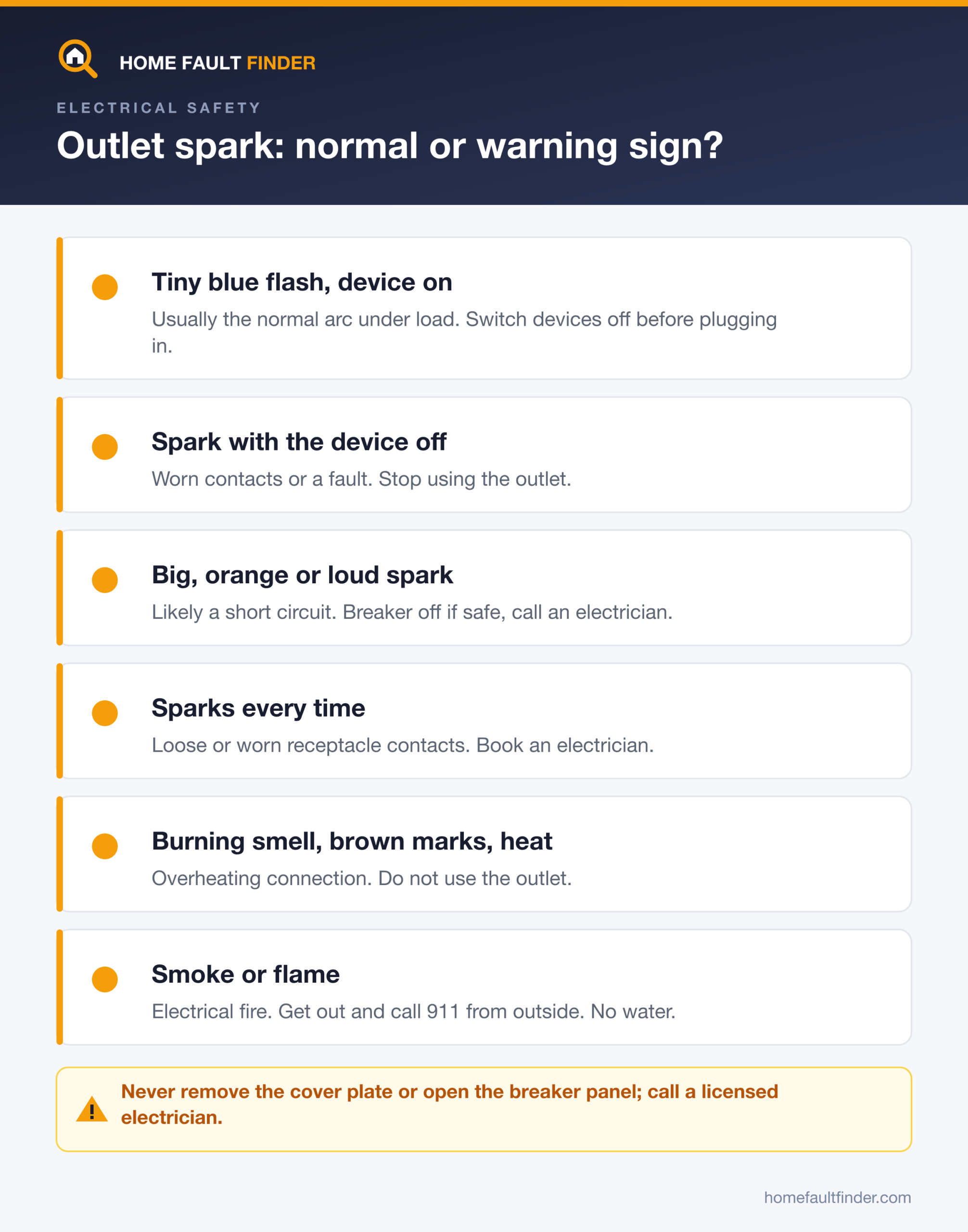
Telling a normal outlet spark from a dangerous one comes down to five observations: the spark’s color and size, how long it lasts, whether it repeats, whether a device was drawing power, and what you notice afterward, such as heat, smell or marks. Use the table below as a quick decision tool before you plug anything else into that outlet.
| What you notice | Most likely meaning | What to do |
|---|---|---|
| One tiny blue flash, instant, device was switched on | Normal arc under load | Switch devices off before plugging in |
| Same small flash with the device switched off | Worn contacts or a fault in the device or cord | Stop using the outlet |
| Large, white, yellow or orange spark, or a loud pop | Short circuit or heavy arcing | Stop; breaker off if safe; electrician |
| Sparks every time you plug in | Loose or worn receptacle contacts or connection | Stop using the outlet; electrician visit |
| Burning smell, melted or brown marks on plug or faceplate | Overheating at a connection | Do not use; electrician |
| Faceplate warm, hot or buzzing | Loose connection heating up | Do not use; electrician soon |
| Smoke or flame | Electrical fire | Leave, call 911 from outside |
Why does my outlet spark when I plug something in?
Outlets spark when plugging in for a handful of reasons: a device that is already switched on, worn receptacle contacts, a loose wire connection behind the faceplate, a short circuit, moisture, overloading, or older aluminum branch wiring. Only the first cause is harmless; every other one needs a licensed electrician to inspect it.
| Cause | How common | Typical clue |
|---|---|---|
| Plugging in a device that is switched on (load arc) | Very common | Small blue flash only with high-draw appliances |
| Worn receptacle contacts | Common in older outlets | Plugs wobble or fall out under the cord’s weight |
| Loose terminal or push-in (backstab) connection | Common | Warm faceplate, flickering device, repeated sparks |
| Short circuit in a cord, plug or appliance | Occasional | Big pop, breaker trips, blackened plug |
| Moisture or water exposure | Occasional | Kitchen, bath, garage or outdoor outlet; GFCI may trip |
| Aluminum branch wiring (homes wired roughly 1965 to mid-1970s) | Uncommon | Hot faceplates, flickering lights, burning plastic smell |
| Overloaded circuit | Common | Several heat-producing appliances on one outlet or strip |
Worn contacts are among the most commonly reported causes. Spring-metal contacts inside the receptacle lose tension over years, so the plug touches lightly, arcs and heats up. The CPSC notes that a plug that slips out easily or pulls out under its cord’s weight may have a loose connection likely to overheat; it also flags push-in (back-wired) connections as prone to loosening.
Aluminum wiring is a special case: in a CPSC-sponsored survey, aluminum-wired homes built before 1972 were 55 times more likely than copper-wired homes to have an outlet connection reach “fire hazard conditions.” Only an electrician should judge or repair it.
What should you do right after an outlet sparks?
After an outlet sparks, the safe sequence is simple: let go of the plug, check for smoke, flame, smell or heat without touching the faceplate, stop using that outlet, and switch off its circuit breaker only if you can do so from dry ground without opening the panel cover. Then book a licensed electrician to inspect the outlet.
Never touch a faceplate or plug that is smoking, sizzling, discolored or hot, and never remove the cover plate. Use dry hands on a dry floor.
-
Step back and look
Watch the outlet for 10 to 20 seconds. Smoke or flame means call 911.
-
Switch the device off, not the plug
Turn the appliance off with its own switch. If the plug is cool and undamaged, pull it out by the plug body, never by the cord.
-
Check the plug and cord
Black soot, melted plastic or a bent blade means the device stays unplugged until repaired or replaced.
-
Cut power to the circuit if you can do it safely
Flip only the clearly labeled breaker to OFF by its handle. Never remove the panel cover; if unsure or the area is wet, leave it. If the breaker keeps tripping on its own, see our guide to a circuit breaker that keeps tripping.
-
Mark the outlet out of use
Tape over it so nobody plugs in. Time: 1 minute.
-
Call a licensed electrician
Describe the spark color, frequency, and any smell or heat.
If the outlet stopped working entirely after the spark, the breaker or a GFCI upstream has probably tripped. See our guides to an outlet with no power and how to reset a GFCI outlet; reset only once.
What if the outlet sparks and smokes or catches fire?
An outlet that sparks and then smokes or shows flame is an electrical fire emergency. Get everyone out, close the door behind you, and call 911 from outside. Never throw water on it: water conducts electricity. An extinguisher is only for a small, contained fire when you have a clear exit and 911 is already called.
The U.S. Fire Administration describes Class C extinguishers as made for plugged-in electrical equipment, with an agent that does not conduct electricity; multipurpose “A-B-C” models also qualify. If you are unsure, leave and call 911 (USFA: Choosing and Using Fire Extinguishers).
A smell without smoke is still a stop sign; see our guide to a burning smell from an outlet.
Will an AFCI or GFCI stop a sparking outlet?
An AFCI (arc-fault circuit interrupter) is the device built for this problem: it monitors the circuit and shuts it off when it detects dangerous arcing, such as at a loose connection. A GFCI (ground-fault circuit interrupter) protects people from shock when current leaks to ground, for example through water. Neither replaces a repair.
The NFPA checklist describes AFCIs as protection against fire that shuts off a circuit when unintended arcing occurs, and recommends having a qualified electrician install them if your home lacks them. Where each device is required depends on the code edition your local authority adopted. A breaker that has not tripped is not an all-clear. Our comparison of GFCI vs AFCI breakers explains the difference in plain terms.
How much does it cost to fix a sparking outlet?
Fixing a sparking outlet usually costs $150 to $400 nationally, according to Fixr’s electrical outlet repair cost guide. The final price depends on whether the electrician only replaces the receptacle or also has to repair damaged wiring, add GFCI or AFCI protection, or address aluminum connections.
| Job | Typical national range |
|---|---|
| General outlet repair | $75–$200 |
| Replace a standard outlet | $120–$200 |
| Repair a sparking or burned outlet | $150–$400 |
| Full range reported, simple to complex | $50–$500 |
Costs climb when heat has damaged the box or wiring, or several outlets share the problem. For aluminum wiring, the CPSC recognizes only copper replacement and two connection-repair methods as permanent, done by a qualified electrician.
What will not fix a sparking outlet
Several common reactions to a sparking outlet make the problem worse or simply hide it. Avoid these while you wait for an electrician; a receptacle that grips plugs loosely should be replaced by a qualified electrician, according to the CPSC.
- Bending plug blades apart for a tighter fit. The CPSC warns this usually causes worse overheating later.
- Plugging the same high-draw appliance into a power strip or extension cord on that outlet instead.
- Installing a larger breaker or fuse because the old one keeps tripping. The CPSC says never to do this.
- Repeatedly resetting a breaker or GFCI that trips again right away.
Call a licensed electrician if an outlet sparks more than once, sparks with the device off or nothing plugged in, produces a large or orange spark or a pop, smells like burning plastic, looks brown or melted, buzzes, or feels hot. The NFPA lists sparks from an outlet and discolored or warm outlets among the reasons to call a qualified electrician.
Call sooner if your home is decades old or has aluminum branch wiring. Work inside outlet boxes and panels is governed by local code and often needs a permit; it is not a DIY repair.
Frequently asked questions
Can you use an outlet after it sparks?
You can keep using an outlet after one small blue spark if the device was switched on, the spark vanished instantly, and the plug and faceplate stay cool with no smell or marks. Any repeat, discoloration, heat or burning odor means stop using it until a licensed electrician checks it.
Why would an outlet spark with nothing plugged in?
An outlet that sparks, pops or crackles with nothing plugged in is never normal. With no plug there is no load at the face, so the arcing is inside the box, usually a loose or damaged connection, a failing receptacle or moisture. Switch off its breaker if safe and call an electrician the same day.
Why does my outlet spark when I plug in my phone charger?
A phone charger draws little power, so a visible spark when plugging it in points to worn outlet contacts, a loose connection, or a damaged charger. Try the charger in another outlet. If it sparks there too, replace the charger; if not, have the outlet inspected.
Why does an outlet spark when you unplug something?
An outlet sparks when unplugging because current is still flowing as the blades leave the contacts. The CPSC recommends switching appliances off before unplugging and never pulling by the cord. Sparks or smoke near the plug, or a hot faceplate, mean the cord or outlet needs a qualified repair.
Should I turn off the breaker to a sparking outlet?
Turning off the breaker for a sparking outlet is a sensible precaution if the panel is in a dry spot, the breaker is clearly labeled, and you only use the handle without removing any cover. If you are unsure which breaker it is, leave the panel alone and call an electrician.