A water heater reset button that keeps tripping means the high-limit safety switch (the ECO) is sensing water far hotter than the thermostat should ever allow, commonly 170–190°F on residential electric tanks. One trip can be a fluke; a second trip within days points to a stuck thermostat, a shorted element or a loose wire, and needs a technician.
- Typical electric tank high limits are rated at 170°F or 190°F, above the thermostat’s adjustable range.
- A trip within minutes usually points to a shorted element; a trip after hours or days, to a stuck thermostat.
- GE Appliances says a qualified technician must find the cause before the heater returns to service.
- Thermostat or element replacement typically runs $150–$350 installed, as of November 2026.
- Never bypass the reset switch or plug the temperature and pressure (T&P) relief valve.
This guide is for owners of an electric tank whose red reset button keeps popping. We explain what the button protects against, what each trip’s timing tells you, which checks are safe, and which jobs belong to a professional. If you have no hot water and no tripped button, start with our guide to a water heater with no hot water.
- What does the reset button on a water heater do?
- Where is the reset button on an electric water heater?
- Why does the reset button keep tripping?
- What does the timing of the trip tell you?
- What can you safely check yourself?
- Why won’t the reset button click or stay in?
- Do gas water heaters have a reset button?
- Is it safe to keep pressing the reset button?
- How much does it cost to fix?
- Frequently asked questions
What does the reset button on a water heater do?
The water heater reset button is the manual-reset lever of the high-limit switch, also called the energy cut-off (ECO). The ECO is a safety switch that cuts power to the heating elements when tank water gets dangerously hot. Once it opens, it stays open until someone resets it by hand, so the heater cannot quietly overheat again.
According to GE Appliances’ water heater support page, the ECO is combined with the thermostat, sits above the heating element in contact with the tank surface, and breaks the power circuit to the element if the water becomes excessively high in temperature. It only acts when the thermostat fails to switch the element off.
Rheem’s parts catalog lists upper thermostats with a manual-reset high limit fixed at 170°F or 190°F, paired with adjustable ranges such as 90–150°F or 120–180°F. Your heater’s exact rating is on the part and in its manual.
Where is the reset button on an electric water heater?
On most residential electric water heaters, the reset button sits on the upper thermostat assembly, behind the upper metal access cover on the side of the tank. The button is usually red and often labeled “reset” or “ECO.” Many tanks have two thermostats, but typically only the upper one carries the high-limit reset.
Behind that cover are live terminals. A full-size U.S. electric tank normally runs on a 240-volt circuit fed by a double-pole breaker, and contact can be fatal. Your manual shows the location and whether a homeowner reset is allowed at all; GE’s guidance is that only a qualified service technician should reset it.
Switch off the water heater’s breaker first and leave it off. If you are unsure which breaker feeds it, or the panel shows scorching or a burning smell, call an electrician. Do not open the panel cover.
Why does my water heater reset button keep tripping?
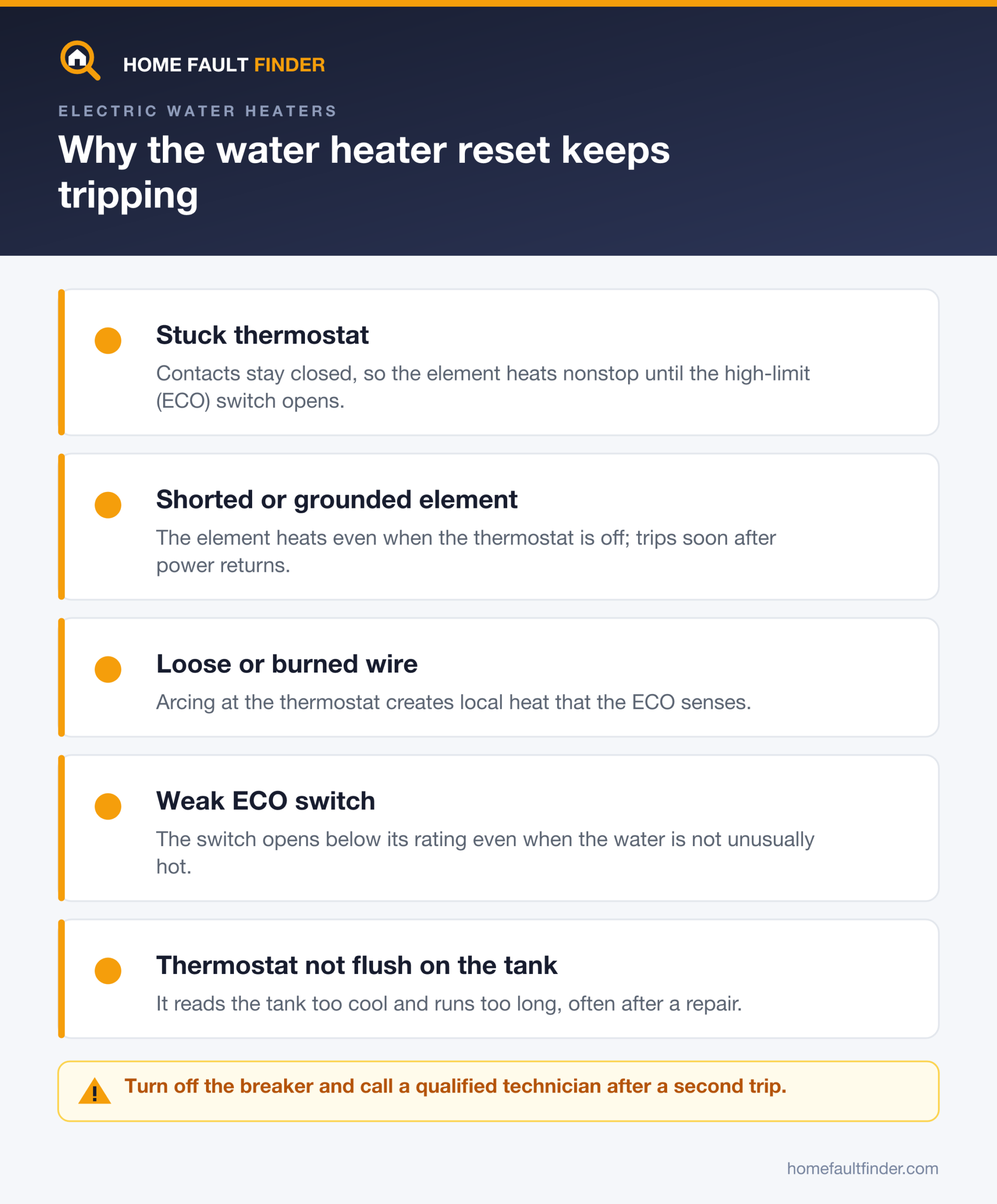
A water heater reset button keeps tripping when something lets an element keep heating past the thermostat set point, or when heat builds up right at the thermostat assembly. The most common culprits are a thermostat whose contacts no longer open, a heating element shorted to the tank, a loose or burned wire connection, and a failing ECO switch.
| Cause | What happens | Typical clue |
|---|---|---|
| Stuck thermostat | Contacts stay closed; element heats nonstop | Scalding water before the trip |
| Shorted or grounded element | Heats even when the thermostat is off | Trips soon after power returns |
| Loose or burned wire | Arcing creates heat at the thermostat | Burnt smell near the upper cover |
| Thermostat not flush on the tank | Reads too cool, runs too long | Starts after a repair |
| Weak ECO switch | Opens below its rating | Water not unusually hot |
| Set point near the top of its range | Little margin before the limit | Trips after heavy use |
| Heavy sediment | Longer, hotter heating cycles | Rumbling sounds, older tank |
The first two causes are the ones most commonly seen. Thermostats and elements are inexpensive, so a tripping button rarely means the tank is finished. Our water heater troubleshooting guide covers the wider fault picture.
Trips right away or after days: what does the timing tell you?
The timing of each water heater reset trip is the most useful clue a homeowner can collect without opening anything. A trip within minutes of restoring power, a trip after several hours of heating, and a trip only every few weeks usually point to different faults, so note the date, time and water temperature of every trip.
| What you notice | Most likely direction |
|---|---|
| Pops within minutes, or the breaker trips too | Shorted element or wiring fault |
| Water gets scalding, then pops after hours | Thermostat stuck closed |
| Pops every few days or weeks, water normal | Weak ECO, loose connection, poor thermostat contact |
| Pops right after an adjustment or repair | Set point too high or part out of position |
| Pops while the T&P valve discharges | Overheating; treat as urgent |
These patterns are a guide, not a diagnosis; confirming the failed part takes meter testing by a qualified technician.
What can you safely check yourself?
Homeowner checks on a water heater whose reset button keeps tripping should stay outside the cabinet: the breaker, the area around the tank, the relief valve discharge pipe and the paperwork. These steps take about 15 minutes and need only a flashlight.
Turn the water heater’s breaker off first. Do not remove access covers, touch wiring or test elements. If water or steam comes from the T&P valve pipe, keep clear of its outlet and call a plumber.
-
Switch off the breaker
Turn off the double-pole breaker labeled for the water heater (1 minute). If the breaker itself trips, see our guide to a circuit breaker that keeps tripping.
-
Look and smell around the tank
Check for a burnt smell, scorch marks on the jacket, or water on the floor (2 minutes). Any burning smell means leave the breaker off.
-
Check the T&P discharge pipe
Dampness or mineral crust at the pipe’s end suggests the valve has opened, which fits overheating. See our guide to a leaking water heater pressure relief valve.
-
Read the label and manual
Find the model number on the rating plate and look up the manual (5 minutes). It states voltage, wattage and whether a homeowner reset is allowed.
-
Log the trip
Note when it tripped and whether the water was unusually hot. Two trips in a week means book a technician.
Why won’t the water heater reset button click or stay in?
A water heater reset button that will not click usually means the ECO has not tripped, or the switch is still too hot to latch. A button that clicks and pops straight back out, or will not stay in, usually means a failed ECO or a fault that reopens it immediately. Either way, pressing harder will not help.
No click usually means another cause, such as a tripped breaker or a burned-out element. A switch that just opened from real overheating typically must cool before it latches. A switch that never latches after hours of cooling generally needs replacing, along with the thermostat it is built into.
Do gas water heaters have a reset button?
Gas water heaters do not use the red electric-style reset button, but most have their own high-temperature cutoff built into the gas control valve, and many newer tanks add a flammable vapor safety system. When those devices shut the burner down, the pilot or burner goes out and the control may flash a status code.
Bradford White’s service manual for its gas models, for example, describes an ECO inside the combination thermostat and gas valve, plus a resettable thermal switch on the inner combustion-chamber door that shuts down the pilot and main burner if flammable vapors or flame roll-out are detected. A tripped thermal switch is a combustion warning, not a nuisance fault, and belongs to a licensed gas technician.
Do not touch light switches, appliances or the water heater controls. Leave the house right away and call your gas utility or 911 from outside.
Is it safe to keep pressing the reset button?
Repeatedly pressing a water heater reset button is not safe once it has tripped more than once, because each trip means the tank reached a temperature the designers treat as abnormal. The ECO is the last electrical safeguard before the T&P relief valve, and a failed thermostat can deliver scalding water to every faucet in the house.
Common mistakes:
- Resetting over and over while a thermostat is stuck closed.
- Taping or wiring around the reset switch; a bypassed ECO removes overheating protection entirely.
- Plugging or capping a dripping T&P valve, the device that keeps the tank from building dangerous pressure.
- Turning the thermostat higher to make up for lukewarm water.
- Restoring power after a breaker trip or burning smell.
For a sensible everyday setting and the scald-risk trade-offs, see our guide to what temperature a water heater should be set to.
How much does it cost to fix a water heater that keeps tripping?
Fixing a water heater whose reset button keeps tripping usually means replacing a thermostat, a heating element, or both, and the installed cost is typically $150–$350 per repair as of November 2026. Thermostats on electric tanks commonly come with the ECO built in, so the high-limit switch and thermostat are often replaced together as one part.
| Repair | Typical installed cost (as of November 2026) |
|---|---|
| Thermostat replacement (often includes the ECO) | $150–$300 |
| Heating element replacement | $150–$350 |
| Minor valve or connection repair | $150–$250 |
| Typical water heater repair range | $150–$600 |
Repair usually makes sense on a tank that is otherwise sound. If the heater is past roughly 10 years, rusty, or leaking from the tank body, compare the quote against our water heater replacement cost guide and the signs you need a new water heater before paying for parts.
Call a licensed plumber, electrician or appliance technician if the reset trips a second time, a breaker trips with it, you notice a burning smell, or the T&P valve discharges. Testing elements, tightening connections and replacing the ECO involve 240-volt parts and are not homeowner jobs. On gas units, any thermal switch trip or gas smell goes to a licensed gas technician or your gas utility.
Frequently asked questions
Should I turn off the water heater if the reset keeps tripping?
Yes. Once the reset button has tripped more than once, switch off the water heater’s breaker and leave it off until a technician has found the cause. The tank stays full and the cold water supply keeps working, so the only loss is hot water while you wait for the repair.
Can a bad heating element trip the reset button?
Yes. A heating element that is shorted or grounded to the tank can keep drawing current even when the thermostat has switched off, so the water overheats until the high-limit switch opens. A trip within minutes of restoring power, or a breaker trip at the same time, often points to this fault.
Is the reset button the same as the circuit breaker?
No. The breaker in your electrical panel protects the wiring from overcurrent, while the reset button on the water heater protects against overheated water. A breaker trip suggests an electrical fault such as a shorted element or wiring problem; a reset trip suggests the water got too hot.
Can I replace the reset button by itself?
On most residential electric tanks, the high-limit switch is built into the upper thermostat, so the whole assembly is replaced as one part. A technician matches the replacement to the thermostat and limit rating listed in the manual and on the existing part, rather than fitting a generic switch.
Does a tankless water heater have a reset button?
Some tankless models have a manual-reset high limit, but most report faults as error codes on the display instead. Check the manual for your model; for example, our guides to Rinnai and Navien codes explain the overheating codes on those brands.