

A dishwasher making a grinding noise almost always has a hard object, such as broken glass, a fruit pit or a bone fragment, caught in the filter, chopper or pump. Cleaning the filter area takes about 10 minutes and costs nothing. Grinding that continues with a clean filter points to a worn pump or motor, a $100 to $600 repair.
- Debris in the filter area is the first thing to check, and clearing it takes roughly 10 minutes with no tools on most models.
- Professional repairs for a grinding dishwasher run from $100 to $250 for a drain pump up to $400 to $600 for a motor, as of November 2026.
- Some dishwashers have a built-in food chopper, so a short grinding sound at certain points in the cycle is normal on those models.
- Grinding only while draining points to the drain pump; grinding through the whole wash points to the circulation pump or motor.
A grinding dishwasher sounds alarming, but the cause is far more often a stray piece of debris than a dying machine.
This guide works through the causes cheapest and easiest first. Our broader dishwasher troubleshooting guide covers faults that are not noise related.
- Why is my dishwasher making a grinding noise?
- Is a grinding noise from a dishwasher ever normal?
- What causes a dishwasher grinding noise?
- When does the grinding happen: filling, washing or draining?
- How do you fix a dishwasher grinding noise?
- What will not fix a grinding dishwasher?
- How much does it cost to fix a grinding dishwasher?
- Should you repair or replace a grinding dishwasher?
- Can you keep using a dishwasher that grinds?
Why is my dishwasher making a grinding noise?
A dishwasher grinding noise means something hard is touching a moving part, or a moving part has worn out. In most cases a small object has slipped past the racks and reached the filter, chopper or pump at the bottom of the tub. Less often, the pump is running without enough water or its bearings have failed.
Three parts move inside a dishwasher: the circulation pump, the drain pump and the spray arms. A circulation pump is the motor-driven pump that pushes water through the spray arms; a drain pump is the smaller pump that empties the tub. Many models also have a chopper, a small blade that cuts up food before it reaches the pump.
Whirlpool’s own support article on the subject lists foreign objects stuck in the filter area as the cause to check first (Whirlpool Product Help: Grinding).
Is a grinding noise from a dishwasher ever normal?
A brief grinding noise from a dishwasher can be normal on models with a built-in food chopper. Whirlpool states that some of its dishwashers have a chopper that can make a grinding sound at different points in the wash cycle. A normal chopper sound is short and even; a loud, rattling or constant grind is not.
Your owner’s manual says whether your model has a chopper. To download a missing manual, see how to find your appliance model number.
What causes a dishwasher grinding noise?
Dishwasher grinding noises come from six common causes: debris in the filter area, a jammed chopper, a blocked drain pump, a spray arm hitting dishes, a pump running without enough water, and worn pump or motor bearings. The first four can be checked at home in under 30 minutes. The last one needs a technician.
| Cause | How it sounds | DIY? | First check |
|---|---|---|---|
| Debris in the filter or sump (glass, pits, bones, twist ties) | Rattling, crunchy grind that comes and goes | Yes | Remove and rinse the filter, clear the sump |
| Jammed or damaged chopper blade | Harsh grind early in the wash | Partly | Look for objects around the chopper cover |
| Object in the drain pump | Grinding only while the tub empties | Partly | Clear the filter, check the drain pump cover if your manual shows one |
| Spray arm hitting a dish or utensil | Rhythmic knocking or scraping | Yes | Spin both arms by hand with the racks loaded |
| Low water level (pump running nearly dry) | Dry grind with poor cleaning | Partly | Confirm water is entering the tub |
| Worn circulation pump or motor bearings | Constant grind or growl for the whole wash | No | Call an appliance technician |
Hard debris is by far the most common cause: broken glass, olive and cherry pits, chicken bone fragments, popcorn kernels and toothpicks.
When does the grinding happen: filling, washing or draining?
The point in the cycle when a dishwasher grinds identifies the faulty part faster than any other clue. A dishwasher fills, washes and drains in separate stages, and a different component runs in each one. Start a normal cycle, stay nearby for the first 10 minutes and note exactly when the noise begins and ends.
| When you hear it | Part that is running | Most likely cause |
|---|---|---|
| In the first minute, before water sprays | Drain pump (most cycles start with a short drain) | Object in the drain pump or filter |
| While water is spraying | Circulation pump, chopper, spray arms | Debris at the chopper, low water, or worn bearings |
| Only when the tub empties | Drain pump | Debris in the drain pump impeller |
| All the time, getting worse over weeks | Circulation pump motor | Worn bearings or a failing motor |
If grinding during draining comes with water left in the tub, follow our guide to a dishwasher that won’t drain.
How do you fix a dishwasher grinding noise?
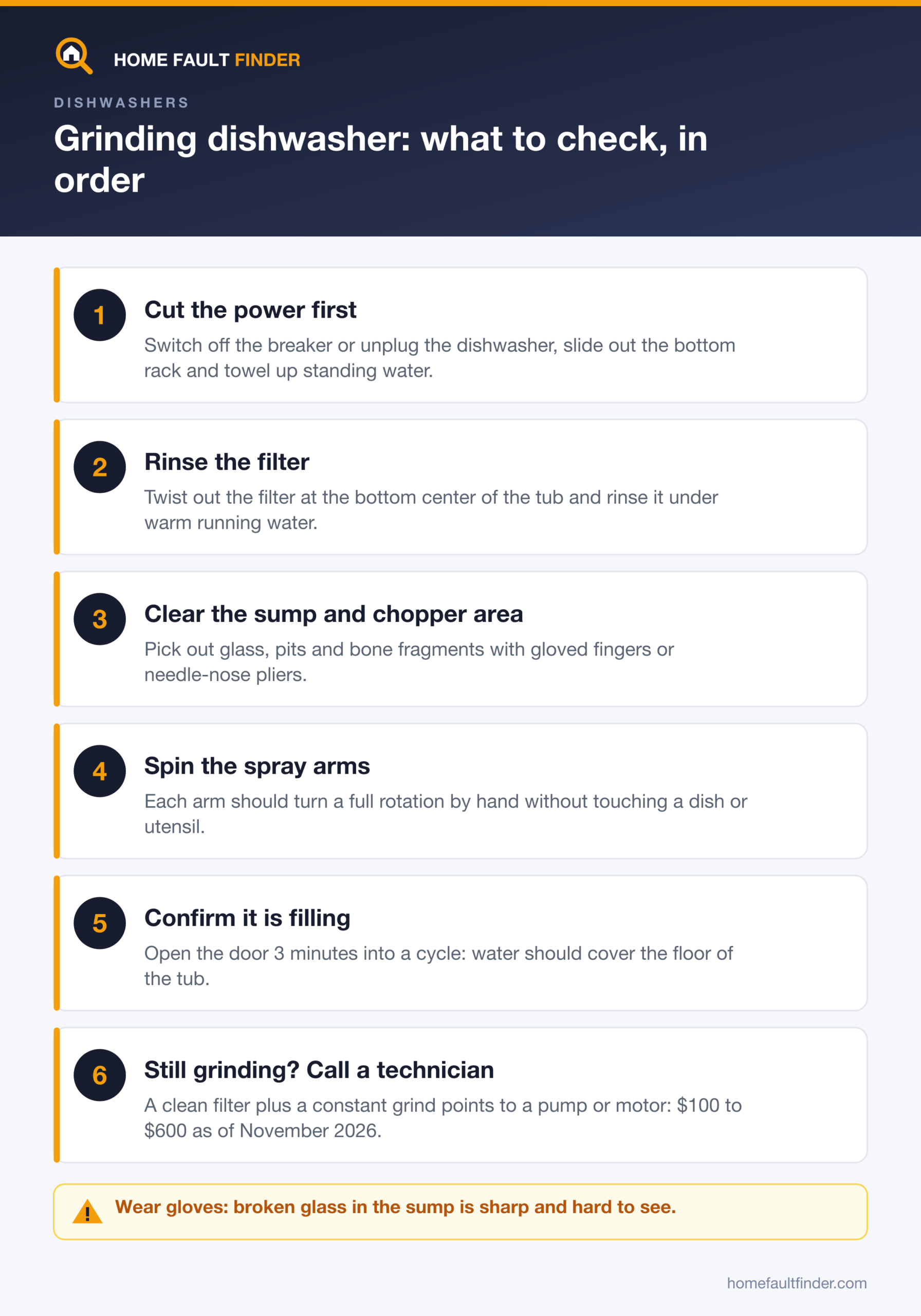
Fixing a dishwasher grinding noise starts with cutting the power and clearing the filter area, then checking the spray arms and the water level. Work through the steps in order and run a short test cycle after each one. You need a flashlight, a pair of work gloves, a towel and about 20 to 30 minutes.
Switch off the dishwasher at its breaker or unplug it before reaching into the bottom of the tub. Wear gloves: broken glass in the sump is sharp and hard to see under water.
-
Cut the power and empty the tub
Turn off the breaker or unplug the dishwasher, then slide out the bottom rack. Towel up any standing water. Time: 5 minutes. Cost: $0.
-
Remove and rinse the filter
Twist out the cylindrical filter at the bottom center of the tub and rinse it under warm running water. Our guide to cleaning a dishwasher filter covers the common styles. Time: 5 to 10 minutes.
-
Clear the sump and chopper area
With a flashlight, pick any glass, pits or bones out of the filter opening with gloved fingers or needle-nose pliers. On Whirlpool-built models with a maintenance-free filter, empty the foreign object cup in front of and below the lower rack: press the center tab, pull up, empty it and push it back until it locks.
-
Check the spray arms
Spin the lower and upper spray arms by hand. Each should turn a full rotation without touching anything. Reload any tall pan or utensil in the arm’s path. Time: 5 minutes.
-
Confirm the dishwasher is filling
Restore power, start a normal cycle and open the door after about 3 minutes. Water should cover the floor of the tub around the filter. A nearly dry tub means the pump is starved of water; see dishwasher not filling with water.
-
Run an empty test cycle and listen
Run a short cycle with no dishes inside. Grinding that continues with a clean filter, free spray arms and a normal water level points to a pump, which is the point to stop and call a technician.
What will not fix a grinding dishwasher?
Several popular remedies do nothing for a dishwasher grinding noise, and a few make the damage worse. Grinding is a mechanical problem, so it needs a mechanical fix: remove the object or replace the worn part. Cleaning products and repeated cycles do neither, and some of them add damage.
- Running a cleaning tablet or vinegar cycle. Cleaners dissolve grease and limescale, not glass, pits or bone.
- Running the cycle again and hoping it clears. Each run drags the object across the pump impeller and can crack it.
- Poking a screwdriver into the pump with the power on. The pump can start without warning.
- Pulling the dishwasher out to open the motor yourself. It is connected to household wiring and a pressurized water line.
How much does it cost to fix a grinding dishwasher?
Fixing a grinding dishwasher costs nothing when debris is the cause and between $100 and $600 when a part has to be replaced by a professional, as of November 2026. A drain pump sits at the low end and a motor at the high end, with labor typically billed at $50 to $100 per hour.
| Repair | Typical cost (parts and labor) | Notes |
|---|---|---|
| Clear debris from filter and sump | $0 DIY | About 10 to 30 minutes of your time |
| Service call or diagnostic fee | $50 to $100 | Often credited toward the repair if you go ahead |
| Drain pump repair | $100 to $250 | Covers clearing or replacing the pump |
| Pump replacement | $150 to $400 | Varies by model |
| Motor replacement | $400 to $600 | The most expensive common dishwasher repair |
Fixr puts the national range for a typical dishwasher repair at $100 to $300 (Fixr dishwasher repair cost guide). See also how much it costs to repair a dishwasher.
Should you repair or replace a grinding dishwasher?
Repairing a grinding dishwasher makes sense when the fix costs less than half the price of a comparable new machine and the dishwasher is under about 9 years old. Replacement makes more sense when a motor or pump assembly fails on a machine already near the end of the typical 9 to 12 year lifespan.
Bob Vila’s repair-or-replace guide uses the same 50 percent threshold (Bob Vila: repair or replace a dishwasher). As a worked example, if a comparable new dishwasher costs $700, the threshold is $350. A $200 drain pump repair is well under it, so repair. A $500 motor replacement is over it, so on a 10-year-old machine replacement is the better use of the money.
The same $500 motor on a 4-year-old dishwasher can still be worth doing. Our guide to appliance lifespans and when repair stops making sense explains the reasoning.
Can you keep using a dishwasher that grinds?
A dishwasher that grinds should not be used again until the filter area has been checked. Hard debris can chip the chopper blade or crack a pump impeller within a few cycles, turning a free fix into a $150 to $400 pump replacement. Stop the cycle, cut the power and inspect the sump first.
To prevent a repeat, scrape pits, bones and toothpicks off plates before loading, clean the filter every 1 to 3 months, and clear every fragment after any breakage.
Call an appliance technician if the grinding continues after the filter, sump and spray arms are clear and the tub is filling normally. Stop using the dishwasher and switch off its breaker right away if you smell burning, see water under the machine, or the breaker trips. Do not pull the dishwasher out, open the base or disconnect its wiring or water supply yourself.
Frequently asked questions
Why does my dishwasher make a grinding noise when it starts?
A dishwasher that grinds as soon as it starts usually has debris in the drain pump, because most cycles begin with a short drain before filling. Clean the filter and sump first. If the tub was unused for weeks, dry pump seals can also sound rough for the first minute and then quiet down.
Why is my dishwasher grinding but there is no water in it?
A dishwasher grinding with no water inside is running its pump dry. The usual causes are a closed or kinked water supply line, a clogged inlet screen or a failed water inlet valve. Stop the cycle, because a pump that runs dry wears quickly, and check that the supply valve under the sink is fully open.
Can broken glass damage a dishwasher?
Broken glass can damage a dishwasher if it reaches the pump. Fragments can chip the chopper blade, crack the pump impeller and cut the door seal. Cut the power, put on gloves, lift out the filter and remove every piece from the sump before running another cycle, then rinse the filter under the faucet.
Is a humming noise the same problem as a grinding noise?
A humming noise is a different problem from a grinding noise. Humming with no water movement suggests a pump motor that is jammed or failing to start, while a steady low hum during the wash is normal. Grinding means a hard object is touching a moving part or a bearing has worn out.
Is it safe to remove the dishwasher filter myself?
Removing the dishwasher filter yourself is safe, and manufacturers design it for owner cleaning. Switch off the breaker or unplug the machine first, wear gloves in case of broken glass, and twist the filter out by hand. Do not run the dishwasher with the filter removed, because debris will go straight into the pump.