

A dishwasher not filling with water is usually caused by a closed or partly closed supply valve, a door that is not fully latched, a stuck float switch, or a clogged or failed water inlet valve. Check them in that order: the first three cost nothing, and an inlet valve replacement typically runs about $75–$200 installed (as of October 2026).
- Many manufacturers specify 20–120 psi at the dishwasher; below 20 psi the inlet valve may not work properly.
- A hum with no water points to the inlet valve or its screen, not the control board.
- Total silence usually means the machine is not calling for water: door latch, float switch, or controls.
- Draining while it should be filling usually means the drain hose has no high loop and is siphoning.
- Never bypass the float switch; it is what stops the tub from overfilling onto your floor.
A dry sump and dirty dishes mid-cycle mean the problem sits somewhere between your home’s water supply and the valve that lets water into the tub. The fill path is short, and most fill failures can be found in about 15 minutes without special tools.
Below you will find a sound-based decision tree, step-by-step fixes, brand error codes that point to fill problems, and current repair costs. For other symptoms, start with our complete dishwasher troubleshooting guide.
- Why is my dishwasher not filling with water?
- What does a normal dishwasher fill look like?
- What should you check first?
- How do you fix a dishwasher that won’t fill?
- Can a stuck float switch stop the fill?
- How do you know the inlet valve is bad?
- Why is it draining but not filling?
- Which error codes mean a fill problem?
- How much does it cost to fix?
- Common mistakes that will not fix it
- FAQ
Why is my dishwasher not filling with water?
A dishwasher not filling with water is almost always caused by one of seven things: a closed supply valve, an unlatched door, a stuck float switch, a clogged inlet screen, a failed inlet valve, a kinked supply line, or low water pressure. Control board faults are possible but rare, so they belong at the end of the list.
| Cause | How common | What you notice | DIY? |
|---|---|---|---|
| Supply valve closed or partly open | Very common | Silence or weak hiss, often after plumbing work | Yes, free |
| Door not fully latched | Common | Cycle does not progress | Yes, free |
| Float switch stuck up | Common | No fill, no hum | Yes, free |
| Clogged inlet valve screen | Common | Hum or trickle; hard-water homes | Yes, power and water off |
| Failed water inlet valve | Common | Hum with no water, or nothing | Moderate DIY or pro |
| Kinked supply line | Occasional | Right after the unit was pushed back in | Yes |
| Low household pressure | Occasional | Other faucets weak too | Plumber |
| Control board fault | Rare | Everything else tests fine | Pro |
What does a normal dishwasher fill look like?
A normal dishwasher fill is much smaller than most people expect. The inlet valve opens for a short, timed or metered period and lets in only enough water to cover the sump at the bottom of the tub, usually just below the heating element. You will never see a full tub, even when everything works.
Modern machines sip water; ENERGY STAR notes a certified dishwasher can save about 8,400 gallons a year compared with washing by hand. A shallow puddle is normal. A bone-dry sump a few minutes into the cycle confirms a fill failure.
What should you check first?
The fastest way to find why a dishwasher will not fill is to listen at the door during the first two minutes of a cycle. The sound tells you whether the control is calling for water and the valve is failing, or whether the machine never asks for water at all. Use this decision tree before touching any parts.
| What you hear | What it usually means | Check first |
|---|---|---|
| Nothing: no hum, no hiss | Control is not calling for water | Door latch, float switch, power to the unit |
| Steady hum, no water | Valve is energized but water is blocked | Supply valve, kinked line, inlet screen, then valve |
| Click, then a weak trickle | Water reaches the valve at low flow | Supply valve fully open, screen, house pressure |
| Pump running, water leaving | Water drains as fast as it fills | Drain hose high loop |
How do you fix a dishwasher that won’t fill?
Fixing a dishwasher that won’t fill means working along the fill path from the cheapest checks to the parts behind the lower panel. Turn off the dishwasher circuit at the breaker before removing any panel, and close the supply valve before disconnecting anything that carries water.
Switch off the breaker (or unplug a cord-connected unit) before removing the kick panel or touching the inlet valve; it runs on 120 volts. Keep a towel and a shallow pan ready before loosening any water connection.
-
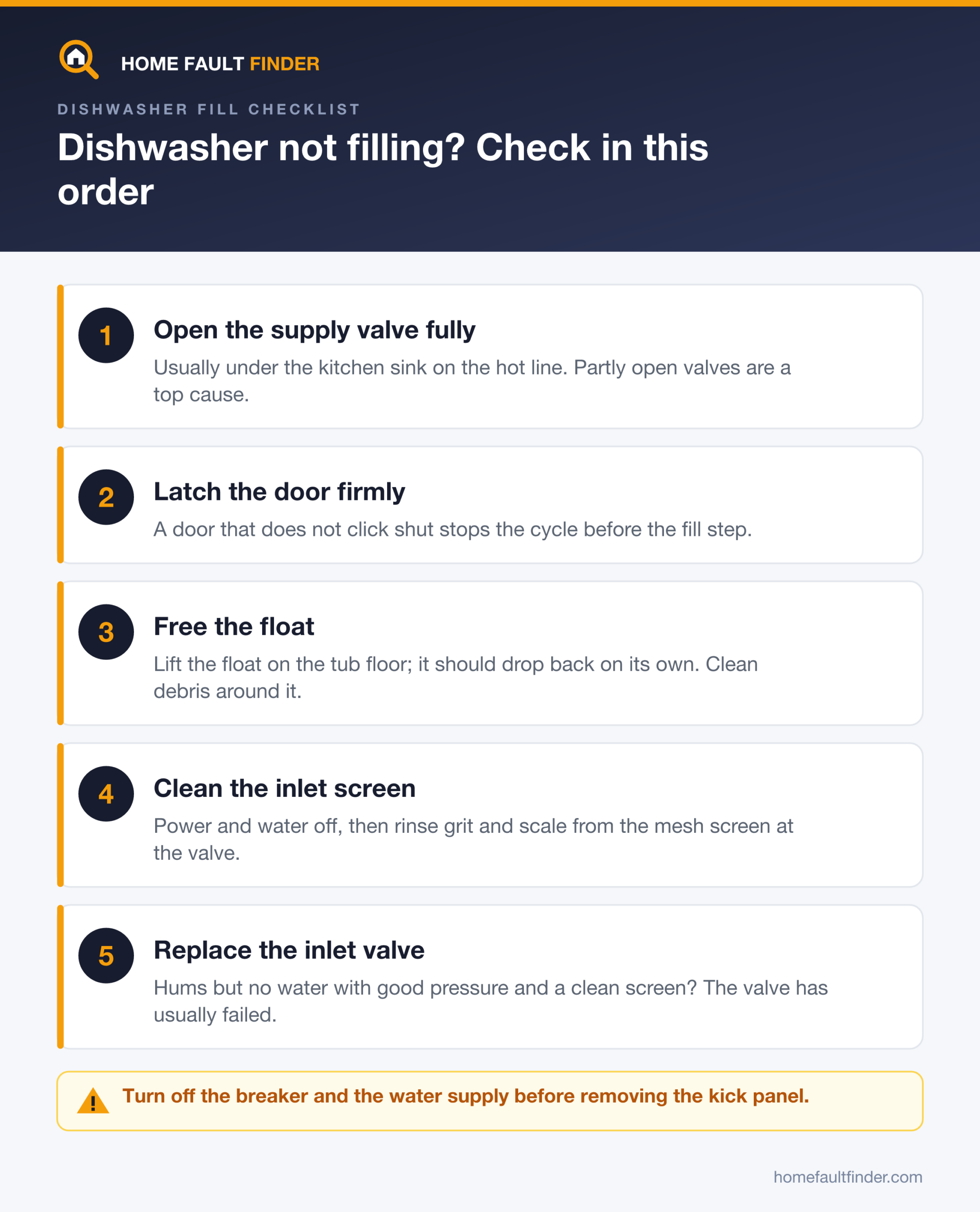
Open the supply valve fully
It is usually under the kitchen sink on the hot line. Turn it fully counterclockwise. Time: 1 minute. Cost: $0.
-
Check the door latch
Close the door until it clicks and make sure racks or pans are not blocking it. A latch that never closes stops the cycle before the fill; see dishwasher won’t start.
-
Free the float
Lift the dome-shaped float near the front of the tub floor. It should rise about half an inch and drop on its own. Clean debris around it. Time: 5 minutes.
-
Inspect the supply line
With the power off, look behind the kick panel for a kinked or crushed line. Straighten or replace it, and leave a gentle curve when sliding the machine back.
-
Check household pressure
If the kitchen faucet is weak too, the supply is the problem. Samsung, for example, specifies 20–120 psi; check your own manual.
-
Clean the inlet screen
With power and water off, disconnect the line at the valve and rinse grit and scale from the small mesh screen. Time: 20–30 minutes.
-
Replace the inlet valve
A valve that still hums but passes no water, with a clean screen and good pressure, has usually failed. Moderate DIY if you are comfortable with plumbing; otherwise book a technician.
Can a stuck float switch stop the fill?
A float switch is a safety switch that tells the control board when the tub has reached its maximum water level. When the plastic float sticks in the raised position, the switch reports a full tub, so the control never opens the inlet valve. The result is a silent machine that never fills.
Food scraps, grease, and broken glass under the float are the usual culprits. If the float moves freely but nothing changes, the switch below the tub may have failed and needs replacing with the correct part. Do not tape down or jumper the float switch.
How do you know the water inlet valve is bad?
A water inlet valve is an electrically operated valve behind the lower kick panel that opens when the control sends it 120 volts. A bad valve typically hums without letting water through, trickles with good house pressure, or does nothing even after its screen is cleaned.
Other signs include scale or corrosion on the valve body, a slow drip into the tub when the machine is off, and repeat fill problems in hard-water homes. Confirming the fault means checking voltage at the valve with the power on, which we leave to a technician. The part is usually inexpensive; most of the bill is labor.
Why is my dishwasher draining but not filling?
A dishwasher that drains but does not fill is usually siphoning: water runs out of the tub as fast as it comes in. Siphoning happens when the drain hose has no high loop or air gap, so gravity pulls water out through the sink drain or garbage disposer.
Make sure the hose rises up under the countertop, at the height your installation instructions specify, before it drops to the drain. If the drain pump runs constantly even with a correct loop, see our guide to a dishwasher that won’t drain.
Which error codes mean a fill problem?
Several brands display an error code when the dishwasher does not detect enough water within a set time, which narrows the search to the supply side. Code meanings vary by brand and model generation, so confirm any code in your owner’s manual before replacing parts.
On Samsung dishwashers, 4E or 4C indicates a water supply error (see Samsung dishwasher error codes). On Bosch models, E16, E17, and E18 relate to filling or low water level, while E15 means water has reached the base tray (see Bosch dishwasher error codes). Other brands use their own systems.
How much does it cost to fix a dishwasher that won’t fill?
The cost to fix a dishwasher that won’t fill ranges from $0 for an opened valve or freed float to roughly $75–$200 for a professionally replaced inlet valve and $200–$500 for a control panel replacement, as of October 2026. Most fill repairs land at the low end because the common parts are inexpensive.
| Repair | Typical cost | Notes |
|---|---|---|
| Open valve, free float, straighten line | $0 | Owner checks |
| Diagnostic visit | $50–$75 | Often credited toward the repair |
| Service call fee | $35–$100 | Varies by area |
| Water inlet valve replacement | $75–$200 | Fixr: $75–$150; a July 2026 repair-company guide: $100–$200 |
| Control panel replacement | $200–$500 | Rare cause of fill failures |
| Technician labor | $50–$100 per hour | Plus parts |
If the machine is otherwise in good shape and the fault is the valve, float, or supply, repair is almost always worth it. For a failed board on an older unit, compare the quote with a new dishwasher; our dishwasher repair cost guide covers that decision.
Common mistakes that will not fix it
Several popular quick fixes for a dishwasher not filling with water either do nothing or create a bigger problem, such as a flooded floor or a ruined valve. Avoid the four mistakes below; each one costs time or money without touching the real cause of the fill failure.
- Replacing the control board first: it is the priciest part and the least likely cause.
- Pouring water into the tub to “prime” it: extra water can trip the float or leak sensor.
- Removing the inlet screen permanently: grit then reaches the valve seat.
- Letting a humming valve run: stop the cycle until you find the cause.
Call an appliance technician if the supply, latch, float, and screen all check out and the dishwasher still will not fill, if testing would require measuring voltage with the power on, or if you see scorched wiring or water near electrical parts. Call a plumber if the shutoff valve is seized or leaking, or if low pressure affects the whole house. Never bypass a safety switch to make the machine run.
Frequently asked questions
How long should a dishwasher take to fill?
Most dishwashers finish the first fill within the first few minutes of a cycle, often after a short initial drain. You should hear water entering and see a shallow pool in the sump soon after. A dry sump well into the cycle points to a supply, latch, float, or inlet valve problem.
Can low water pressure stop a dishwasher from filling?
Yes. If pressure at the dishwasher is below what the inlet valve needs, the valve may not open fully and the control can time out with too little water. Samsung, for example, specifies 20 to 120 psi. Check whether other faucets are weak before replacing dishwasher parts.
Why does my new dishwasher not fill with water?
On a new installation, the usual causes are a supply valve left closed or partly open, a supply line kinked when the machine was pushed into the cabinet, or a drain hose without a high loop that siphons water out. Check those three before suspecting a defective new valve.
Can I run my dishwasher without the float switch?
No. The float switch prevents overfilling, and running without it, or with it bypassed, can flood the kitchen and damage floors and cabinets. If the float switch has failed, replace it with the correct part for your model instead of jumpering it.
Is it worth repairing a dishwasher that won’t fill?
Usually yes. The most common causes cost nothing or involve an inlet valve priced around $75 to $200 installed as of October 2026. Repair is less attractive only when the control board has failed on an older machine and the quote approaches the price of a new dishwasher.