A toilet tank not filling after a flush is usually caused by a partly closed shut-off valve, debris clogging the fill valve, or a float set too low. Check the valve behind the toilet first, then flush debris out of the fill valve. A healthy tank refills in about a minute; most fixes cost under $35 in parts.
- A half-closed stop valve and grit in the fill valve seal are the two most common causes, and both cost $0 to fix.
- Modern toilets use 1.28 to 1.6 gallons per flush, so a multi-minute refill means a restriction.
- A tank that fills and then empties on its own has a leaking flapper, not a bad fill valve.
- A new fill valve lists at $18.99 (October 2026); plumbers commonly charge $60 to $150 to fit one.
This guide is for anyone whose toilet tank stays empty, fills at a trickle, stops halfway, or fills and then drains away. Each symptom points to a different part. It is one of the most frequent faults in our roundup of common household plumbing problems. You will not need special tools for most of it: a towel, a cup and a screwdriver.
Why is my toilet tank not filling after a flush?
A toilet tank refills through the fill valve, the vertical valve on one side of the tank that opens when its float drops and closes when the float rises. When the tank does not refill, water is either not reaching the valve, the valve cannot open fully, or the float is telling it to stop too early.
Most modern toilets use a float-cup valve, where a plastic cup slides up the valve body; older toilets use a ballcock with a horizontal arm and ball float. Name your symptom first:
- No water at all: closed stop valve, blocked or frozen supply line, or a jammed valve seal.
- Very slow fill: partly closed stop valve, debris in the fill valve, or low house pressure.
- Stops short of the fill line: float set too low or a siphoning refill tube.
- Fills, then empties: a leaking flapper.
What causes a toilet tank to fill slowly or not at all?
Toilet tank filling problems come from seven causes, listed below from cheapest and most common to most involved. Match your symptom to the likely cause and fix, then skip straight to the section that applies instead of replacing parts by guesswork.
| Symptom | Likely cause | Fix |
|---|---|---|
| Slow fill after recent work or cleaning | Stop valve only partly open | Open the valve fully |
| Slow fill with hissing or sputtering | Grit or scale in the fill valve seal | Back-flush; clean or replace the seal |
| Stops 1 to 2 inches low | Float set too low | Raise the float |
| Valve keeps running, level barely rises | Refill tube siphoning inside the overflow tube | Clip the tube above the water line |
| No water at all | Kinked, blocked or frozen supply line | Check and replace the line |
| Fills, then empties | Leaking flapper | Dye test, replace the flapper |
| Every fixture is slow | Low whole-house pressure | Check the main valve and regulator |
How do you check the water supply to the toilet?
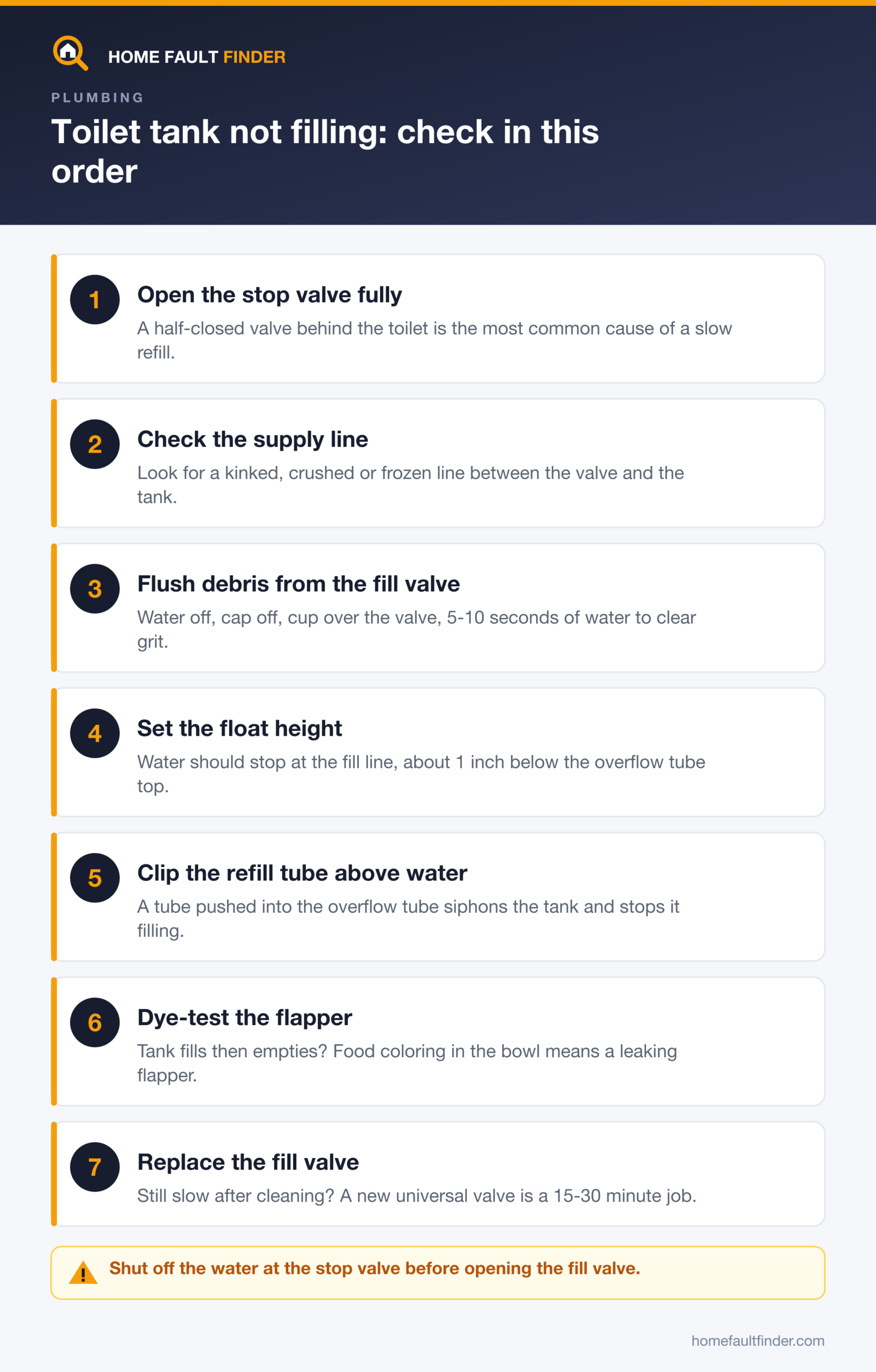
Water supply problems are the first thing to rule out when a toilet tank fills slowly, because the fix takes seconds. The supply stop valve is the small handle on the wall or floor behind the toilet, joined to the tank by a flexible supply line. Even half closed, it can stretch a refill to several minutes.
Turn the handle counterclockwise until it stops; a quarter-turn valve is fully open when the handle lines up with the pipe. Then inspect the supply line: braided lines get crushed when the toilet is pushed back, older plastic lines harden and crack, and a line in an unheated wall can freeze. Thaw a frozen line slowly, never with an open flame.
Multi-turn stop valves that have not moved in years often have a dried-out packing seal and can start dripping from the stem. Put a towel underneath first. If it drips or will not turn by hand, stop and see the pro section below.
How do you clean a clogged toilet fill valve?
Cleaning a clogged fill valve restores full flow in many slow-fill cases, especially after plumbing work or a water main repair has stirred sediment into the pipes. Grit lodges between the valve seal and its seat, and the fix is to back-flush it out with the cap removed.
-
Shut off the water and empty the tank
Close the stop valve and flush, holding the handle down. Set the heavy porcelain lid flat on a towel on the floor. Time: 2 minutes.
-
Remove the fill valve cap
Hold the valve body steady so it does not twist, then release the cap as printed on the valve; on many float-cup valves it is a push and a short counterclockwise turn.
-
Inspect the seal
Grit or white scale on the rubber seal is the clog. Replace a seal that is cracked, swollen or grooved.
-
Back-flush the valve
Hold an upside-down cup over the open valve and turn the water on for 5 to 10 seconds to blow debris out, then off again.
-
Clean and reassemble
Rinse the seal, soak scaled seals in white vinegar for 20 to 30 minutes, refit the cap, open the stop valve and flush twice to time the refill.
How do you adjust the float so the tank fills all the way?
Float height controls how high a toilet tank fills before the fill valve shuts off. A float set too low stops the tank short and weakens the flush, which looks like a filling fault. The correct water level is the fill line marked inside most tanks, or about 1 inch below the top of the overflow tube.
- Float-cup valve: pinch the clip and slide the cup up, or turn the adjustment screw clockwise in small steps.
- Ballcock: turn the screw on top of the valve to raise the arm.
Never set the level above the overflow tube, or water spills into the bowl nonstop, the opposite fault covered in our guide to a toilet that keeps running. Also check the refill tube: it should clip to the top of the overflow tube with its end above the water. Pushed down below the water line, it siphons the tank as fast as the valve fills it.
Why does the tank fill and then empty on its own?
A toilet tank that fills normally and then empties on its own is leaking into the bowl, almost always past a worn or warped flapper. The fill valve is working; the water simply escapes, sometimes heard as a brief phantom refill.
Confirm it with a dye test: add a few drops of food coloring to the tank, do not flush, and wait 10 to 15 minutes. Color in the bowl means the flapper is leaking. Bleach and chlorine drop-in tablets speed up rubber wear; Fluidmaster warns against them on its fill valve product page. If the flush is also weak, see why a toilet won’t flush properly.
What if the whole house has low water pressure?
Low whole-house water pressure makes every toilet fill slowly, and no fill valve repair will fix it. Open a nearby sink faucet fully: if it and the shower also run weakly, the restriction is upstream, commonly a partly closed main valve, a failing pressure-reducing valve or, on a well, a pressure tank problem.
Our guide to low water pressure throughout the house covers how to narrow it down. For scale, federal rules cap toilets at 1.6 gallons per flush and WaterSense models use 1.28 gallons or less, according to the EPA WaterSense program, so a healthy supply refills a modern tank quickly.
Should you repair or replace the fill valve?
Replacing a toilet fill valve is the better choice when cleaning does not restore normal flow, because a new universal valve costs under $20 and installs in under half an hour. Replace rather than clean again if two or more of these apply:
- Still slow after a fully open stop valve and a cleaned seal.
- Cracked valve body or a float cup that sticks.
- An old metal ballcock with corrosion or a constant hiss.
- The valve also fails to shut off reliably.
Fluidmaster lists its 400H PerforMAX as adjustable from 9 to 14 inches, fitting 2-inch and 3-inch flush valve toilets from 1.28 to 3.5 gallons per flush, with a 7-year limited warranty. Some one-piece and dual-flush toilets need the maker’s own valve.
How much does it cost to fix a toilet tank that won’t fill?
Fixing a toilet tank that won’t fill costs nothing to under $35 in parts for most DIY repairs, and $60 to $150 for a plumber to replace the fill valve. Ranges below are as of October 2026, with sources under the table.
| Repair | DIY parts | Professional |
|---|---|---|
| Open stop valve, adjust float or refill tube | $0 | Rarely needed |
| Clean the fill valve | $0 (vinegar, cloth) | $60–$200 (slow-fill repair) |
| Replace the fill valve | $18.99–$34.99 (valve or valve + flapper kit) | $60–$150 |
| Replace the flapper | $16.99–$28.99 | $60–$120 |
| Replace the supply line | $11.99–$13.99 | Often added to a valve job |
| Replace the stop valve | Not a beginner job | $60–$150 |
Common mistakes that make it worse
Several well-meant fixes for a slow-filling toilet tank either miss the cause or create a new leak. The five below are the ones most commonly behind a second repair or a wet floor, and each is avoidable with a minute of checking before you pick up a tool:
- Buying a fill valve before checking the stop valve.
- Raising the float above the overflow tube.
- Pushing the refill tube deep into the overflow tube.
- Overtightening plastic nuts until they crack; for water on the floor, see our guide to a toilet leaking at the base.
- Forcing a seized stop valve with pliers.
Call a licensed plumber if the stop valve leaks at the stem, will not turn by hand, or will not shut the water off. Replacing it can mean cutting or soldering supply pipe, and a failure can flood the bathroom. Know where your main shut-off is first; see how to shut off your water in an emergency.
Also call a pro for a cracked tank or water on the floor you cannot trace.
Frequently asked questions
How long should it take for a toilet tank to refill?
Most modern toilet tanks refill in roughly 30 seconds to about a minute with normal household water pressure. A tank that takes three minutes or longer has a restriction, most commonly a partly closed stop valve, debris in the fill valve, or low whole-house pressure. Older 3.5-gallon tanks take a little longer to refill.
Can low water pressure stop a toilet from filling?
Low water pressure slows a toilet refill but rarely stops it completely. If the tank gets no water at all, look for a closed stop valve, a kinked or frozen supply line, or a jammed fill valve seal. If every faucet in the house is weak, the cause is upstream of the toilet.
Why does my toilet tank fill but the bowl stays low?
A low bowl with a full tank usually means the refill tube has slipped off the overflow tube, so no water is sent to the bowl after a flush. Clip the tube back onto the overflow tube with its end above the water line. A partly blocked vent pipe or a crack in the bowl are rarer causes.
Do I need to turn off the water to clean a fill valve?
Yes, turn off the stop valve behind the toilet before removing the fill valve cap, otherwise water sprays out under full pressure. The only time the water goes back on with the cap off is the 5 to 10 second back-flush, with a cup held firmly over the open valve.
How long does a toilet fill valve last?
Toilet fill valve lifespan depends heavily on water hardness and sediment, but many last several years before seals wear. Fluidmaster backs its 400H fill valve with a 7-year limited warranty. Replace the valve sooner if it hisses, shuts off unreliably, or fills slowly even after the seal has been cleaned.