A microwave tripping the breaker is usually an overloaded circuit: a typical microwave pulls 12 to 13 amps, so a kettle or toaster on the same 15-amp or 20-amp circuit pushes it over the limit. If it trips instantly, when the door opens, or on a circuit with nothing else running, suspect an internal fault and stop using it.
- A microwave with 1,500 watts of input power draws about 12.5 amps, leaving little room on a 15-amp circuit.
- GE and Panasonic both call for a grounded 120-volt outlet on a 15- or 20-amp circuit that the microwave does not share.
- Tripping when you open or close the door is a classic sign of a failed door switch or interlock, which needs a technician.
- Never open the cabinet: the high-voltage capacitor inside can hold a lethal charge even after the microwave is unplugged.
We focus on what is specific to microwaves: how much current they draw, which circuits they belong on, and what the timing of the trip reveals.
If other appliances trip the same breaker too, start with our guide on why a circuit breaker keeps tripping.
Why does my microwave keep tripping the breaker?
A microwave keeps tripping the breaker for one of two broad reasons. Either the circuit is asked to carry more current than its breaker allows, which is an overload, or current is flowing somewhere it should not, which is a short circuit or ground fault. Overload is the most common cause and the only one a homeowner should investigate.
A circuit breaker is a switch that opens when current exceeds its rating, protecting the wiring in the wall. The usual causes, most common first:
| Cause | Typical sign | Who fixes it |
|---|---|---|
| Shared circuit overload | Trips when a kettle or toaster runs too | You: move appliances |
| Extension cord or worn outlet | Plug or outlet feels warm | You; electrician for the outlet |
| GFCI or AFCI trip | A GFCI outlet or test-button breaker trips | Electrician if it repeats |
| Failed door switch or interlock | Trips as the door opens or closes | Appliance technician |
| Shorted diode, capacitor or magnetron | Instant trip at Start, hum or burning smell | Appliance technician |
| Weak breaker | Trips with the microwave alone, at light load | Electrician |
What does the timing of the trip tell you?
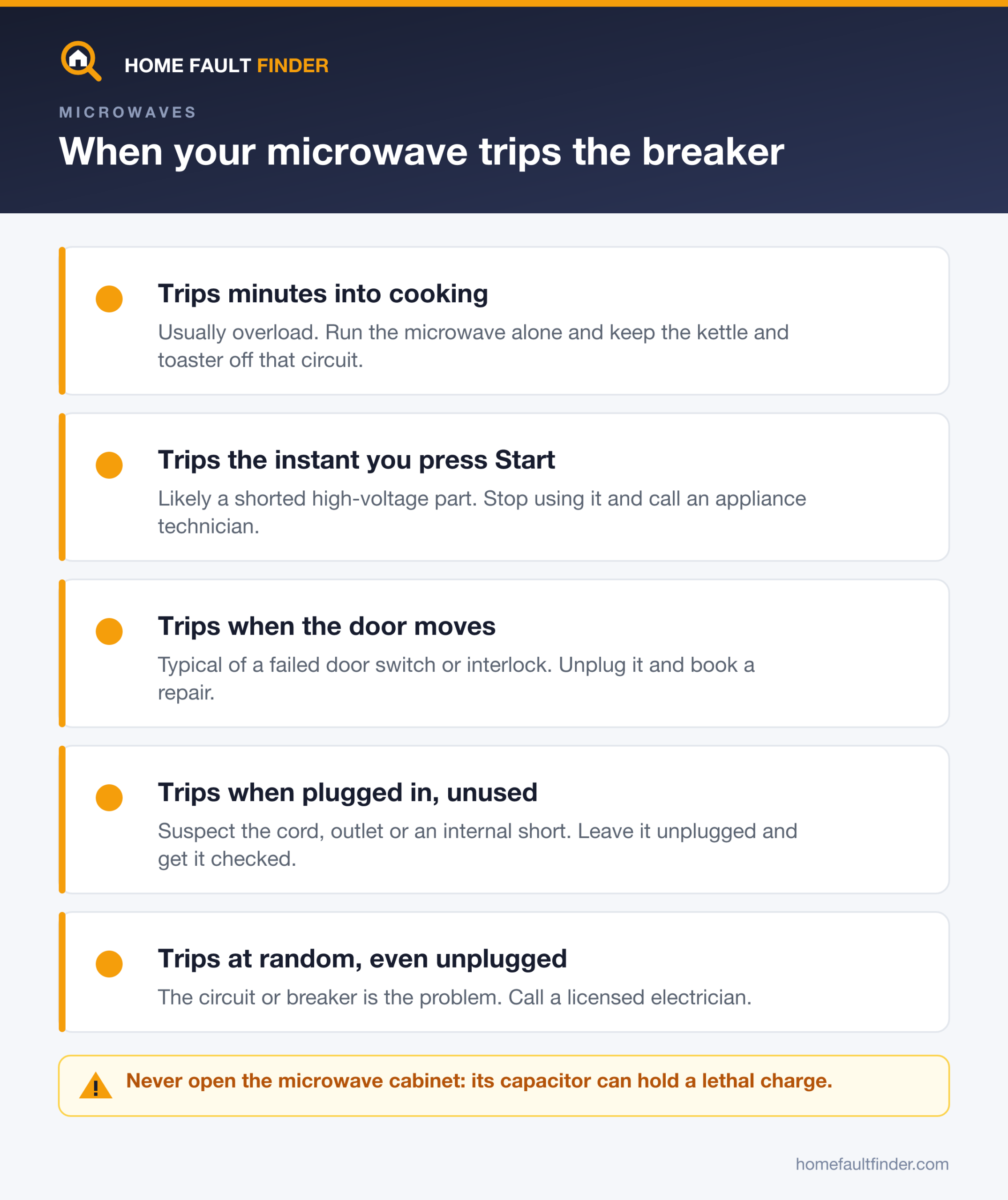
The timing of a microwave breaker trip is the single most useful clue you have. A thermal overload takes seconds to minutes to heat the breaker, while a short circuit trips it almost instantly. Note exactly when the power goes out before you reset anything, because the pattern points to a different cause each time.
| When it trips | Most likely cause | What to do first |
|---|---|---|
| 30 seconds to a few minutes into cooking | Overload from other appliances | Run the microwave alone |
| The instant you press Start | Shorted high-voltage part or weak breaker | Stop using it; call a technician |
| When the door opens or closes | Failed door switch or interlock | Unplug it and book a repair |
| When plugged in, before use | Damaged cord, outlet or internal short | Leave it unplugged; get it checked |
| Randomly, even when not in use | Circuit fault or failing breaker | Unplug it; call an electrician |
How many amps does a microwave draw?
A microwave draws far more power from the wall than the cooking wattage on the box suggests. Manufacturer specifications for 1,100-watt countertop models from GE and Panasonic, for example, list about 1,500 watts of input power, because turning electricity into microwave energy loses a share as heat.
To work out the current, divide input watts by 120 volts: 1,500 ÷ 120 = 12.5 amps. A 15-amp circuit carries about 1,800 watts in total, a 20-amp circuit about 2,400. Add a 1,000-watt toaster and a 15-amp circuit is at 2,500 watts, well over its limit. Check the labels on your own appliances; our guide to reading an appliance rating plate shows where to look.
Does a microwave need its own circuit?
Microwave manufacturers generally say yes. GE says its countertop and over-the-range microwaves require a 120-volt, individual, properly grounded branch circuit protected by a 15- or 20-amp breaker or time-delay fuse, and that over-the-range models should always be on a dedicated circuit (GE Appliances electrical requirements).
Panasonic’s guidance is just as direct: the oven should run on a separate, dedicated circuit, and no other appliance should share it, or the branch circuit fuse may blow or the breaker may trip (Panasonic microwave electrical requirements). Some larger models need at least 20 amps, so check your own manual.
Many countertop microwaves share a kitchen circuit with the kettle and toaster. Running them one at a time usually stops the trips; a dedicated circuit is a job for a licensed electrician, and requirements depend on your local electrical code.
Why does my microwave trip the GFCI or AFCI?
A GFCI (ground-fault circuit interrupter) is a safety device that cuts power when it detects current leaking to ground, and an AFCI (arc-fault circuit interrupter) cuts power when it detects arcing in the wiring. Kitchen circuits often have one or both, so a microwave trip may come from these devices rather than from a plain overload.
A GFCI outlet has Test and Reset buttons, sometimes on a different outlet from the microwave’s; GFCI and AFCI breakers have a Test button in the panel. Repeated GFCI trips can mean real leakage from a damaged cord or worn insulation, or a worn device. See how to reset a GFCI outlet and GFCI vs AFCI breakers.
Never replace a GFCI or AFCI with a standard device to stop the trips; have an electrician test it.
Can I plug a microwave into an extension cord or power strip?
Plugging a microwave into an extension cord or power strip is a common hidden cause of tripping and overheating. GE says it strongly recommends against using an extension cord with a microwave, and that the microwave should be plugged into its own properly grounded, dedicated outlet to prevent flickering lights, blown fuses or tripped breakers (GE Appliances on extension cords).
Plug the microwave straight into a wall outlet. If the plug fits loosely or the outlet is discolored, stop using that outlet and have it replaced. See our extension cord safety guide.
Why does it trip when I open or close the door?
A microwave that trips the breaker when the door opens or closes almost always has a failed door switch or interlock. Microwaves use several switches behind the latch to make sure the magnetron cannot run with the door open, and on many models one of them is designed to deliberately short the circuit if the others fail.
That short is meant to blow the internal fuse, but the breaker may trip first. Unplug the microwave; door switches sit next to high-voltage parts, so testing them is a technician’s job. Never tape or bypass a latch. If the door also sticks, see microwave door will not open.
Which internal faults trip the breaker?
Internal microwave faults that trip a breaker are usually in the high-voltage section: the high-voltage diode, the high-voltage capacitor, the transformer or the magnetron. When one shorts, current jumps the moment cooking starts, and the breaker trips instantly, sometimes with a loud hum, a buzz or a burning smell.
The high-voltage capacitor inside a microwave can store a lethal charge even after the microwave has been unplugged for a long time. Do not remove the outer cover, and do not try to discharge, test or replace any internal part yourself. Diagnosis inside the cabinet is for a qualified appliance technician.
A blown internal fuse makes the microwave go dead, often without tripping anything, and usually has a cause such as a door switch or shorted part. If you see flashes inside the cavity, read microwave sparking inside.
How to stop a microwave tripping the breaker
Stopping a microwave from tripping the breaker starts with the safe checks below, done in order. None involves opening the microwave or the electrical panel cover. If the breaker trips again with the microwave running alone, stop and call for help.
-
Unplug the microwave and note the timing
Was the trip instant, delayed, door-related or random? What else was running?
-
Switch off the other appliances
Turn off the kettle, toaster and coffee maker on nearby outlets.
-
Reset the breaker once
Open the panel door, push the tripped lever fully to OFF, then ON. Do not remove the panel cover. If it trips again with nothing plugged in, call an electrician.
-
Plug the microwave directly into the wall
Remove any extension cord, power strip or adapter; use a grounded three-prong outlet.
-
Run it alone for one minute
Heat a cup of water. No trip means overload: never run it alongside other heating appliances.
-
Try one other circuit, then stop
If it trips on a different breaker too, the fault is inside. Unplug it and book a technician.
A larger breaker, holding the lever on, a heavier extension cord, or a new fuse without finding why the old one blew. Each adds fire or shock risk.
What does it cost to fix a microwave that trips the breaker?
The cost to fix a microwave that trips the breaker ranges from nothing, if the cure is moving the toaster, to the price of a new microwave if the magnetron has failed. For internal faults, the repair estimates below come from Fixr’s microwave repair guide; get a written quote from a local technician before approving work.
| Repair | Typical range |
|---|---|
| Service call fee (often credited toward the repair) | $50–$100 |
| Fuse replacement | $50–$100 |
| Door switch replacement | $50–$100 |
| High-voltage diode replacement | $50–$125 |
| Magnetron replacement | $100–$300 |
| Transformer replacement | $100–$300 |
On a cheap countertop model, a magnetron repair can approach the price of a new unit; our microwave repair cost guide covers the repair-or-replace decision.
Call a licensed electrician if the breaker trips with nothing plugged in, feels warm or will not stay on, if an outlet is scorched or loose, or if a GFCI or AFCI keeps tripping.
Call an appliance technician if the microwave trips breakers on two circuits, trips when the door moves, hums loudly or smells burnt. Never open the cabinet: its high-voltage capacitor can stay charged after unplugging.
Frequently asked questions
Is it dangerous if my microwave keeps tripping the breaker?
A microwave tripping the breaker is the breaker doing its job; repeated resetting is the real risk. If it trips with the microwave running alone, or instantly at startup, unplug it and stop using it until a technician has checked it.
Can a microwave and a refrigerator be on the same circuit?
A microwave and a refrigerator can share a circuit only if their combined current stays under the breaker rating, and many manufacturers want the microwave on its own circuit. A compressor starting while the microwave runs can trip a borderline circuit.
Why did my microwave start tripping the breaker all of a sudden?
A sudden change usually means a new load on the circuit, a worn outlet, or a part that has begun to fail. If nothing new was added to the circuit, an internal fault such as a door switch or high-voltage part is more likely.
Can a bad breaker cause a microwave to trip?
A worn breaker can trip below its rating, especially during a microwave’s startup surge. Signs include trips at light load, warmth or a lever that will not latch. Breaker testing and replacement need the panel cover off, so leave them to an electrician.
Will a surge protector stop my microwave from tripping the breaker?
A surge protector will not stop a microwave tripping the breaker. Surge protectors guard against voltage spikes, not overloads, and most power strips are not meant for a sustained 12-amp load. Plug the microwave directly into a grounded wall outlet.
Should I repair or replace a microwave that trips the breaker?
Repair or replace depends on the fault. A door switch or fuse repair, often $50 to $100, is usually worth doing. A failed magnetron on a cheap countertop model can cost close to a new unit, while over-the-range models more often justify repair.