
A heat pump frozen or covered in ice is only a fault when the ice is thicker than about 1/4 inch or does not clear after a defrost cycle, which normally lasts 5 to 15 minutes. Switch the thermostat to emergency heat, clear snow and debris, replace the air filter, and let the unit thaw for 2 to 4 hours.
- Light frost under 1/4 inch on the outdoor coil is normal and should melt during an automatic defrost cycle of 5 to 15 minutes.
- Natural thawing takes 2 to 4 hours above freezing; ice that lasts 6 to 8 hours or comes straight back needs a technician.
- Never chip the ice or pour hot water on the unit, because coil fins, tubing and fan blades are easy to damage.
- Typical repairs for a unit that keeps freezing run $75 to $1,500 as of November 2026, depending on the failed part.
A heat pump is an electric heating and cooling system that moves heat between the outdoor air and your home instead of burning fuel. In winter the outdoor coil runs colder than the air around it, so some frost is part of the design. The trouble starts when frost becomes a shell of ice the system cannot shed.
Is frost on a heat pump normal in winter?
Frost on a heat pump is normal in winter as long as the layer is thin and temporary. Carrier describes a light coating of generally less than 1/4 inch as expected during cold-weather operation, and says that thicker ice, a solid coating, or ice that survives a defrost cycle is not normal and needs attention.
Normal frost is a white dusting that still shows the fin pattern, and damp days near freezing produce the most of it. A problem freeze-up is clear or milky ice that hides the fins, hangs as icicles, locks the fan blades, or builds up from the base.
What does the heat pump defrost cycle do, and how long does it take?
The heat pump defrost cycle is an automatic routine that melts frost off the outdoor coil by briefly reversing the system into cooling mode. Lennox puts a typical cycle at 5 to 15 minutes and Carrier at about 5 to 10 minutes, and most systems check for frost every 30 to 90 minutes while heating.
During defrost, hot refrigerant flows through the outdoor coil and meltwater runs out of the cabinet base. A whooshing sound, steam off the unit and cooler air at the vents for a few minutes are all normal.
Lennox notes that the coil surface is much colder than the surrounding air, so a heat pump may defrost with outdoor temperatures in the 40s Fahrenheit. The warning sign is the opposite: hours of heating in frosty weather with no defrost cycle at all.
Why is my heat pump frozen or covered in ice?
A heat pump stays frozen or covered in ice when frost forms faster than the defrost cycle can remove it, or when the defrost cycle does not run at all. Carrier lists restricted airflow, low refrigerant and water runoff freezing on the coil as the usual causes, and Lennox adds failed defrost controls and drainage problems.
| Cause | What you see | Who fixes it |
|---|---|---|
| Snow, leaves or debris blocking the unit | Snow drifted against the sides, leaves packed into the fins | Homeowner |
| Dirty indoor air filter or closed vents | Weak airflow at the vents, long run times | Homeowner |
| Water dripping onto the unit | Ice heaviest on top or one side, under a gutter or downspout | Homeowner (fix the water source) |
| Poor drainage under the unit | Ice climbing from the base, unit low or tilted on its pad | Homeowner or HVAC technician |
| Defrost control board, timer or sensor failure | Even, thick frost and no defrost cycle for hours | HVAC technician |
| Outdoor fan motor failure | Fan not spinning once the ice has melted | HVAC technician |
| Low refrigerant from a leak | Weak heat, hissing, ice on the copper lines, quick refreeze | EPA-certified HVAC technician |
What should you do when a heat pump is covered in ice?
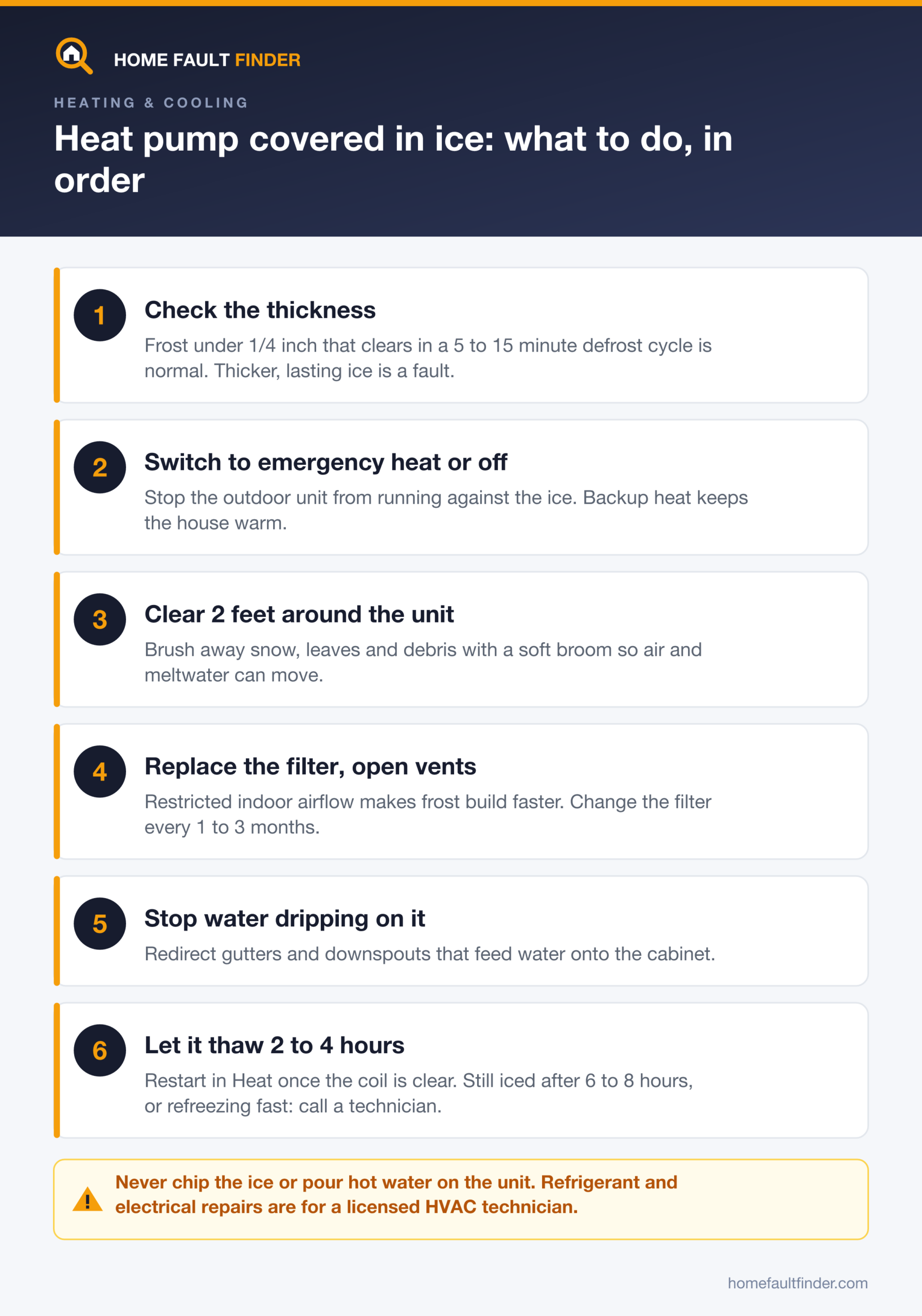
When a heat pump is covered in ice, the safe response is to stop it from running against the ice, keep the house warm with backup heat, remove whatever is blocking air or drainage, and let the ice melt on its own. Everything in the steps below is done from the thermostat or from outside the cabinet, with no panels removed.
-
Switch the thermostat to emergency heat or off
Set the thermostat to Em Heat (emergency heat) so the backup heater warms the house while the outdoor unit thaws. With no backup heat, switch it to Off. Time: 1 minute. Cost: $0.
-
Clear snow, leaves and debris around the cabinet
Use a soft broom and gloved hands to open at least 2 feet of clear space on all sides and free the base so meltwater can run out. Tools: broom, gloves. Time: 10 minutes.
-
Replace the air filter and open the vents
Replace the filter at the air handler or return grille if it looks gray or clogged. See our guide to the best MERV rating for a furnace filter before you buy, then open closed registers and uncover return grilles. Time: 10 minutes.
-
Stop any water that falls on the unit
Redirect a downspout or place a temporary board above the unit to deflect drips. Leave gutter work that needs climbing to a professional in icy conditions.
-
Let the ice melt, then restart in heat mode
Once the coil is completely clear, switch back to Heat and watch the unit for an hour or two. A healthy system keeps itself clear with short defrost cycles.
If the thermostat does not respond, start with our ” + L(“thermostat-not-working”, “thermostat not working guide”) + “. If the unit thaws and runs but the house stays cold, see ” + L(“heat-pump-not-heating”, “how to diagnose a heat pump that is not heating”) + “.
How long does a frozen heat pump take to thaw?
A frozen heat pump takes about 2 to 4 hours to thaw naturally when the outdoor temperature is above freezing, according to Lennox, and longer in colder weather. Lennox advises calling a technician if the ice has not melted within 6 to 8 hours or if the unit refreezes quickly after it clears.
Emergency heat uses resistance strips or a backup furnace instead of the outdoor unit, so the heat pump sits idle while the ice melts. Backup heat is less efficient, so expect a higher electricity bill for those hours. If a long freeze keeps the ice from melting, book a service visit.
What will not fix a frozen heat pump
Most damage to a frozen heat pump is done by the owner trying to hurry the thaw. The outdoor coil is made of thin aluminum fins around soft copper tubing that holds pressurized refrigerant, so shortcuts that seem harmless on a frozen windshield can turn a free fix into a coil replacement.
- Chipping or scraping the ice. Carrier says never to chip ice from the coil. A screwdriver or scraper can puncture tubing and bend fins.
- Pouring hot water on the unit. Lennox warns that the sudden temperature change can crack components.
- Using a heat gun or torch. Open heat beside wiring and refrigerant lines is a fire risk.
- Wrapping or covering the sides. A tarp or full cover blocks airflow, so frost builds faster.
- Letting it keep running. A fan hitting ice or a compressor working against a blocked coil can fail.
How much does it cost to fix a heat pump that keeps freezing?
Fixing a heat pump that keeps freezing costs between $75 and $1,500 for most causes, based on national ranges published by Fixr and checked as of November 2026. The low end is a service call or a cleaning; the high end is finding and repairing a refrigerant leak. Fixr puts the average heat pump repair at $400.
| Repair | Typical cost range |
|---|---|
| Service call and diagnosis | $75–$250 |
| Drain line cleaning | $75–$300 |
| Outdoor coil cleaning | $100–$300 |
| Circuit board replacement (includes defrost control boards) | $150–$700 |
| Refrigerant recharge | $100–$600 |
| Refrigerant leak repair | $200–$1,500 |
| Reversing valve replacement | $350–$700 |
Fixr reports hourly labor of $75 to $150 beyond the first hour, and winter is peak season, so same-day visits cost more. Check the warranty before you book; parts coverage can remove the largest item from the invoice.
Should you repair or replace a heat pump that keeps icing up?
Repairing a heat pump that keeps icing up makes sense when the unit is young and the fault is a control or airflow part, and replacement becomes worth pricing when an older unit needs a major refrigerant-side repair. Fixr gives a typical heat pump lifespan of 10 to 15 years and an average replacement cost of $8,350.
A common rule of thumb in the HVAC trade is to multiply the age of the unit in years by the repair quote. If the result is above $5,000, get a replacement quote too. Two worked examples show how it plays out:
- 5-year-old unit, $400 defrost board: 5 × $400 = $2,000. Well under $5,000, so repair it.
- 12-year-old unit, $1,200 leak repair and recharge: 12 × $1,200 = $14,400. Far above $5,000, so compare the repair against a new system.
For the full comparison, see ” + L(“ac-repair-vs-replace-cost”, “repair or replace your AC unit: a cost comparison”) + “, and for a different type of system, ” + L(“heat-pump-vs-furnace”, “heat pump vs furnace”) + “.
How do you stop a heat pump from freezing up again?
Stopping a heat pump from freezing up again comes down to three things: steady airflow indoors and outdoors, a dry path for meltwater, and defrost controls that are tested before winter. Lennox recommends professional maintenance in spring and fall, and the rest of the list takes a few minutes a month.
- Replace the air filter every 1 to 3 months during the heating season.
- Keep 2 feet of clear space around the outdoor unit, shrubs included.
- After each snowfall, brush snow off the top and away from the base.
- Ask the technician to test the defrost sensor and control board during the fall visit.
Add the outdoor unit to your cold-season routine with our ” + L(“winterizing-home-checklist”, “winterizing your home checklist”) + “.
When to call a pro
Call a licensed HVAC technician if the ice is thicker than 1/4 inch and returns within a day of thawing, if it has not melted after 6 to 8 hours, if the outdoor fan does not spin once the ice is gone, if you hear grinding, banging or hissing, if the refrigerant lines are iced, or if the unit never goes into defrost.
Do not remove the cabinet panels, test electrical parts, or add refrigerant yourself. The outdoor unit carries high voltage and capacitors that hold a charge, and under EPA Section 608 rules only certified technicians may service the refrigerant circuit.
Frequently asked questions
Should I turn off my heat pump if it is frozen?
Yes. Lennox advises switching a frozen heat pump off at the thermostat so it cannot run against the ice and damage the fan or compressor. If your thermostat has an emergency heat setting, use that instead so the backup heater keeps the house warm while the outdoor unit thaws.
Is steam coming from a heat pump in winter normal?
Steam rising from the outdoor unit for a few minutes is normal. It is water vapor from frost melting during the defrost cycle, and it often comes with a whooshing sound and a stopped fan. Smoke with a burning smell is different: switch the system off and call a technician.
Does a heat pump defrost when it is above freezing outside?
Yes. The outdoor coil runs much colder than the air around it, so frost can form and a defrost cycle can start even when the outdoor temperature is in the 40s Fahrenheit, especially on damp days. Defrosting in mild weather alone does not mean the heat pump has a fault.
Should I cover my heat pump during an ice storm?
Do not wrap or fully cover a heat pump that is running, because blocked sides stop airflow and cause more icing. A rigid guard above the top only can deflect falling ice and dripping water. After freezing rain, check the unit and thaw it safely before normal use if it is glazed over.
Why does a heat pump freeze up in summer?
In summer a heat pump ices in cooling mode, so the ice forms on the indoor coil and the large insulated copper line, not on the outdoor fins. Restricted airflow or a low refrigerant charge is the usual cause. Switch the system off, replace the filter, and follow our guide to an air conditioner freezing up.