

A dryer making a loud noise usually has a worn moving part or a loose object. A rhythmic thump points to flat drum support rollers, grinding to worn drum glides or a bearing, and banging to shoes or unlevel feet. Unplug the dryer before checking anything; most professional part jobs cost $100–$250.
- Thumping usually means drum rollers, grinding means glides or a bearing, rattling means a loose object, and roaring means airflow.
- Professional drum roller replacement runs about $100–$150 and drum bearing replacement $100–$250 (Fixr, as of October 2026).
- Unplug before opening any panel; on a gas dryer, also close the gas shutoff valve and leave the gas line alone.
- Grinding plus a hot smell means stop now: friction and trapped lint are both fire risks.
The type of sound narrows a noisy dryer down to one or two parts. This guide covers standard vented electric and gas dryers: which part is failing, whether the dryer is safe to use, and whether the fix is DIY or a job for a technician. For problems that are not noise-related, start with our complete dryer troubleshooting guide.
- What does a loud dryer noise usually mean?
- Which part is making the noise?
- Why is my dryer thumping?
- Why is my dryer banging or clunking?
- Why is my dryer grinding or scraping?
- Rattling, squealing, humming and roaring
- How do I find the noise safely?
- What will not fix a noisy dryer?
- How much does it cost to fix?
- Frequently asked questions
What does a loud dryer noise usually mean?
A loud dryer noise usually means a friction part has worn out or an object is loose where it should not be. Dryer drums ride on rollers, glides, a belt, an idler pulley and sometimes a rear bearing, and each of those is a wear part designed to be replaced after years of use.
Noise that grew louder over weeks points to wear; noise that started suddenly after one load points to a coin, clip or sock in the drum seam or blower. Normal sounds include a thermostat click and a gas burner’s soft whoosh. Our gas vs electric dryer comparison explains how the two designs differ.
Which part is making the noise in my dryer?
The part making noise in a dryer can usually be identified from three clues: the type of sound, whether it repeats with each turn of the drum, and whether it continues with an empty drum. The table below matches each common sound to its most likely cause and to whether the repair is realistic to do yourself.
| Sound | Most likely cause | Also check | DIY or pro? |
|---|---|---|---|
| Rhythmic thump | Flat drum support rollers | Idler pulley, heavy item | DIY if confident |
| Irregular bang or clunk | Shoes, unbalanced load, unlevel feet | Loose blower wheel | DIY |
| Grinding or scraping | Worn drum glides or rear bearing | Seized idler pulley, object at drum seal | DIY possible; pro if shaft is worn |
| Rattle or tick | Coins or clips in drum seam | Vent hood flap, loose screws | DIY |
| Squeal | Rollers, idler pulley, glazed belt | Drum felt seal | DIY if confident |
| Loud hum, drum not turning | Broken belt or seized roller | Motor that will not start | Stop; motor work is pro |
| Roaring | Debris in blower wheel or clogged vent | Crushed foil duct | DIY vent; pro for blower |
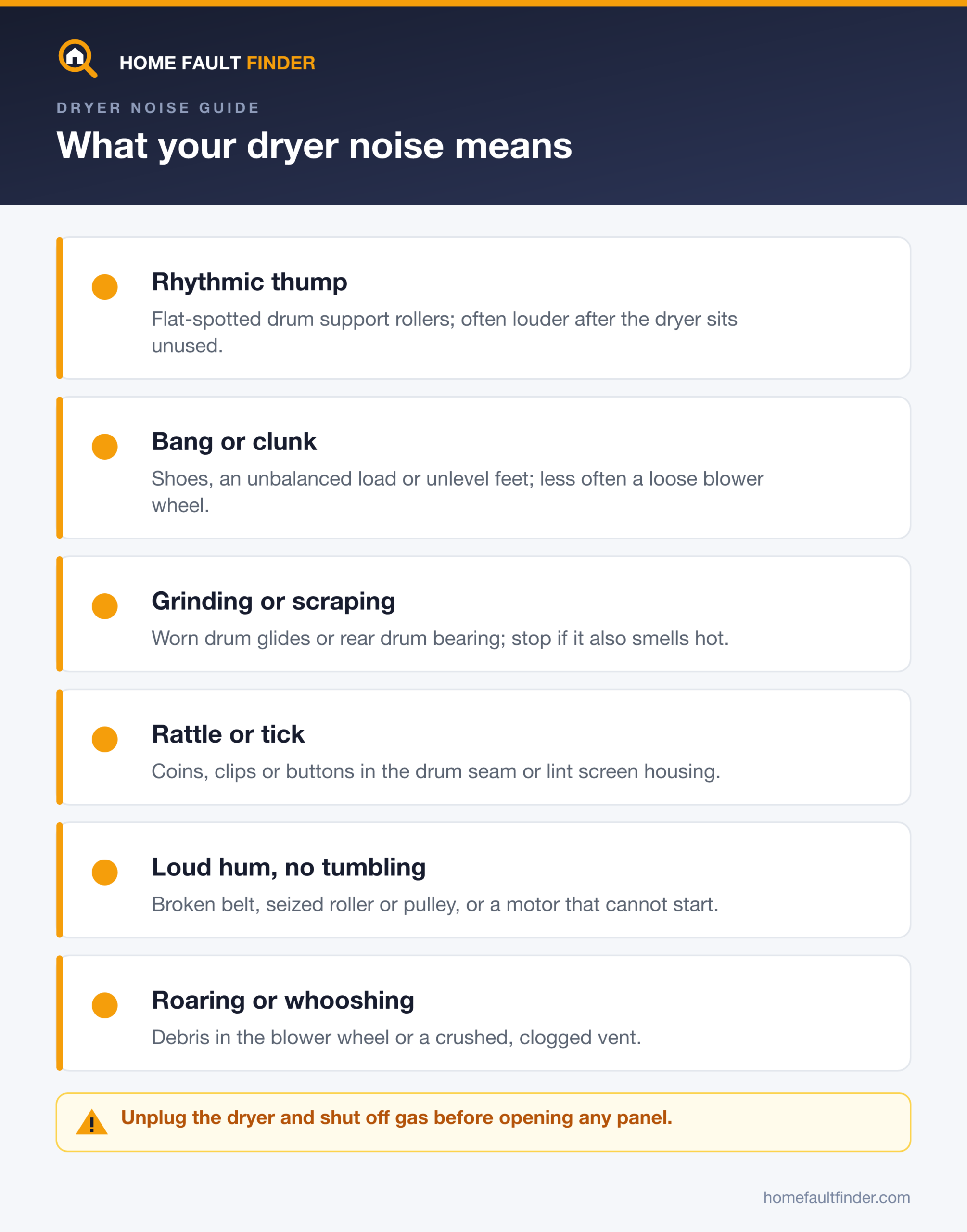
Why is my dryer thumping?
A thumping dryer most often has drum support rollers with flat spots. A drum support roller is a small rubber or plastic wheel on a metal shaft that carries the drum’s weight; once it flattens, it bumps on every rotation, often loudest after the dryer sits unused.
Other causes:
- Idler pulley wear. The idler pulley is the spring-loaded wheel that keeps the belt tight; a failing bearing makes it wobble and knock.
- A heavy single item. Sneakers thump against the drum.
- A damaged belt. A cracked or lumpy belt thumps as the bad spot passes the motor pulley; see our guide to broken dryer belt symptoms.
A thump that fades after a few minutes of running is classic flattened rollers.
Why is my dryer banging or clunking?
A dryer banging or clunking at irregular intervals is usually reacting to its load or footing rather than a failed part. Shoes, a heavy towel bundle, or a sheet that wraps the load into a ball will slam against the drum, and an unlevel cabinet rocks against the floor, wall or washer.
- The load. Remove shoes and untangle sheets before drying.
- The leveling feet. Put a level on top, front to back and side to side, and adjust the feet until the dryer does not rock when pushed at the corners.
- Clearance. Leave a small gap from the wall and washer.
- A loose blower wheel. The blower wheel is the fan that pulls air through the drum and out the vent. A loose one clunks at start and stop.
Why is my dryer making a grinding or scraping noise?
A grinding or scraping dryer usually has worn drum glides or a worn rear drum bearing, which lets the metal drum rub the cabinet. Drum glides are small plastic or nylon pads that support the drum’s front lip; once worn through, the drum scrapes metal on every turn and may leave dark marks on clothes.
Many dryers support the drum’s back with a shaft and bearing; a worn bearing lets the drum sag and grind. A seized idler pulley also grinds as the belt drags across it.
Grinding is the sound to take most seriously. Metal-on-metal contact makes heat, so a dryer that grinds and smells hot should be unplugged until repaired; see what to do when a dryer smells like burning.
What causes rattling, squealing, humming or roaring?
Rattling, squealing, humming and roaring dryer noises each point to a different area of the machine. Rattling is usually a small loose object, squealing is a worn friction part, humming without tumbling means the motor cannot turn the drum, and roaring usually means something is restricting airflow through the blower and vent.
Rattling or ticking
Coins, bobby pins and underwire slip through the drum seam and rattle around the cabinet or blower housing. A rattle from outside is often the vent hood flap.
Squealing
A squeal that follows drum speed comes from rollers, the idler pulley or a glazed belt; see our guide to a squealing or squeaking dryer.
Humming with no tumbling
A loud hum with a still drum means a broken belt, a seized roller or pulley, or a motor that cannot start. Turn the dryer off at once, because a stalled motor overheats.
Roaring or whooshing
A roar often comes from a sock or lint clump caught in the blower wheel or from a crushed, clogged vent. Our guide on how to clean a dryer vent covers the full cleanout.
How do I find the source of a dryer noise safely?
Finding the source of a dryer noise safely means listening while the dryer runs empty, then doing every hands-on check only after the dryer is unplugged and, on a gas model, the gas valve is closed. Most causes can be narrowed down in 15 to 20 minutes without opening the cabinet.
Unplug the dryer. On a gas dryer, also turn the manual gas shutoff valve to off if you can reach it without moving the machine, and do not disconnect or move the gas line. If you smell gas, do not touch any switch or plug: leave the house and call your gas utility or 911 from outside.
-
Run it empty and listen
Air-fluff, empty drum, two minutes. One thump per turn points to rollers; a constant noise to the idler pulley, motor or blower.
-
Unplug and shut off gas
Disconnect power and, on gas models, close the shutoff valve as described above.
-
Turn the drum by hand
Bumpy or scraping resistance points to rollers, glides or a bearing. A drum that spins with almost no resistance usually has a broken belt.
-
Check the drum seam and lint slot
Use a flashlight and a flexible pickup tool to remove coins, clips or fabric. Cost: free.
-
Level the cabinet and inspect the vent
Adjust the feet until the dryer does not rock, straighten crushed duct, and confirm the outdoor flap opens while running.
-
Open the cabinet only if comfortable
Rollers, glides and the idler pulley sit behind the panels and drum. Follow your model’s service manual.
What will not fix a noisy dryer?
Several popular quick fixes for a noisy dryer only hide the sound briefly or create a new problem. A worn roller, glide, pulley or bearing is a mechanical failure, and the reliable repair is replacing the worn part, usually together with its neighbors in the same drum assembly.
- Spraying lubricant. Oil on a belt makes it slip, and on rollers it collects lint into a sticky mass.
- Replacing only the belt. Worn rollers keep thumping, and a seized pulley can ruin the new belt.
- Bypassing a safety part. Never jumper a thermal fuse or belt switch to keep a noisy dryer running.
- Ignoring the vent. The NFPA dryer safety tip sheet names failure to clean as the leading cause of home dryer and washer fires.
How much does it cost to fix a loud dryer?
Fixing a loud dryer usually costs about $100–$250 when a technician replaces rollers, a bearing or the belt, and $250–$450 if the drive motor has failed, according to Fixr’s dryer repair cost guide as of October 2026. Buying parts yourself costs less, but the drum still has to come out.
| Repair | Typical professional cost | Notes |
|---|---|---|
| Diagnostic visit | $50–$80 | Often credited toward the repair |
| Labor rate | $50–$100 per hour | |
| Drum roller replacement | $100–$150 | Idler pulley and belt often done at the same time |
| Drum bearing replacement | $100–$250 | Drum must come out |
| Drive belt replacement | $150–$250 | Routed around idler and motor pulley |
| Motor replacement | $250–$450 | Compare with a new dryer |
| New dryer (comparison) | $600–$1,500 | Before installation |
A roller or glide job on an otherwise healthy dryer is usually worth doing; a motor on an old dryer may not be. Our full dryer repair cost guide covers other repairs.
Call a technician if the noise comes from the motor, if the drum grinds and smells hot, if the dryer hums but will not turn, or if you are not comfortable removing the drum. On a gas dryer, leave anything near the burner, gas valve or gas line to a qualified professional.
Frequently asked questions
Is it safe to keep using a dryer that is making a loud noise?
A dryer that only thumps from worn rollers is not an emergency, but the wear worsens and can damage the belt. Stop using it at once if you hear grinding metal, if it hums without turning, or if you notice a hot or burning smell, because those signs mean friction or a stalled motor.
Why is my new dryer so loud?
A new dryer is usually loud because it is not level, packing material was left inside, or it touches a wall or washer. Remove shipping materials, level all four feet, and leave a gap around the cabinet. If the noise continues, contact the manufacturer while the warranty applies.
Why does my dryer make a loud noise only when it starts?
A noise only at startup often comes from flat-spotted drum rollers that smooth out as they warm up, an idler pulley with a dry bearing, or a loose blower wheel that clunks as the motor speeds up. If the noise fades after a few minutes, rollers are the most likely cause.
Can a clogged dryer vent cause a loud noise?
A clogged dryer vent can cause a louder roar as the blower fights restricted airflow, and a crushed duct or stuck outdoor flap can rattle. The U.S. Fire Administration advises checking that the vent is not crushed or restricted and that the outdoor vent covering opens while the dryer runs.
How long do dryer drum rollers last?
Dryer drum rollers commonly last many years in normal household use, and in practice they often start thumping or squealing once a dryer reaches middle age. Large, frequent loads wear them faster. Rollers are usually replaced as a set together with the idler pulley and belt.
Does a dryer noise mean the motor is going bad?
A dryer noise points to the motor only when a loud hum or grinding from the lower rear continues with the belt removed, or when the motor hums but will not spin. Most loud noises come from rollers, glides or the idler pulley instead, which are cheaper repairs.