

A washer not agitating usually has a simple cause: a faulty lid switch, an overloaded or low-water cycle, or a washer still sensing the load for 20–30 seconds. If the motor hums or the agitator turns freely by hand, the fault is mechanical — worn agitator dogs, a broken motor coupler, a slipped belt, or the transmission.
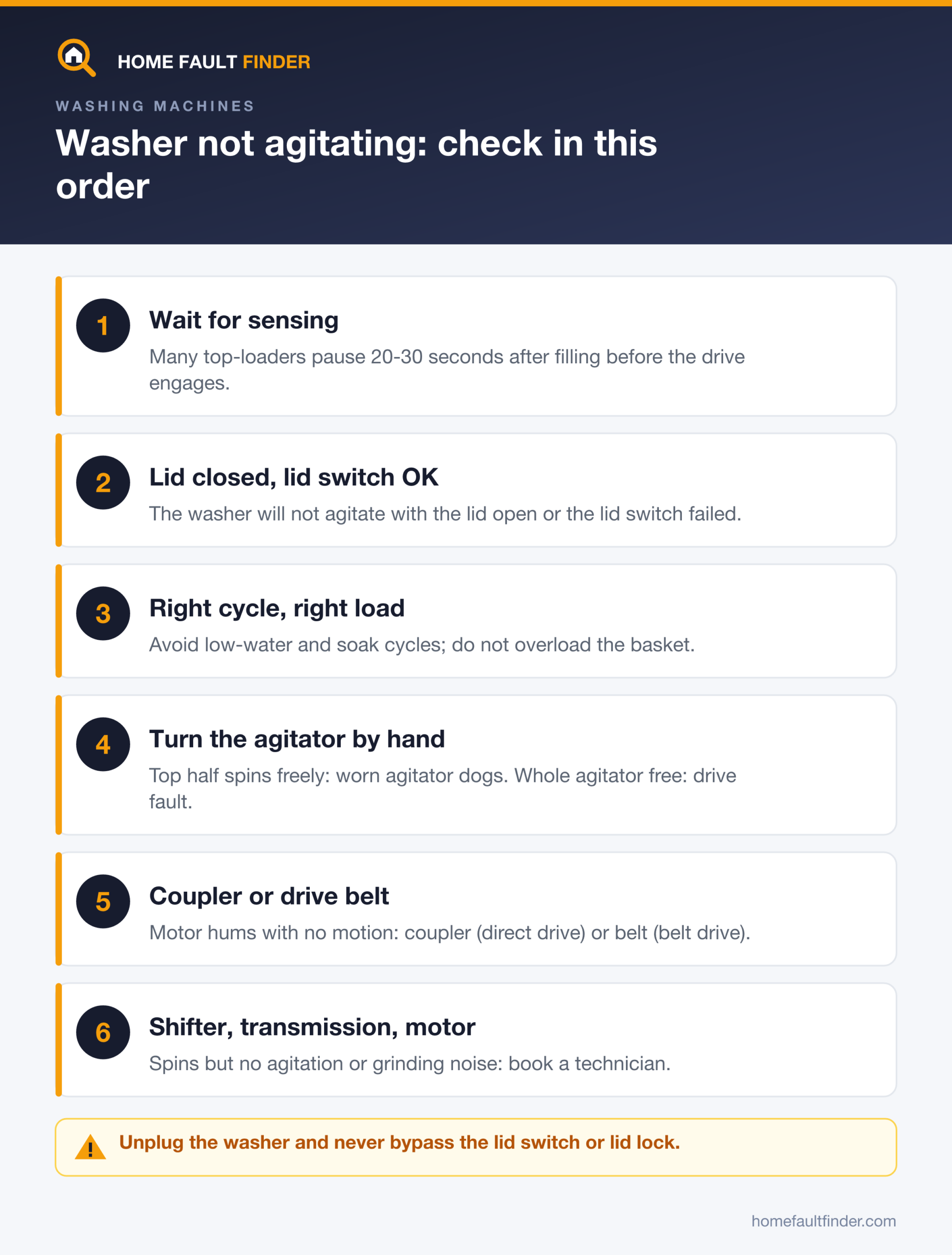
- Many top-loaders wait 20–30 seconds after filling before the drive moves.
- With the lid open or the lid switch failed, a washer may fill and drain but will not agitate.
- Agitator dogs and the direct-drive motor coupler are the cheapest mechanical failures; per Fixr, a coupling repair runs about $85–$160 with labor.
- A transmission or motor repair ($200–$500 per Fixr) on a washer past roughly half its 10–13 year life usually favors replacement.
- Never tape, jumper, or otherwise bypass the lid switch or lid lock to make the washer run.
This guide covers top-load washers, both agitator and high-efficiency (HE) impeller models, that fill but then sit still, hum, click, or barely move the clothes. If yours agitates but will not spin, see our guide to a washing machine that won’t spin. For other symptoms, start at our washing machine troubleshooting guide.
What does “washer not agitating” mean?
A washer not agitating means the wash basket fills with water but the agitator or impeller does not twist back and forth to move the clothes. An agitator is the tall center post in a traditional top-loader; an impeller is the low disc or cone in an HE top-loader that rubs clothes against each other instead.
A classic agitator moves visibly within seconds of the fill; an impeller moves the load slowly and pauses often, so it can look idle while working normally. Front-loaders have no agitator, so their equivalent fault is a drum that does not turn.
Is the washer broken or just sensing the load?
A top-load washer that seems not to agitate is often just pausing to sense the load or finish filling. GE Appliances notes that on newer top-loaders the drive can take about 20 to 30 seconds after filling stops to engage, and HE impeller models add sensing pauses, slow rotations, and quiet stretches by design.
Rule out these normal behaviors first:
- Sensing time: wait at least a full minute after the water stops before deciding nothing is happening.
- Low-water cycle: Whirlpool’s product help notes that clothes may not agitate properly on a low-water cycle; a bulky or deep-fill cycle gives a higher water level.
- Added water: extra water can make clothes float rather than move.
- Soak or pause: a soak cycle or a pressed Pause button stops motion without any fault.
- Overload: a basket packed tight can stall the agitator or trigger an off-balance correction.
GE’s quick test: note where one garment sits, run the washer for a minute or two with the lid closed, then look again. If it moved, the washer is agitating.
What causes a washer not to agitate?
The most common causes of a washer not agitating are an open or failed lid switch, an overloaded or wrong cycle, worn agitator dogs, a broken direct-drive motor coupler, and a worn or slipped drive belt. Less often the shift actuator, the transmission, the motor, or the control board is at fault. The table runs from most common and cheapest to least common and costliest.
| Cause | Typical sign | DIY-friendly? |
|---|---|---|
| Lid not closed / lid switch or lid lock fault | Fills, then nothing happens; may still drain | Check yes; replace switch with care |
| Overload, wrong cycle, low water | Clothes barely move, basket packed | Yes |
| Worn agitator dogs (cam dogs) | Bottom of agitator moves, top half spins freely | Yes, inexpensive kit |
| Broken motor coupler | Motor hums, no agitation and no spin; may still drain | Moderate |
| Worn or slipped drive belt | Motor runs, burning-rubber smell, weak motion | Moderate |
| Shift actuator / mode shifter | Spins but will not agitate, or the reverse; clicking | Moderate to hard |
| Transmission (gearcase) | Grinding, leaking oil, agitator stuck or loose | Usually a pro job |
| Motor or control board | Silent after fill, no hum, error code | Pro job |
What do the sounds tell you? A symptom decision tree
The sound a washer makes when it should be agitating is the fastest way to narrow down the fault. A hum points at a stalled drive, a click or free-spinning agitator points at a worn coupling part, and complete silence after the fill points at the lid circuit, the cycle setting, or the electronics.
- Fills, then silence: check the lid, the lid switch or lid lock, then the cycle.
- Loud hum but nothing moves: the motor cannot turn the drive. Suspect the motor coupler (direct drive) or belt and pulley (belt drive). Stop the cycle — a stalled motor overheats.
- Clicking, and the agitator top turns freely by hand: worn agitator dogs.
- The whole agitator turns freely by hand and the motor runs: broken coupler, slipped belt.
- Spins fine but will not agitate: on HE models, the shift actuator or mode shifter; on older agitator models, the transmission.
- Grinding noise with weak or no agitation: transmission or drive bearings.
If a code shows, see our guides to Whirlpool washer error codes and GE washer error codes.
How do you fix a washer that won’t agitate?
Fixing a washer that won’t agitate starts with power and settings, moves to the lid circuit, and only then reaches the drive parts under the agitator or behind the cabinet. Stop as soon as agitation returns.
Unplug the washer and turn off both water supply valves before removing the agitator, the cabinet, or any panel. Do not tape down, jumper, or otherwise bypass the lid switch or lid lock — it stops the basket while hands can reach inside.
-
Confirm power and reset
Check the plug, the outlet, and the breaker. Then unplug the washer for about one minute. On GE top-loaders, GE’s support page describes a motor reset: plug back in and, within 30 seconds, lift and lower the lid six times within 12 seconds, raising it at least 2 inches each time. Other brands differ. Time: 2 minutes.
-
Check the cycle and the load
Choose a normal or bulky cycle, remove a few items, and make sure the selector is not stuck between positions. Time: 5 minutes. Cost: $0.
-
Inspect the lid and lid switch
Look for a broken lid strike, a missing lid magnet, or a lid lock that does not engage. Replace a failed switch; never bypass it. Time: 10 minutes.
-
Test the agitator by hand
Unplugged and empty, turn the agitator. Top half free: worn dogs. Whole agitator free: a drive fault. Time: 2 minutes.
-
Replace the agitator dogs
Remove the cap and top section, then fit a dog kit matched to your model number. Tools: socket set. Time: 20–30 minutes.
-
Check the coupler or belt
Direct drive: a broken coupler leaves the motor humming. Belt drive: look for a cracked or loose belt. Both need panels off. Time: 45–90 minutes.
-
Book a technician for deeper faults
Shift actuator, transmission, motor, and control board faults need model-specific testing. Get a diagnosis before ordering parts.
Why does only the top of the agitator move — or not at all?
Agitator dogs are small plastic cams inside a two-piece (dual-action) agitator that lock the top section to the bottom in one direction and let it ratchet in the other. When the dogs wear smooth, the bottom of the agitator still moves but the top half slips, so clothes roll poorly and you often hear a clicking or grinding sound.
Dogs only affect the top section: if the bottom also stands still, look at the coupler, belt, or transmission.
Why does a washer spin but not agitate?
A washer that spins but does not agitate has a working motor and drain, so the fault is in the part that switches the drive between wash and spin. On many HE top-loaders that part is the shift actuator or mode shifter; on older agitator models it is the transmission or a broken agitator spline.
A failing shift actuator may click repeatedly, show a shifting error, or leave the washer stuck in one mode; testing needs your model’s service sheet. Transmission faults often bring grinding or oil under the washer.
For the opposite symptom, see our won’t-spin guide covers that path.
What if a front-load washer drum will not turn?
A front-load washer has no agitator, so “not agitating” on a front-loader really means the drum does not rotate during the wash. The usual causes are a door lock that does not engage, an overloaded or unbalanced drum, a worn drive belt on belt-driven models, or a fault in the direct-drive motor or its control board.
A blinking lock light or door code is the first clue; never force or override the door lock. Our comparison of front-load vs top-load washers explains how the two drive systems differ.
How much does it cost to fix a washer that won’t agitate?
The cost to fix a washer that won’t agitate ranges from nothing for a cycle or load correction to roughly $300–$575 for a motor or agitator replacement with labor. Fixr’s national cost guide puts a typical washing machine repair at $150–$400, with a diagnostic visit of $50–$100 that is usually waived if you proceed.
| Repair | Typical cost (parts + labor) |
|---|---|
| Diagnostic visit | $50–$100 (often waived with repair) |
| Lid switch | $85–$160 |
| Motor coupling | $85–$160 |
| Drive belt | $120–$175 |
| Transmission | $200–$350 |
| Control board | $250–$400 |
| Motor | $300–$500 |
| Agitator replacement | $350–$575 |
Doing the dogs, lid switch, or coupler yourself removes the labor share. For a breakdown by fault, see our washing machine repair cost guide.
Is it worth repairing a washer that won’t agitate?
Repairing a washer that won’t agitate is usually worth it when the fault is a lid switch, agitator dogs, a coupler, or a belt, because those parts are inexpensive. A transmission, motor, or control board on a washer past roughly half of its typical 10–13 year lifespan is where replacement often makes more financial sense.
If the quote tops half the price of a comparable new washer, compare options first. Our guide on when to replace a washing machine walks through the cost-per-remaining-year calculation.
Call an appliance technician if the motor still hums without motion after a reset, you smell burning, see oil, hear grinding, or a drive error code returns.
Motor, control board, shift actuator, and transmission diagnosis involve live-voltage testing and model-specific service procedures. Do not open the control console or test circuits on a plugged-in washer, and never bypass the lid switch or lid lock to keep it running.
Frequently asked questions
Why does my washer fill with water but not agitate?
A washer that fills but will not agitate is most often waiting to sense the load, has the lid open or a failed lid switch, or is on a soak or low-water cycle. Wait a full minute after filling stops, close the lid firmly, and pick a normal cycle. If it still sits still, check the agitator by hand for worn dogs.
Is it normal for an HE washer to barely move the clothes?
Yes, high-efficiency impeller washers use little water and move the load slowly, with frequent pauses for sensing. Clothes rub against each other rather than being pushed by a tall post. A real fault is likelier if nothing moves for several minutes, the washer hums, or clothes come out dry or still dirty.
Can I fix agitator dogs myself?
Yes, agitator dogs are among the easiest washer repairs. With the washer unplugged, remove the agitator cap and top section, replace the small plastic dogs with a kit matched to your model number, and reassemble. The job usually takes 20 to 30 minutes with a screwdriver or socket set.
What does a broken motor coupler sound like?
A broken motor coupler usually produces a steady hum with no agitation and no spin, because the motor runs but no longer drives the transmission. Some washers still drain normally. You may also find small pieces of rubber or plastic under the washer, where the coupler sits between the motor and transmission.
Will overloading stop a washer from agitating?
Yes, an overloaded basket can stall the agitator or impeller and trigger repeated off-balance corrections. Clothes should be able to move freely around the basket. Remove some items, distribute the rest evenly, and choose a higher water level or bulky cycle for large items such as comforters.